Opinion
Africa’s Debt Trap: Why Borrowing Is Blocking Development


By Kingsley Moghalu
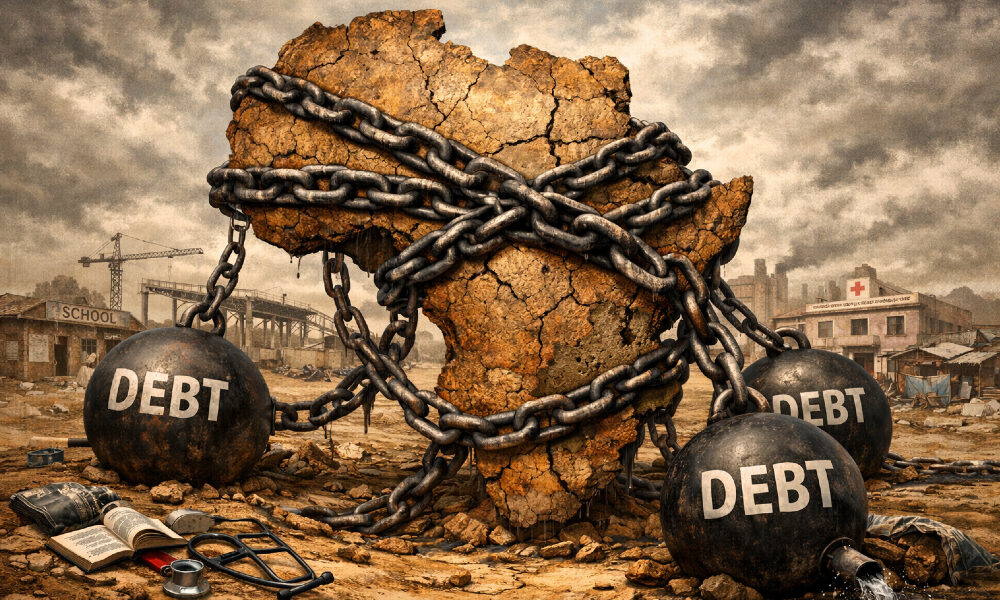
A striking statistic from The Africa Report crystallizes the continent’s fiscal crisis: many of Africa’s poorest countries now spend more on debt service than on healthcare, education, and infrastructure combined. This inversion of priorities reveals a uncomfortable truth – debt has become a straitjacket rather than a springboard for African development.
The path forward requires not just borrowing less, but understanding why African governments borrow so unwisely in the first place.
The roots of Africa’s debt overhang lie in fundamental misunderstandings about economic management that plague the continent’s leadership. Too many African leaders operate under a deceptively simple assumption: if we can service our debts, what harm is there in borrowing?
This thinking ignores the structural realities that make African debt uniquely burdensome. The “Africa risk premium” means the continent borrows internationally at punishing rates of 10 to 13 percent, compared to the 2 to 5 percent that developed economies pay.
When your revenues depend on volatile commodity prices and your borrowing costs are triple those of wealthier nations, the margin for error vanishes quickly.
Like households that overextend themselves on credit cards, African governments have discovered that the old adage holds true: those who go borrowing go sorrowing. The mathematics are unforgiving, yet the pattern repeats with depressing regularity across the continent.
The Debt-to-GDP Delusion
Perhaps the most dangerous misconception driving African indebtedness is the misuse of debt-to-GDP ratios. Conventional economic wisdom suggests this ratio should not exceed 60 to 65 percent.
Yet finance ministers across Africa routinely point to the United States (with a debt-to-GDP ratio of 120 percent) or Japan (the world’s highest at 240 percent) as justification for their own aggressive borrowing.
This comparison reveals a profound failure to grasp economic fundamentals. The United States and Japan are productive powerhouses that generate wealth through innovation, industrial capacity, and efficient internal capital formation.
Their economies create the revenue streams necessary to service even massive debt loads. No African country operates in this league.
The structural foundation of developed economies – their technological sophistication, diversified industrial bases, and robust tax collection systems – differs fundamentally from the commodity-dependent, often informal economies that characterize much of Africa.
Citing Japanese debt levels to justify borrowing in countries with weak institutions, narrow export bases, and limited industrial capacity is not just misleading; it is economically illiterate. Yet this conceptual laziness persists, enabling fiscal policies that mortgage national futures for short-term political gains.
The Infrastructure Fallacy
Another dangerous misunderstanding centers on infrastructure borrowing. African leaders frequently justify debt by pointing to infrastructure needs, and certainly the continent’s infrastructure deficit is real and constraining.
But two critical concepts are consistently overlooked.
First, infrastructure projects financed through debt should, wherever possible, generate revenues that help retire that debt. Toll roads, ports, power plants, and telecommunications networks can produce returns that justify borrowed capital.
Too often, however, African governments borrow for prestige projects or infrastructure that generates minimal revenue, leaving taxpayers to shoulder the burden indefinitely.
Second, debt is not the only – or even the best – way to finance infrastructure. Public-private partnerships (PPPs) allow governments to share both risks and rewards with private capital.
These arrangements can bring not just financing but also technical expertise and operational efficiency that purely government-led projects often lack. Yet PPPs remain underutilized across much of Africa, as governments default to the politically simpler path of sovereign borrowing.
The Corruption Premium
No discussion of African debt patterns can ignore the elephant in the room: corruption. In too many African countries, accountability and transparency around borrowed funds are virtually nonexistent.
Significant portions of international loans simply vanish into the private accounts of government officials. This corruption tax makes already expensive borrowing even more costly, as nations must repay not just the infrastructure they built, but also the villas and foreign bank accounts of their leaders.
The lack of institutional safeguards means borrowed funds often fail to reach their intended purposes. When debt doesn’t build productive capacity or improve public services, it becomes purely extractive – transferring wealth from future taxpayers to today’s corrupt officials and foreign creditors.
Political Expedience Over Economic Prudence
Underlying these technical misunderstandings is a more fundamental problem: political expediency. Borrowing allows leaders to fund projects and programs without the political pain of raising taxes or making hard budgetary choices.
The bill comes due years later, often after those leaders have left office. This temporal mismatch between political incentives and economic reality creates a systemic bias toward overborrowing.
A Way Forward
Breaking this cycle requires more than technical fixes. It demands a shift in how African leaders conceptualize development finance.
Borrowing should be seen not as a routine fiscal tool but as an exceptional measure justified only when projects generate clear returns. Debt sustainability must be assessed not against the ratios of wealthy nations but against Africa’s own economic realities – its revenue volatility, its higher borrowing costs, and its institutional weaknesses.
African countries need stronger fiscal institutions that can resist political pressure for unsustainable borrowing. They need transparency mechanisms that allow citizens to track where borrowed funds go.
They need to embrace alternative financing models like PPPs that share risks and attract expertise. Most fundamentally, they need leaders who understand that development requires building productive capacity, not just accumulating debt.
The current trajectory is unsustainable. When debt service crowds out investment in human capital and productive infrastructure, countries are consuming their future to fund their present.
Africa deserves better than leaders who confuse borrowing with development and debt with progress. Until that understanding takes root, the continent will remain trapped in a cycle where those who should be investing in tomorrow are instead mortgaging it away.
Kingsley Moghalu is a Nigerian political economist, lawyer, and academic with broad expertise in international affairs, finance, and governance. A former Deputy Governor of the Central Bank of Nigeria and founding President of the African School of Governance, he is recognized globally for his leadership in economic policy, international development, and public sector reform. Moghalu has advised governments, corporations, and international organizations on strategy, finance, and global competitiveness. A respected thought leader, speaker, and author, he brings intellectual rigor and executive experience to debates shaping Africa’s economic transformation and global governance.