Opinion
Africa’s Dairy Revolution: The White Gold Opportunity in Trade and Value Addition
Africa’s dairy trade is quietly becoming a multi-billion-dollar opportunity. Here’s why South Africa, Egypt, and Kenya lead the pack – and where investors should look next.


By Ashish Muley
Africa is not usually where global investors go looking for dairy deals. Milk powder, cheese, and butter tend to conjure images of the Netherlands, New Zealand, or Wisconsin – not Nairobi, Kigali, or Lusaka. Yet a quiet transformation is underway. Across the continent, a handful of countries have built dairy industries robust enough to export beyond their own borders, and the implications for trade, food security, and foreign investment are only beginning to be understood.
The continent as a whole still buys more dairy than it sells. But that broad statistic obscures a more interesting story: a rising class of exporters that are turning milk into a genuine commercial asset, one shipment of UHT milk or wheel of cheese at a time.
The Leaders of the Pack
Ranked by estimated export value and regional trade significance, ten countries stand out as Africa’s dairy trade leaders, according to a compilation of United Nations Comtrade data (2023–2025), ITC Trade Map figures, national export statistics, and industry reports.
- South Africa – The undisputed heavyweight. South Africa’s dairy sector supplies both its immediate Southern African neighbors and buyers well beyond the continent, underpinned by a mature processing base and established export logistics.
- Egypt – A powerhouse in cheese and UHT milk, Egypt ships processed dairy products across the Middle East, North Africa, and increasingly into Sub-Saharan markets.
- Kenya – East Africa’s dairy engine, exporting primarily to Uganda, Tanzania, Rwanda, and South Sudan, and anchoring the region’s dairy value chain.
- Uganda – A fast climber, with growing milk powder and UHT milk exports feeding both regional demand and buyers in the Middle East.
- Morocco – A steady exporter of processed dairy to West Africa and select international markets.
- Tunisia – Focused on North African and Mediterranean trade routes.
- Zambia – An emerging player supplying the Democratic Republic of Congo, Malawi, and Zimbabwe.
- Zimbabwe – A regional supplier of processed dairy within Southern Africa.
- Namibia – Exports concentrated among its Southern African neighbors.
- Rwanda – One of the fastest-growing exporters on the list, serving the DR Congo, Burundi, and other East African markets.
What the Rankings Reveal
Two patterns jump out. First, South Africa and Egypt remain Africa’s principal gateways to global dairy markets – the only two countries on this list with export ambitions that extend meaningfully beyond the continent. Second, and arguably more important, is the strengthening of intra-African dairy trade. Kenya, Uganda, Zambia, and Rwanda are not chasing distant markets; they are building supply chains with their immediate neighbors, a shift made easier by the gradual reduction of tariff barriers under the African Continental Free Trade Area (AfCFTA).
That regional integration matters. It suggests Africa’s dairy story is no longer just about individual national champions, but about an emerging continental market – one where a liter of milk produced in Kampala might reasonably end up in a shop in Kigali or Kinshasa.
The Opportunity Hiding in Plain Sight
Here is the paradox worth dwelling on: despite producing millions of tonnes of milk each year, Africa remains a net importer of dairy, particularly milk powder and other value-added products. Meanwhile, urbanization, population growth, rising incomes, and shifting consumer tastes are all pushing demand for higher-quality dairy products upward. That gap between what Africa produces and what it actually processes into market-ready goods is precisely where the opportunity lies.
For investors, agribusinesses, and policymakers, the most promising entry points include:
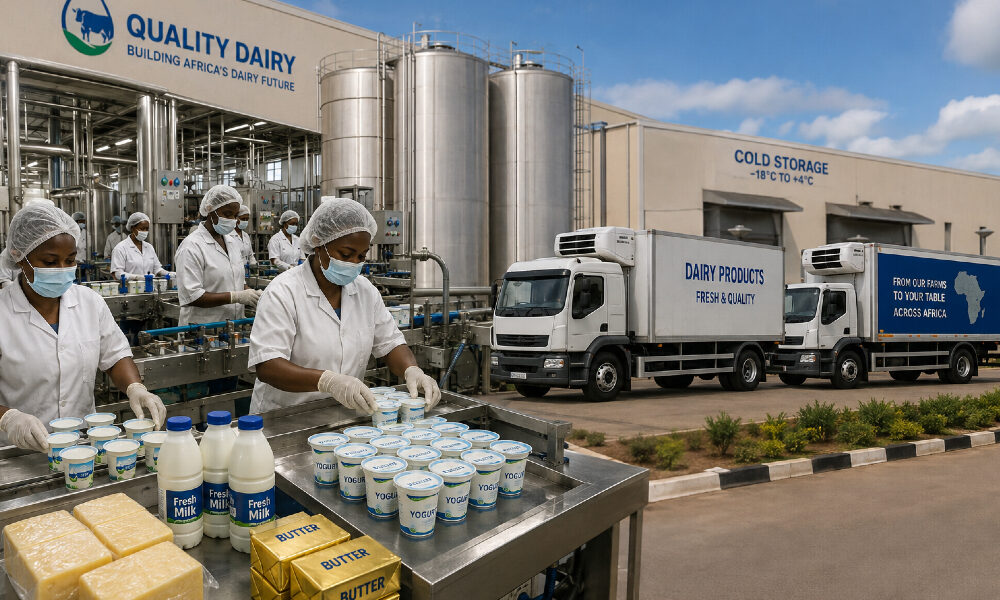
- Milk collection and cold-chain infrastructure, the unglamorous but essential backbone of any dairy economy
- Processing plants for UHT milk, cheese, butter, yogurt, and milk powder
- Improved cattle genetics and breeding programs to lift yields
- Animal feed production and livestock nutrition
- Cold storage, refrigerated transport, and logistics
- Modern packaging and processing technology
- Digital tools for farm management, traceability, and quality assurance
Why the Timing Matters
Several forces are converging to make this decade a plausible inflection point for African dairy. Consumption is rising steadily across the continent.
AfCFTA is expanding the addressable market for regional producers and lowering the friction of cross-border trade. Governments, eager to reduce import dependence, are actively promoting local value addition. And the appetite for public-private partnerships and foreign direct investment in agribusiness has rarely been stronger.
An Opening for India
One country in particular is well positioned to help Africa close its dairy gap: India. As the world’s largest milk producer, India brings decades of hard-won experience in dairy cooperatives, milk collection systems, processing technology, cold-chain management, animal health, and affordable equipment manufacturing – much of it built for exactly the kind of smallholder-driven, cost-sensitive environment that characterizes African dairy farming.
That expertise creates a natural opening for collaboration: Indian technology providers, equipment manufacturers, investors, and agribusiness firms partnering with African producers to build dairy value chains that are resilient, competitive, and built to last.
The Bottom Line
Africa’s dairy sector has quietly outgrown its old identity as a purely agricultural, subsistence-driven story. It is becoming something more strategic: a food-security priority, a value-addition opportunity, and – for investors paying attention – a genuine multi-billion-dollar market in the making.
Ashish Muley is an independent consultant with Stalwart Management Consulting, with 27+ years in agricultural commodity value chains, export markets, and international trade. He has led projects on business development and capacity building across African countries in partnership with international organizations. Formerly, he spent 15 years in financial services leadership, focusing on sales, marketing, and business development. Based in Pune, India, Ashish advises on agricultural trade, commodity markets, Warehouse Receipt System (WRS) and Asia–Africa economic opportunities, and regularly writes on international trade and logistics.