Business
Africa’s Currencies Are Rallying. Exporters Should Be Watching Reserves Instead.
Exporters celebrating a stronger naira and rand are looking at the wrong metric. The real danger lies in import cover.


By John Kourkoutas
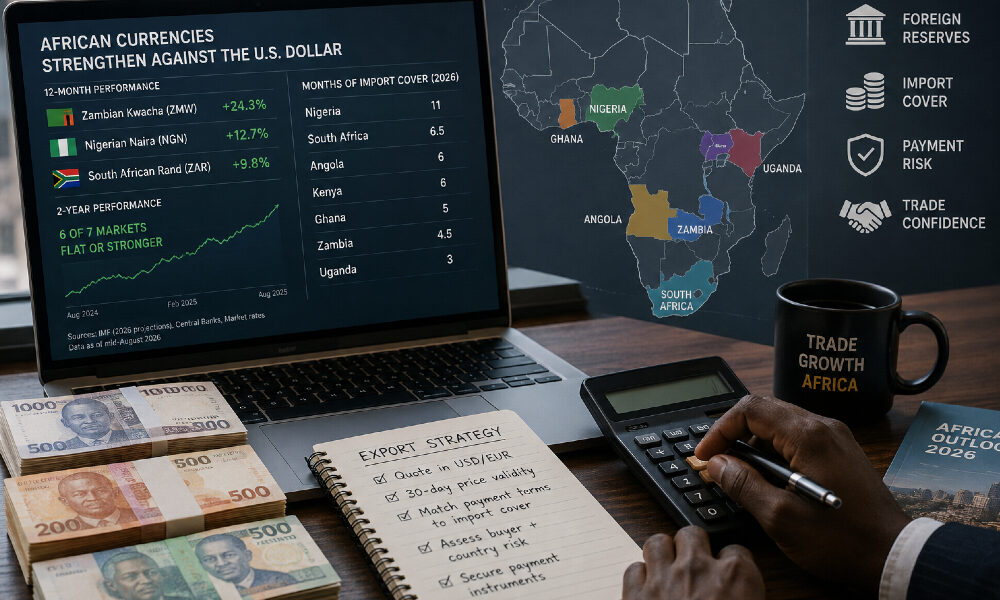
African currencies just posted their strongest run in years. The kwacha, the naira, and the rand have all outperformed the dollar over the past twelve months. Six of the seven currencies tracked here are flat or stronger over a two-year horizon – a rare and genuine break from a continent whose monetary history has mostly been one long depreciation.
Twelve-month performance against the U.S. dollar:
| Currency | Change vs. USD |
|---|---|
| Zambian kwacha | +24.3% |
| Nigerian naira | +12.7% |
| South African rand | +9.8% |
That is real news, and it deserves the headlines it’s getting. But for anyone who actually ships goods into these markets – rather than trading their currencies – the exchange rate is close to irrelevant. The number that matters is import cover.
Forget the Exchange Rate. Watch the Reserves.
Import cover measures how many months of a country’s imports its foreign-currency reserves can finance. It is, in effect, a measure of whether your buyer’s bank can get its hands on the dollars needed to settle your invoice.
This distinction is not academic. A buyer can hold the full purchase price in local currency, want to pay you on time, and still fail to do so – because the hard currency simply is not available to convert. A strong currency tells you nothing about that risk. Import cover does.
Months of import cover, 2026:
| Country | Months of Cover |
|---|---|
| Nigeria | 11.0 |
| South Africa | 6.5 |
| Angola | 6.0 |
| Kenya | 6.0 |
| Ghana | 5.0 |
| Zambia | 4.5 |
| Uganda | 3.0 |
Same continent. Same encouraging currency story. Wildly different payment risk from one market to the next.
Reading the Board, Country by Country
Nigeria now leads the continent on cover, at 11 months, backed by reserves near US$52 billion, real interest rates above 10 percent, and three separate rating upgrades this year. It is, on the numbers, the most improved payment environment in Africa. Exporters who wrote Nigeria off during the 2023-24 forex crisis are working from a picture that no longer exists.
Zambia has the strongest currency on the list but only middling cover. That is because the kwacha’s fortunes are, in practice, a copper trade: the metal accounts for roughly 70 percent of the country’s export earnings. Bet on the kwacha, and you are betting on copper.
Uganda, at three months of cover, is the market to treat with caution. A fiscal deficit near 7 percent of GDP and debt service consuming a third of government revenue make this a real, growing economy—but not one to finance on open account.
Ghana has cut interest rates aggressively as inflation falls to 4.6 percent. Encouraging, but with only five months of cover, the central bank has limited room to defend the cedi if pressure returns.
Kenya has held its currency near 129 to the dollar for two years running. That kind of stability, even without dramatic appreciation, is often more valuable to an exporter than a currency that is merely strong.
What This Means for Payment Terms
The practical takeaways are straightforward:
- Quote in dollars or euros, not local currency.
- Shorten price validity to 30 days rather than 90.
- Match your payment instrument to the country’s import cover – not to your relationship with the buyer, however good it is.
The Limits of Macro Data
None of this tells you whether a specific bank branch, in a specific town, releases a specific transfer this month. Solvent, willing buyers have queued for hard currency while the national statistics said everything was fine. Country-level data tells you which markets deserve looser terms. It never tells you which buyer does.
That distinction – between market risk and counterparty risk – is where most trade-credit losses in Africa actually originate. Get the macro call right, and you have only cleared the first hurdle.
John Kourkoutas is business development expert that specializes in helping companies, export teams, and business leaders succeed in Africa’s dynamic and emerging markets.