Opinion
Africa’s Cocoa Ambition: From Commodity Supplier to Value Creator


By Mark-Anthony Johnson
From raw bean to finished bar, Africa’s top producers are demanding a seat at the table – and the economics are finally catching up.
For decades, Africa has grown the world’s cocoa but seen little of its wealth. The continent supplies more than two-thirds of the world’s raw cocoa beans, yet captures less than 10 percent of the global chocolate industry’s revenue – a industry worth an estimated US$130 billion annually.
That long-standing inequity is now squarely in the crosshairs of a new generation of policymakers, processors, and producers determined to rewrite the terms of trade.
A Structural Shift, Not a Seasonal Trend
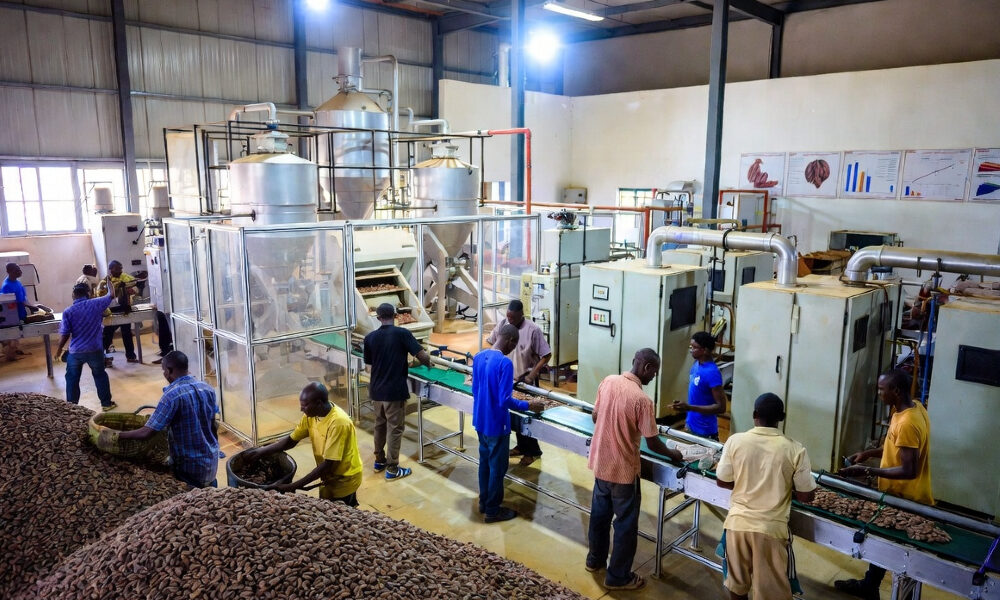
The ambitions are concrete and the timelines are tight. Côte d’Ivoire (Ivory Coast) – already the world’s largest cocoa processor, with a processing capacity of 1.06 million metric tons – has committed to processing at least 50 percent of its cocoa locally.
Ghana, the world’s second-largest producer, is targeting the same threshold by the 2026–2027 harvest season, anchoring that goal partly around its state-backed Cocoa Processing Company (CPC). Together, these two nations account for roughly 60 percent of global cocoa supply, which means their industrial pivot carries consequences far beyond their own borders.
The strategic logic is straightforward: moving up the value chain transforms raw beans into cocoa liquor, cocoa butter, cocoa powder, and cake – intermediate products that command significantly higher margins and insulate producers from the brutal price volatility that governs raw commodity markets.
For nations whose fiscal health has long been hostage to the London and New York futures markets, that insulation is not merely desirable; it is existential.
From Price Taker to Price Maker
The phrase circulating among African trade officials captures the ambition well: the goal is to shift from being a “price taker” to a “price maker.” That transition, however, demands far more than factory construction.
It requires investment in infrastructure, energy reliability, technical expertise, and – critically – consumer market development, both within Africa and abroad.
The African Continental Free Trade Area (AfCFTA), of which both Ivory Coast and Ghana are members, provides a meaningful structural foundation for this effort. A unified continental market of over 1.4 billion people offers the kind of demand base that could, over time, sustain a domestically oriented chocolate manufacturing sector – one that processes cocoa all the way through to the finished bar, rather than handing off semi-processed goods to European and North American manufacturers to capture the final, most lucrative stage of production.
Headwinds Are Real, But So Is the Resolve
The path forward is not without serious obstacles. Both Ivory Coast and Ghana have faced significant supply constraints in recent seasons, driven by a combination of crop disease – most notably swollen shoot virus – and increasingly erratic rainfall patterns tied to climate change.
Tighter supply complicates processing expansion plans that depend on a consistent raw material base.
Regulatory pressure is also mounting from abroad. The European Union’s deforestation regulation, which requires commodity importers to verify that products are not linked to deforestation, is reshaping supply chain requirements across the sector.
For African processors, this presents a dual challenge: compliance demands significant investment in traceability systems, yet it also creates an opportunity to differentiate African-origin, sustainably sourced cocoa products as premium goods in the global market.
The Human Dividend
Beyond the macroeconomics, the stakes are deeply personal for millions of smallholder farmers who remain the backbone of West African cocoa production. Despite generating the raw material upon which a vast global industry depends, most cocoa farmers earn incomes that hover near or below the poverty line.
Increasing local processing – and, ultimately, local manufacturing of finished chocolate – is projected to create tens of thousands of formal jobs while creating new demand channels that could meaningfully improve farmgate prices over time.
The cocoa sector’s transformation is neither inevitable nor guaranteed. It will require sustained political will, strategic private investment, and international trade relationships that reward – rather than penalize – industrial development in producing nations.
But the direction is clear, and the momentum is building. Africa did not merely plant the seeds of the global chocolate industry. It is now determined to harvest the profits, too.
Mark-Anthony Johnson is the founder and CEO of JIC Holdings, a global asset and investment management firm founded in 2009. With over 30 years of experience and strong ties to Africa, his investments span mining, infrastructure, power, shipping, commodities, agriculture, and fisheries. He is currently focused on developing farms across Africa, aiming to position the continent as the world’s breadbasket.