Business
Africa’s Broadband Divide Is an Investment Opportunity
The continent’s fiber-optic skeleton is already built. The businesses that understand how Africans actually connect – and pay – will claim the demand everyone else is overlooking.


By John Kourkoutas
Pull up the International Telecommunication Union’s map of global broadband networks. Terrestrial fiber rendered in blue. Submarine cables tracing every coastline like veins beneath skin. Now find Africa.
Most observers see a void. They see the blanks between the lines and conclude that the continent is, in some fundamental sense, not yet wired. They are reading the map correctly and understanding it almost entirely wrong.
What the map actually shows is a queue forming. And the people at the front are already transacting.
The Highways Are Already Built
Start with what is undeniably there. Submarine cables now ring the entire African continent, with landing stations stretching from Dakar to Mombasa, from Lagos to Dar es Salaam. Inland, terrestrial fiber follows the precise corridors along which goods have traveled for generations: the lines running north from the ports mirror the routes trucks drive every day.
This is not a coincidence. Connectivity is a leading indicator of commercial readiness, and it propagates along trade routes the way root systems follow water. The infrastructure did not arrive ahead of demand. It arrived alongside it, quietly, in the same freight corridors that have carried commerce for centuries.
The Map Shows Structure, Not Customers
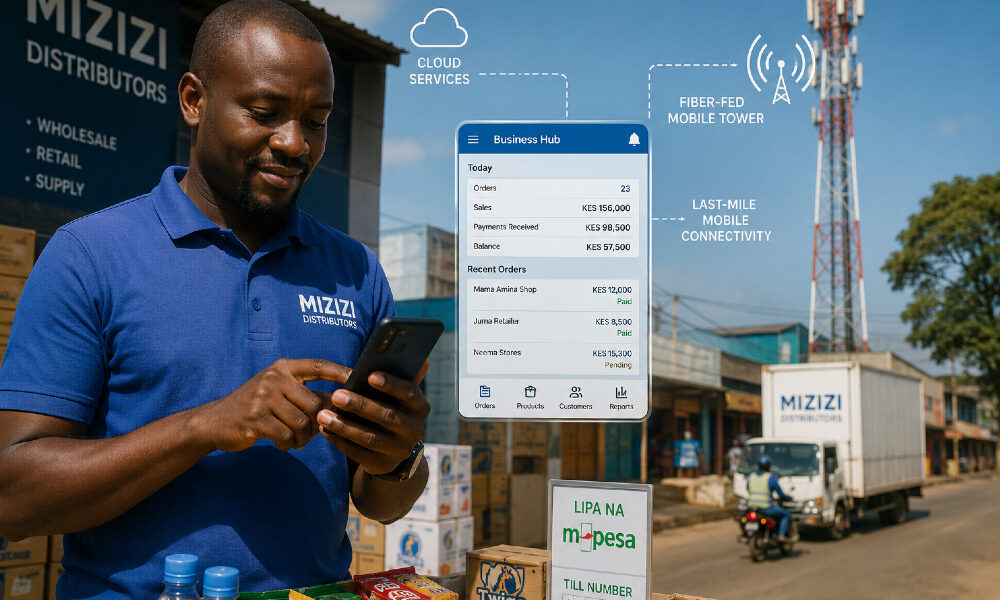
Here is the distinction that trips up nearly every newcomer: in Africa, the last mile is overwhelmingly mobile. That fiber in the ground feeds cell towers, and smartphones do the rest. Your prospective distributor is not sitting behind a desktop on a leased line in a glass office. She is running her entire operation – inventory, orders, supplier negotiations, customer service – from a phone no larger than a deck of cards.
Any market-entry strategy for Africa that treats desktop broadband as the default access point is designing for a customer who largely does not exist.
Money Moves by Phone, Too
M-Pesa. MTN MoMo. Airtel Money. Across much of the continent, mobile money is not an alternative payment method sitting politely alongside bank transfers and credit cards. It is the payment method – for salaries, invoices, school fees, and the granular daily trade that holds local economies together.
A region can look sparse on the ITU map and still process millions of transactions a day over mobile networks. The fiber tells you where the plumbing runs. The phone tells you where the water is actually being used.
What This Means If You Sell Into Africa
Understanding the infrastructure is the easy part. Adjusting your go-to-market playbook is where most foreign firms stumble. Three principles matter more than any others:
- Meet the buyer where the buyer lives. WhatsApp is the office, the product catalog, and the negotiation table rolled into one. Email is the follow-up, not the channel. If your sales team insists on LinkedIn outreach and PDF attachments sent to a Gmail address, you have already lost the room.
- Design everything mobile-first. Product sheets, price lists, your website, your onboarding flow – all of it. If it renders poorly on a six-inch screen over a 3G connection, it does not functionally exist. This is not a design preference. It is a market reality.
- Understand your distributor’s payment stack before you set terms. Their customers pay them through mobile money, often in small, frequent transactions. Your invoicing cycle, your credit terms, your settlement expectations – all of it must respect that cash cycle. Imposing a net-60 structure on a distributor whose revenue arrives in daily MoMo deposits is not conservatism. It is a misunderstanding.
Demand Is Calling
The gaps on that broadband map are not evidence of missing demand. They are evidence of demand that nobody has claimed yet – demand that is alive, liquid, and reaching for a product or service that has not yet bothered to show up.
And when it answers, it will answer from a phone.
The queue is forming. The only question is whether you will be standing in it, or still squinting at the map, wondering why the lines don’t reach far enough inland.
They do. You just need to look at what’s connected to the other end.
John Kourkoutas is business development expert that specializes in helping companies, export teams, and business leaders succeed in Africa’s dynamic and emerging markets.