Business
Africa’s Biggest IPO Is a Triumph. Can It Become a Turning Point?
When the books closed on the Dangote Petroleum & Petrochemicals IPO this week, it was a masterclass in African capital mobilization. But it also casts a harsh light on why the continent’s broader macroeconomic growth remains disconnected from the daily lives of its citizens.


By Mark-Anthony Johnson
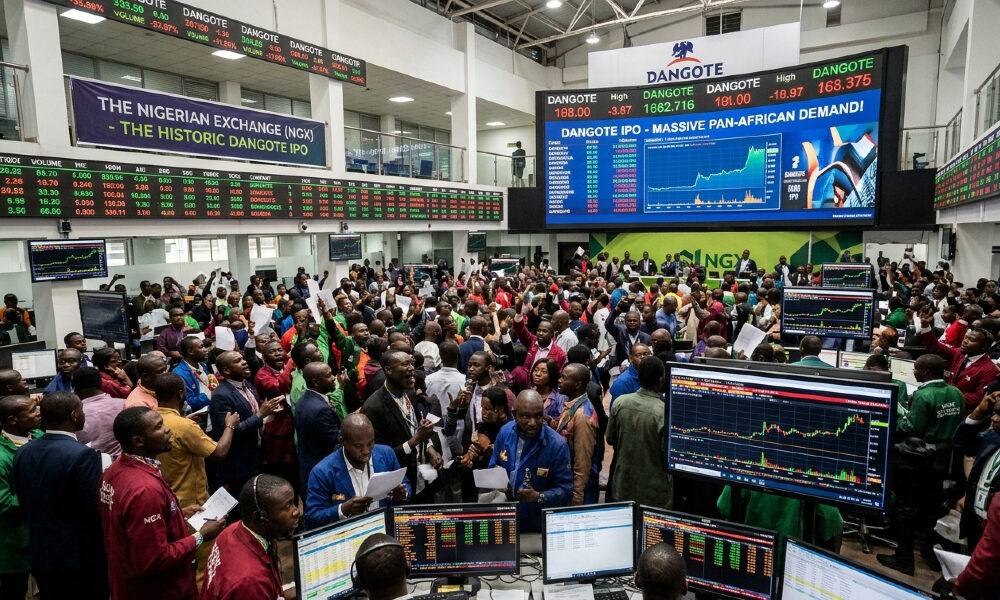
On Tuesday, the books closed on the largest initial public offering in African history. The Dangote Petroleum & Petrochemicals share sale sought about 2.15 trillion naira (US$1.6 billion) by offering 4.1 billion ordinary shares at 525 naira (US$0.4) apiece. Nigerian retail and institutional demand alone covered the base target before a single international allocation had been finalized. By the time the offer shut, orders from Nigeria had reached roughly ₦6.4 trillion (US$4.76 billion), about three times the amount on offer.
Those numbers are staggering, but the more interesting ones describe who showed up. Applications came from 120 countries. Investors took part from all 54 African nations, a degree of continental participation that African capital markets have rarely seen. More than 2 million Nigerian retail investors subscribed, mostly through digital fintech platforms. Billed as “The People’s IPO,” the deal has earned the label in a way few such offerings do.
It would be easy to read this as a simple success story, and in many respects it is. It is also a useful lens on one of the continent’s most persistent puzzles: why so many Africans do not feel the growth their economies report.
A Rush Built on Real Earnings
The stampede was not driven by sentiment alone. Days before the offer closed, the refinery published nine-month results to September 30, 2026. It reported US$22.5 billion in revenue and US$4.73 billion in net profit, underpinned by strong refining margins, throughput of 700,000 barrels a day and accelerating jet fuel exports to Europe and regional African markets. For a continent that has long exported crude and imported the fuel refined from it, a facility that reverses that flow is more than a profitable business. It is an argument that African industrial capacity can compete.
Success has created an awkward problem, however. With demand vastly exceeding supply, many applicants will receive fewer shares than they asked for, and some institutions may receive none. Allocation begins next week under the guidance of the lead domestic and international bookrunners. Aliko Dangote is reportedly weighing a separate secondary sale of part of his personal holdings to accommodate institutions shut out of the primary offering. The Nigerian Securities and Exchange Commission is expected to issue its final no-objection clearance around November 11, with trading on the Nigerian Exchange to follow later in the month.
How that allocation is handled will matter almost as much as the raise itself. A “People’s IPO” that leaves ordinary subscribers with token allotments while larger players are accommodated through side channels would waste much of the goodwill it has built. Transparency over who gets what, and why, is the first test of whether the offering lives up to its name.
The Paradox Behind the Headlines
The deeper question is what a triumph like this means for the economy around it. Several African economies are expanding quickly, with the International Monetary Fund projecting growth of around 4.3 percent for the continent. Yet millions of citizens see little improvement in their daily lives. The reasons are structural, and the Dangote refinery, for all its promise, illustrates several of them.
Growth that does not hire. Much of the continent’s expansion is driven by commodities and capital-intensive sectors such as oil and mining rather than by labor-intensive manufacturing or agriculture. Output rises without a proportional rise in jobs. A world-class refinery is among the most capital-intensive assets imaginable. It can generate billions in profit while employing a small fraction of the workers a comparable textile or food-processing sector would.
A missing transformation. Unlike East Asia or China in their high-growth phases, many African economies have struggled to move smallholder farmers into higher-productivity manufacturing and export-ready industries. Without that shift, rising national income does not become rising household income.
A demographic squeeze. Population growth is outpacing the creation of formal jobs, straining labor markets, local infrastructure and education systems alike. A young, fast-growing population is a dividend only if there is work for it to do.
Public goods that do not arrive. Pockets of high growth often fail to translate into broad public provision of healthcare, reliable electricity and internet access, particularly in rural and peri-urban areas. Corruption and the uneven distribution of state revenue weaken whatever trickle-down effect might otherwise occur.
A debt trap in the background. Many governments carry heavy debt burdens, face declining foreign direct investment and pay punishing borrowing costs. That leaves little fiscal room for social safety nets or poverty reduction, however strong the headline growth rate.
Ownership as a Different Kind of Inclusion
Against this backdrop, the most significant feature of the Dangote offering may not be the capital it raised but the way it raised it. Trickle-down economics has a poor record on the continent. Broad-based ownership offers a different route. When 2 million ordinary savers hold a stake in the country’s most important industrial asset, they share in its dividends and its fortunes directly, rather than waiting for benefits to filter down through a state that has often failed to deliver them.
That is the optimistic reading, and it deserves some skepticism. Retail investors who are allocated a handful of shares will earn modest returns, and a single listing does not create a investing culture. The test is whether this moment deepens the market: more listings, more participation from ordinary savers, and more of the continent’s household wealth flowing into productive local enterprise rather than sitting idle or leaving the continent.
What Success Would Look Like
If the Dangote IPO is to be remembered as a turning point and not merely a record, three things must follow. First, the allocation and listing must be handled fairly and transparently, preserving the trust of the 2 million small investors who showed up. Second, other African companies, particularly ones in labor-intensive sectors, must be encouraged to follow, so that capital markets fund the jobs-rich industries the continent needs and not only its capital-intensive giants. Third, governments must use the confidence this deal has generated to address the weaknesses that growth alone cannot fix: infrastructure, power, governance and the cost of public borrowing.
Africa has just demonstrated that its savers, at home and abroad, will back an ambitious African project at scale. That is a remarkable signal. What it cannot do by itself is turn a growth rate into a living wage. The task now is to make sure the people who bought in on Tuesday are also able to build on it.
Mark-Anthony Johnson is the founder and CEO of JIC Holdings, a global asset and investment management firm founded in 2009. With over 30 years of experience and strong ties to Africa, his investments span mining, infrastructure, power, shipping, commodities, agriculture, and fisheries. He is currently focused on developing farms across Africa, aiming to position the continent as the world’s breadbasket.