Opinion
Africa’s Ancient Rock Art: Lessons for Modern Sustainability
Long before empires carved borders and scribes pressed reed to clay, Africa was already keeping records – in stone.


By Gregory September
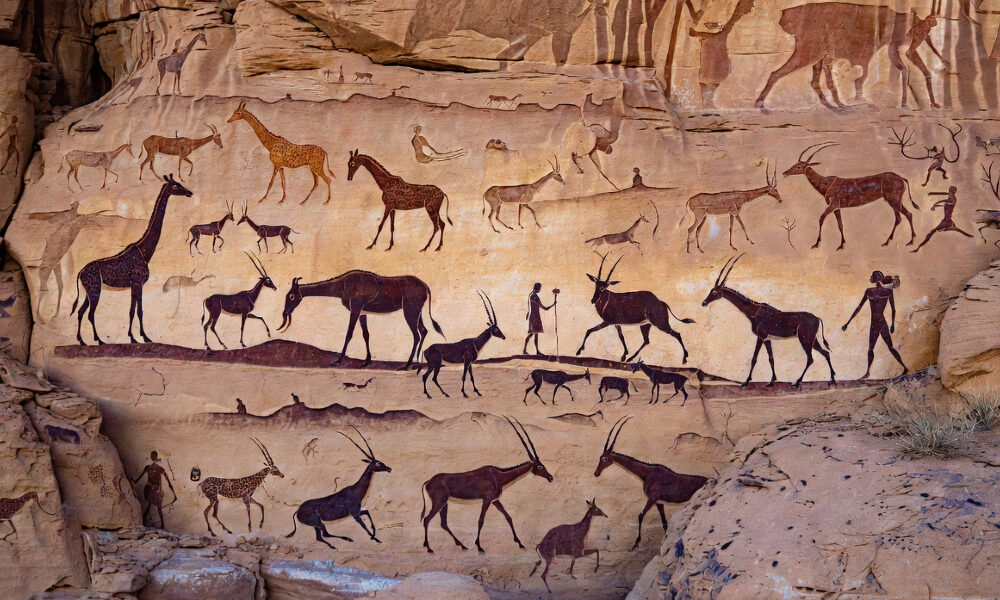
Scattered across the continent, thousands of rock art sites constitute humanity’s oldest living archive. These paintings and engravings document animal migrations, spiritual rituals, ecological abundance, and the slow, unmistakable fingerprints of climate change – many predating most written history by millennia.
To dismiss them as prehistoric curiosity is not merely intellectually careless; it is a costly mistake for anyone serious about building a sustainable future.
A Green Sahara, Remembered in Stone
The evidence is breathtaking in both scale and implication. Saharan rock art dates back 10,000 to 12,000 years, to a period when the desert was not a desert at all – but a verdant expanse of grasslands, lakes, and diverse wildlife.
The ancient artists who painted that world were not simply decorating cave walls. They were documenting an ecosystem in extraordinary detail, one that would later be transformed, over centuries, into the largest hot desert on Earth.
This is not mythology. This is longitudinal environmental data, recorded by people with an intimate, generational understanding of the land they inhabited.
Consider a few remarkable examples.
In Niger, the Dabous giraffes – rock carvings stretching 5.5 meters (18 feet) tall – stand as a testament to the megafauna that once roamed freely across North Africa. In Namibia, Twyfelfontein holds more than 2,500 rock engravings cataloguing species and behaviors with the quiet precision of a field naturalist. Tanzania’s Kondoa rock shelters remain actively connected to living cultural traditions, a rare and powerful continuity between ancient knowledge and present-day communities. In Malawi, the Chongoni landscape alone contains 127 documented rock art sites – an entire regional library, written not in ink, but in pigment pressed against granite.
Indigenous Knowledge as Environmental Science
There is a persistent and damaging tendency in mainstream conservation discourse to treat indigenous knowledge as folklore – anecdotal, sentimental, and subordinate to data collected by credentialed institutions. Africa’s rock art dismantles that hierarchy entirely.
These images represent thousands of years of systematic ecological observation. Ancient African communities tracked species populations, recorded habitat change, and – critically – adapted their behaviors in response to shifting environmental conditions.
That is not superstition. That is science, practiced across generations without the benefit of universities, satellites, or peer-reviewed journals.
The implications for modern sustainability practice are profound. Three of the United Nations’ Sustainable Development Goals map directly onto what African rock art already demonstrates.
Under SDG 13 (Climate Action), Saharan rock art provides some of the world’s longest continuous records of environmental transformation, offering scientists a baseline for understanding climate variability that no modern instrument can replicate.
Under SDG 15 (Life on Land), rock art catalogues species that once populated African landscapes, furnishing biodiversity researchers with historical data against which current loss can be measured.
Under SDG 11 (Sustainable Cities and Communities), protecting these sites is not merely a cultural courtesy – it is the preservation of irreplaceable knowledge infrastructure, one that simultaneously anchors community identity and supports heritage tourism economies.
The Case for Long Memory
Modern sustainability thinking suffers from a chronic affliction: short memory. Policy cycles run on electoral timescales. Corporate sustainability commitments stretch, at best, to 2050. Even the most ambitious climate models rarely extend beyond a century or two of projection.
African rock art operates on a different temporal register entirely – one measured in millennia. The communities that created these archives understood something that contemporary institutions are still struggling to internalize: that surviving environmental change requires not just technical adaptation, but deep, inherited knowledge of how ecosystems behave across vast stretches of time.
Cultural heritage, in this light, is not a soft priority to be funded when budgets allow. It is a hard asset – a repository of tested, time-proven environmental intelligence that no algorithm has yet been trained to replicate.
What Sustainability Leaders Must Do
The question, then, is not whether African rock art is relevant to modern sustainability. The question is why it has taken this long to say so plainly.
Sustainability leaders – in government, business, conservation, and finance – should actively engage with indigenous knowledge systems as primary sources of environmental insight, not as supplementary color. Funding for the protection of rock art sites should be classified not merely as cultural expenditure, but as climate research investment.
And the communities with living connections to these traditions, such as those surrounding Tanzania’s Kondoa shelters, deserve a seat at the table in every regional conservation conversation that claims to be evidence-based.
Africa’s first environmental records were not written in databases. They were not compiled in spreadsheets or submitted to journal review boards.
They were pressed into stone by human hands that understood, with extraordinary clarity, that the land had a story – and that future generations would need to read it.
The records exist. The lessons are legible. The only question is whether modern leaders are willing to look.
Gregory September is a South African academic, author, and geopolitical analyst with extensive experience in government and Parliament. He is the founder and CEO of SAUP (Sustainability Awareness and Upliftment Projects NPC), which focuses on sustainability education and community development. He previously served as Head of Research and Development for the Parliament of South Africa. His work centers on sustainability, African geopolitics, and economic development, and he regularly contributes to analysis of global political and economic affairs.