Opinion
Africa’s Agriculture Graduates Are Fleeing the Fields – and Why That Must Change


By Jean Claude Niyomugabo
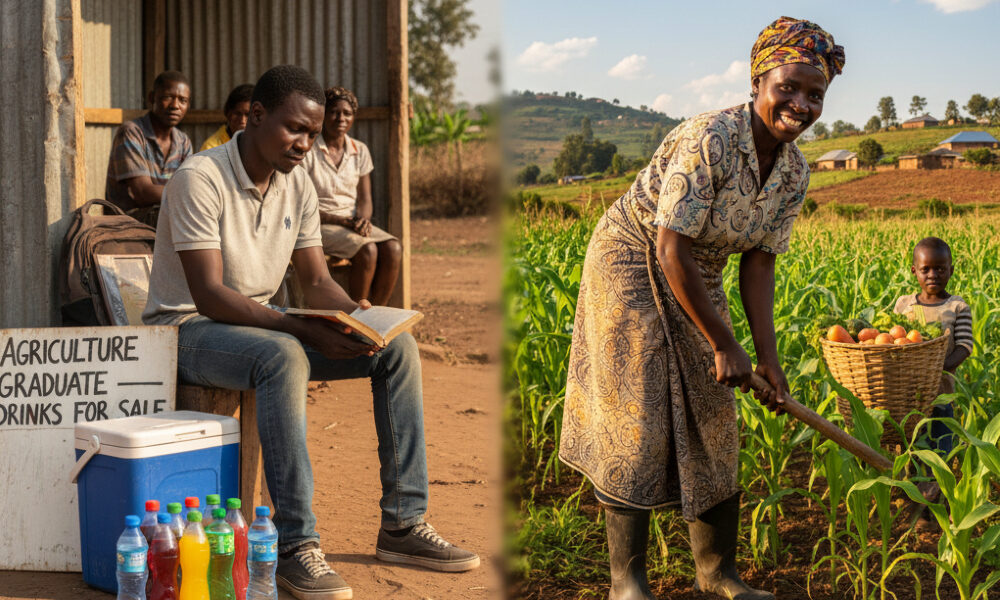
In rural Kenya, a self-taught farmer manages 50 acres of maize and dairy cattle – feeding his community and turning a steady profit. Meanwhile, in the same country’s capital, a graduate with a degree in Crop Protection sells energy drinks at a bus stop.
Another, trained in Animal Science, runs a modest clothing stall. A third, once immersed in soil chemistry, now processes transactions behind a bank counter.
This paradox is playing out across the continent: those with formal agricultural training are abandoning the very sector they were educated to transform – while farmers with no university degrees are quietly building resilient, profitable agribusinesses.
What’s gone wrong?
The Education Gap: When Theory Outpaces Practice
At first glance, one might assume agriculture is unprofitable. But the evidence suggests otherwise. Smallholder and emerging commercial farmers without formal education are expanding operations, adopting new techniques, and feeding millions.
They succeed not because they know more agronomy, but because they treat farming as a business – one that demands resilience, adaptability, and hands-on commitment.
The real issue lies deeper: in how African education systems have framed agriculture – and how society has stigmatized it.
For decades, agricultural curricula across the continent have leaned heavily on theory, often divorced from the realities of soil, weather, markets, and supply chains. Students memorize the nitrogen cycle but rarely touch a plough.
They study pest management without ever scouting a field. By the time they graduate, many view farming not as a dynamic enterprise, but as a fallback for the uneducated – a relic of poverty rather than a frontier of innovation.
Compounding this is a cultural narrative that equates white-collar work with success. From childhood, students are taught that education is a ticket out of the village, not a tool to revolutionize it.
So when agriculture graduates enter the job market, they chase office jobs – even if those roles offer lower income and less autonomy than farming could.
A Sector Ripe for Innovation – If Talent Returns
Yet the opportunity is immense. Africa has 60 percent of the world’s uncultivated arable land and a rapidly growing population.
The African Union estimates the continent’s agribusiness market could be worth US$1 trillion by 2030. Climate-smart practices, digital tools, agro-processing, and export-oriented value chains are transforming farming into a high-tech, high-reward sector.
The graduates who embrace this shift are already proving its potential. In Nigeria, agritech startups founded by former students are using drones for crop monitoring and mobile platforms to connect smallholders to markets.
In Rwanda, young agri-entrepreneurs are turning post-harvest losses into profit through solar-powered cold storage. These are not subsistence farmers – they are scientists, engineers, and CEOs rooted in the soil.
The path forward requires systemic change. Universities must overhaul agricultural education to emphasize experiential learning, entrepreneurship, and market linkages.
Governments should incentivize youth-led agribusinesses through access to land, credit, and infrastructure. And society must reframe farming – not as a last resort, but as a noble, lucrative, and intellectually demanding profession.
Agriculture is not just about food security. It is about economic sovereignty, climate resilience, and intergenerational wealth.
The knowledge held by today’s graduates is too valuable to sit idle in bus terminals or bank lobbies.
The land is waiting. The markets are ready. All that’s missing is the mindset.
It’s time for Africa’s agriculture graduates to return to the fields – not as laborers, but as innovators, owners, and nation-builders.
Jean Claude Niyomugabo is an entrepreneur and digital communication specialist with a strong passion for Africa’s development. He is dedicated to harnessing the power of social media to drive positive change and enhance livelihoods. With diverse interests and a strategic approach to digital engagement, he strives to create meaningful impact through innovation and connectivity.