Opinion
Africa’s Agriculture Funding Gap: A Broken Promise And a Market Signal
Twenty-three years after signing the Maputo Declaration, most African governments still fall short of their own agricultural spending targets. The private sector cannot afford to wait.


By Kevine Otieno
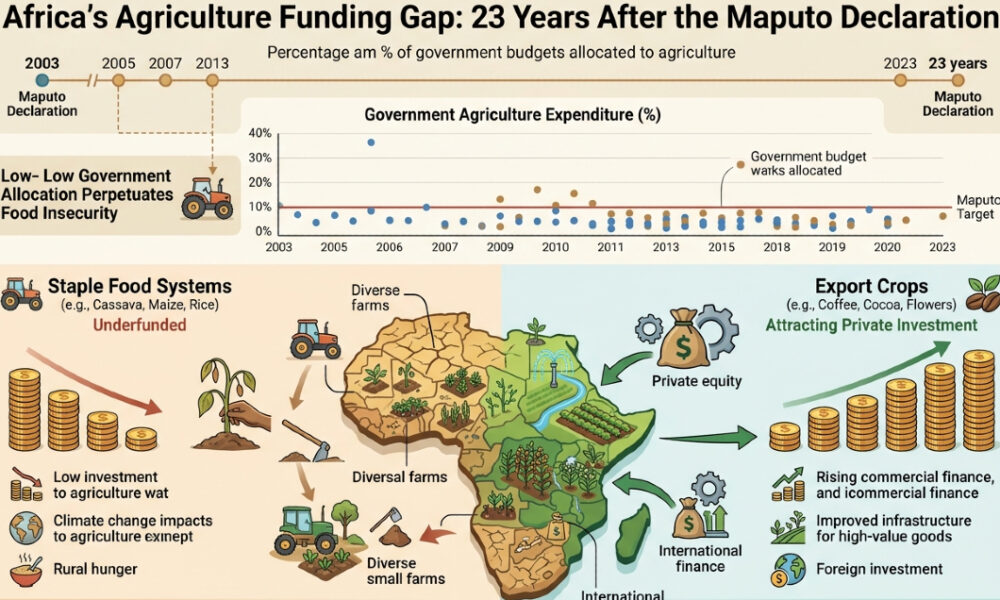
In 2003, African heads of state gathered in Mozambique and made a commitment that seemed, at the time, both ambitious and achievable: allocate at least 10 percent of national budgets to agriculture. Two decades later, the promise remains largely unkept – and the consequences for food security, rural livelihoods, and economic development across the continent have been profound.
The African Union’s newly launched CAADP 2026–2035 Strategy acknowledges this failure with unusual candor. Few countries, it concedes, are on track to meet the decade-old spending benchmark.
While 42 nations have updated their National Agricultural Investment Plans – a positive administrative step – formal planning documents and actual budget disbursements are two very different things. In practice, only a handful of countries consistently allocate the 10 percent threshold, and even then, figures fluctuate from year to year.
Meanwhile, Africa invests less than 1 percent of its agricultural GDP in research, with funds that are frequently committed but never disbursed.
The scale of the resulting gap is staggering. The CAADP framework itself aims to mobilize US$100 billion in combined public and private investment over the next decade – a figure that implicitly acknowledges just how far behind the continent has fallen.
Policy Failure That Doubles As A Market Signal
It would be a mistake to read this story purely as one of government negligence. The chronic underfunding of African agriculture is also – and perhaps more usefully – a signal to private investors about where opportunity lies, and where structural risk is highest.
When governments consistently underinvest, private capital does flow in, but selectively. It gravitates toward export value chains – avocados, cut flowers, specialty coffee – where returns are more predictable and offtake agreements provide a measure of security.
The result is a peculiar inversion: crops destined for European supermarkets attract sophisticated financing, while the staple food systems that feed 80 percent of Africa’s population remain starved of investment. Storage facilities decay. Processing infrastructure stagnates. Market linkages for smallholder farmers remain informal and inefficient.
This misallocation is not the result of market irrationality. It reflects rational responses to risk in the absence of public investment that would otherwise de-risk domestic food systems.
Governments that fulfill their Maputo commitments are, in effect, creating the conditions under which private capital can safely follow. Those that do not are leaving a vacuum – one that markets alone will never fully fill.
CAADP 2026–2035: Ambitious On Paper, Uncertain In Practice
The new continental strategy is, by any measure, the most comprehensive agricultural framework Africa has produced. Its targets are sophisticated: climate-smart production methods, digital agriculture systems, value-added processing, and support for youth-led enterprises.
The document reflects genuine intellectual progress in how African policymakers conceptualize the agricultural challenge.
Yet ambition on paper has historically struggled to survive contact with national budget cycles. The history of CAADP implementation since its inception in 2003 is, regrettably, one of well-designed frameworks that outpaced the political will required to fund them.
Domestic revenue constraints, competing fiscal priorities, and debt-service obligations have repeatedly crowded out agricultural spending – particularly in smaller economies with limited fiscal space.
The new strategy is aware of this dynamic. Its emphasis on mobilizing private investment alongside public funds reflects a pragmatic concession that governments cannot do this alone.
But private capital requires a policy environment, infrastructure, and risk-sharing mechanisms that only governments can provide. The two are complements, not substitutes.
The Commercial Case For Food Systems Infrastructure
For investors willing to look beyond the familiar export crop playbook, the underfunded domestic food system represents a compelling commercial frontier. Storage and cold-chain logistics, grain processing, digital market platforms, and input supply networks all operate in a space where demand is enormous, competition is thin, and impact is measurable.
These are not purely philanthropic plays – they are infrastructure businesses with real revenue models, operating in markets that will only grow as Africa’s urban population expands.
The CAADP framework, whatever its implementation uncertainties, provides something valuable to private investors: a policy signal that the continent’s governments recognize the gap and intend, however haltingly, to close it. Patient capital aligned with that direction has historically performed well.
The question is whether governments will deliver enough of the public investment to catalyze the private flows needed at scale. If the pattern of the past two decades holds, the answer will vary enormously by country – and investors who can navigate that heterogeneity will find themselves well-positioned.
Africa’s agricultural potential is not in doubt. What has been lacking is the sustained public commitment to unlock it. The Maputo Declaration turns 23 this year. The continent’s farmers – and its food security – cannot wait for another decade of unfulfilled pledges.
Kevine Otieno is a food scientist and systems thinker with more than a decade of experience in food safety, One Health, and sustainable agriculture across Africa. Having trained over 100,000 stakeholders, led disease outbreak crisis responses, and built digital platforms expanding access to agricultural science, he works to make food systems safer, more nutritious, and climate-resilient for Africa’s most vulnerable communities. He also mentors graduate students in food science and agri-food systems.