Opinion
Africa’s Agricultural Subsidy Trap: Why Smart Economics Must Replace Handouts
Two of the continent’s most cherished development ideas – farm subsidies and mega-factories – may be doing more harm than good.


By Balbir Singh
Ask almost anyone how to fix African agriculture, and the answer comes fast: subsidize inputs. Cheaper fertilizer, cheaper seed, cheaper machinery – surely that unlocks growth. Ask how to create jobs for Africa’s youth, and the answer is just as automatic: attract big industry. Build the factories, and employment will follow.
Both ideas sound reasonable. Both are largely myths. And both, in practice, have quietly become engines of corruption rather than engines of growth.
The Subsidy Trap
Agricultural subsidies are popular with donors, governments, and voters alike. They photograph well and poll even better. But a growing body of on-the-ground evidence across the continent suggests that subsidy programs are frequently captured long before they reach a farmer’s field – diverted through opaque tendering, inflated contracts, and kickbacks at every link of the supply chain, from manufacturer to distributor to retailer.
Consider the pattern that repeats itself, country after country:
Fertilizer. Subsidized NPK blends distributed through many state programs have been found, in independent testing, to contain only a fraction of their labeled nutrient content. Blending contracts are often awarded through politically connected firms, with tendering processes complex enough to accommodate commissions at every stage. By the time a bag reaches a smallholder, farmers may effectively be paying for fertilizer that delivers almost none of its promised value – turning what should be an investment into a loss, and reinforcing the very perception subsidies were meant to fix: that farming doesn’t pay.
Agrochemicals. Expired or substandard pesticides, procured cheaply and sold through subsidized channels, frequently fail even basic efficacy tests. Farmers end up spraying fields with little more than colored water and diesel fumes – protecting nothing, while the packaging and paperwork protect everyone in the supply chain except the farmer.
Seed. A striking number of subsidized seed tenders specify open-pollinated varieties – seed that any farmer could legally save and replant from a single purchase. That such seed nonetheless gets repackaged, “certified,” and resold year after year to the same farming communities says less about agronomy and more about the certification bureaucracy’s usefulness as a bribe-collection mechanism.
Machinery. Travel through rural Africa and it’s hard to miss the rows of abandoned 60- to 100-horsepower tractors, rusting in fields where farmers still work by hand. These machines were often procured to satisfy subsidy targets, not farmer needs – a mismatch that no amount of “modernization” branding can fix. Meanwhile, drones, satellite mapping tools, and other high-tech add-ons frequently serve the same function: impressive line items in a budget, largely irrelevant to a smallholder’s actual constraints.
The fix isn’t more oversight of a broken model – it’s a different model. Direct cash transfers to farmers’ accounts, letting them decide what their farms actually need, would do more to build a resilient agricultural sector than another layer of subsidized, state-mediated input supply. Pair that with investment in market access and logistics, tax relief on production and processing, and deregulated, producer-led certification – the kind used in many advanced agricultural economies – and Africa’s farmers gain something subsidies rarely deliver: agency. An informed, empowered farmer, not a subsidized one, is the future of African agriculture.
The Big-Factory Fallacy
The second myth is just as durable: that large-scale industrialization is the surest route to youth employment and sustainable growth.
The evidence doesn’t fully bear this out. Countries with substantial heavy industry – South Africa, Mexico, Venezuela, Egypt, among others – continue to post youth unemployment rates well above 30 percent. Meanwhile, economies built around dense networks of small and home-based enterprises – India, China, Vietnam, Rwanda, Kenya, Indonesia, and Japan – have historically generated the overwhelming majority of jobs for their populations through exactly this kind of enterprise, often estimated at 80 percent or more of employment.
The reasoning isn’t complicated. Big industry tends to cluster in big cities, pulling raw materials in from distant rural areas and pushing finished goods back out to the same markets – a costly, carbon-intensive loop. That concentration drives rural-to-urban migration, straining housing, sanitation, and infrastructure, and often subjecting workers to conditions far removed from the “sustainable growth” the model was meant to deliver.
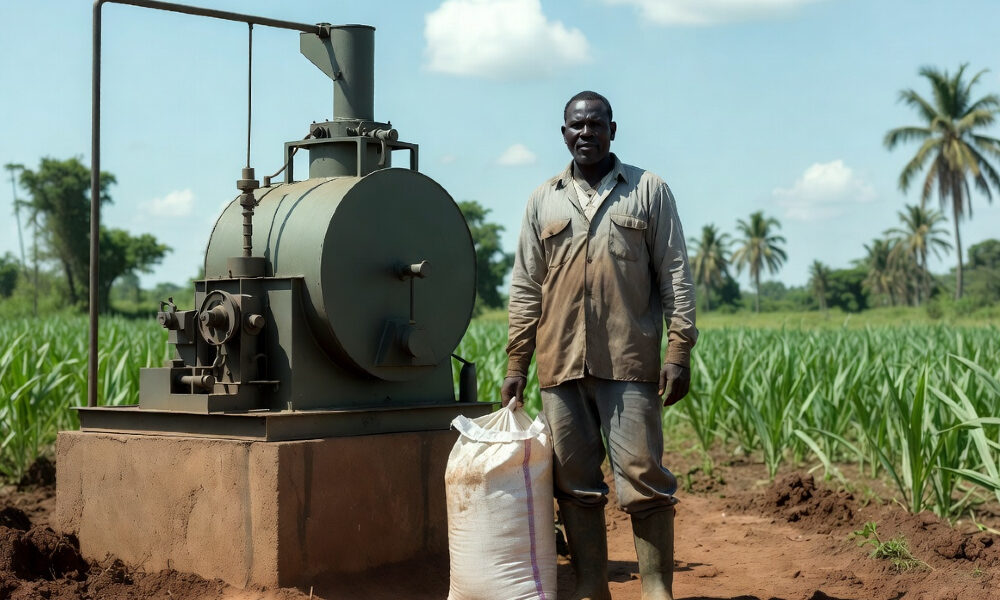
Small-scale, localized industry inverts this logic. Picture a soybean oil mill built where the soybeans are actually grown: only the oil – the highest-value, most transportable product – needs to travel to market. The soybean cake stays local, feeding livestock and poultry. The residual biomass returns to the same soil that grew the crop, as fertilizer. What emerges isn’t just a factory; it’s a circular economy – one that creates jobs, retains value in the community that produced it, and closes the loop environmentally, all without a single ribbon-cutting ceremony for a factory the size of a stadium.
The Common Thread
What links these two myths – subsidy dependency and big-industry worship – is a preference for visible, fundable, photographable interventions over the quieter, harder work of building systems that actually function: transparent markets, direct support to producers, and industry sized to fit the communities it’s meant to serve.
Africa’s development challenge was never a shortage of good intentions or donor funding. It has been a shortage of accountability in how that funding is spent – and a reluctance to trust farmers and small entrepreneurs with the resources and the decisions that are rightfully theirs.
Balbir (Shekhawat) Singh, PhD, is a results-driven agribusiness techno-commercial professional with over 18 years of experience in sales, marketing, agronomy, product management, farming, commodity trading, and agri-inputs (fertilizers, seeds, agrochemicals). Passionate about advancing sustainable farming, he currently serves as Director General/CEO of Sodesep SA-Fertilizer Abuja, Nigeria. He has worked across emerging markets including India, Uganda, Kenya, Cameroon, Tanzania, Indonesia, and Nigeria.