Opinion
Africa’s Agricultural Reckoning: Land Is Not Enough
The continent has the soil, the sun, and the labor force. What it lacks is a willingness to modernize farming before time runs out.


By Jean Claude Niyomugabo
The world’s most productive agricultural nations are not always its largest. Some countries with comparatively modest farmland rank among the globe’s foremost food exporters – not because of geography, but because of relentless investment in efficiency, irrigation, research, logistics, and technology.
That inconvenient truth carries a direct message for Africa: acreage alone does not guarantee abundance.
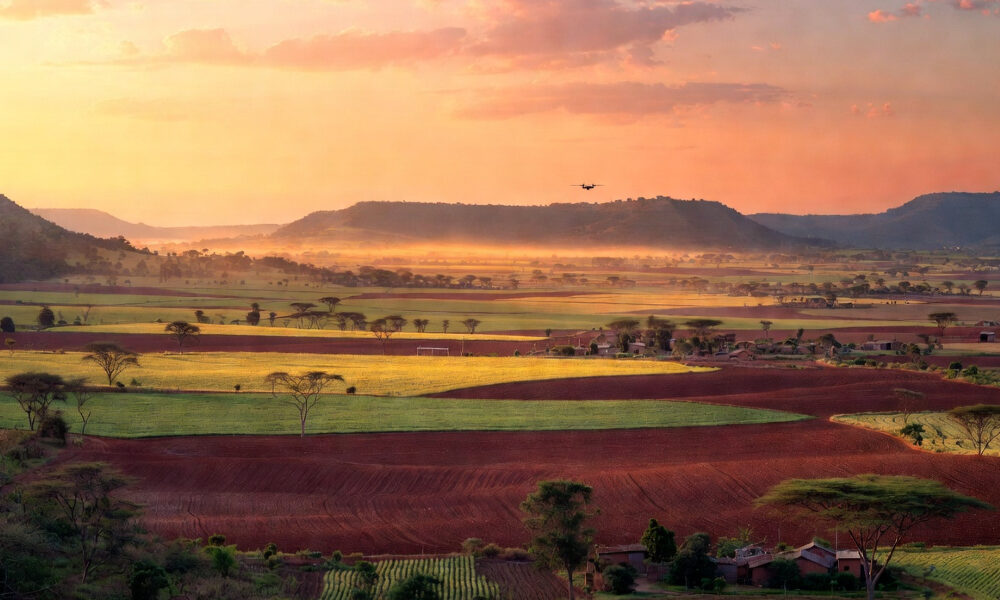
Africa holds vast stretches of arable land, a youthful and growing labor force, and climatic diversity that could sustain a remarkable range of crops. Yet across much of the continent, agricultural productivity remains stubbornly low.
Post-harvest losses erode gains before food ever reaches a market. Mechanization is the exception, not the rule. And a changing climate is compressing the margin for error with each passing season.
The gap between potential and performance has never been more consequential – or more urgent to close.
The Productivity Imperative: Doing More With What Exists
This should fundamentally reshape how policymakers, investors, and development institutions think about African food security. The old framing – centered on expanding the amount of land under cultivation – is no longer sufficient.
The imperative now is productivity: producing significantly more from the land already farmed. That means equipping smallholder farmers with the tools to make better decisions – precision agriculture, satellite monitoring, drone-assisted assessment, real-time weather data, soil testing, and artificial intelligence platforms designed for field conditions, not just boardrooms.
It means treating data as a farm input, as essential as seed or fertilizer.
Africa has more than enough potential to feed itself and to contribute meaningfully to feeding the world. But potential is a promissory note, not a meal.
A Countdown Already in Progress
The demographic and environmental pressures bearing down on this challenge are not abstract. By 2050, the global population will approach ten billion people. Food demand will rise. Competition for arable land will intensify. Climate volatility will render traditional growing patterns increasingly unreliable.
Against that backdrop, the question confronting Africa is disarmingly direct: will the continent continue to farm primarily with yesterday’s tools, or will it invest in the systems that allow its farmers to compete in tomorrow’s markets?
Technology in agriculture is no longer a luxury reserved for wealthy nations with advanced research institutions. It is rapidly becoming a prerequisite for viability – for farm-level profitability, for national food security, and for broader economic development.
The countries that recognize this early will gain structural advantages that compound over time. Those that do not will find themselves increasingly dependent on food imports, exposed to price shocks, and unable to capitalize on what should be one of the continent’s defining strengths.
From Potential to Performance: The Investment Africa Owes Its Farmers
Africa has more than enough potential to feed itself and to contribute meaningfully to feeding the world. But potential is a promissory note, not a meal. Translating it into outcomes requires sustained public and private investment in agricultural research, robust programs for farmer training, support for local innovation ecosystems, and a firm commitment to ensuring that technology reaches the field – not merely the conference circuit.
The future of African agriculture will be built by those who understand that land, people, knowledge, and technology are not alternatives to one another. They are inseparable. The continent that masters that combination will not merely feed its own population – it will help define how the world eats.
Jean Claude Niyomugabo is an entrepreneur and digital communication specialist with a strong passion for Africa’s development. He is dedicated to harnessing the power of social media to drive positive change and enhance livelihoods. With diverse interests and a strategic approach to digital engagement, he strives to create meaningful impact through innovation and connectivity.