Opinion
Africa’s Agricultural Education Crisis: High Marks, Low Impact for Farmers
Graduates who can explain gene editing but cannot quote the price of a bag of urea represent a systemic failure – one that is quietly undermining the continent’s agricultural ambitions.


By Balbir Singh
Walk through the corridors of many agricultural universities across sub-Saharan Africa, and the impression is one of considerable promise. Students are well-dressed and articulate.
Grade sheets gleam with scores above 90 percent. Presentations are polished; technical vocabulary flows freely. Yet shift the conversation from lecture-hall theory to the realities of the farm gate, and something troubling emerges: a stark, widening gulf between academic achievement and practical competence.
Ask a graduating agricultural student how much nitrogen is delivered by two 50-kilogram bags of urea. Ask for the spot price of diammonium phosphate, the going rate for a kilogram of soybean in the nearest commodity market, or what a live goat fetches at the local livestock auction. In too many institutions, these questions are met with silence – not only from students, but in some cases from senior academic staff as well.
The implication is uncomfortable but unavoidable: Africa’s agricultural universities are producing graduates who are theoretically accomplished yet commercially illiterate, well-schooled in the science of farming but profoundly unprepared for its economics.
A Structural Failure Hidden Behind Strong Transcripts
The problem is not one of individual aptitude. It is structural.
Across much of the continent, agricultural education has been designed – consciously or otherwise – to produce strong examination candidates rather than capable agricultural practitioners. Curricula prioritize frameworks, research methodology, and academic presentation over the operational knowledge that farming as a business actually demands.
The result is a peculiar inversion. Students may be conversant with the mechanics of drone-based crop monitoring or the regulatory landscape of genetically modified organisms, yet remain unfamiliar with the input cost structures that determine whether a smallholder turns a profit or slides into debt.
Agriculture is being taught as an intellectual discipline rather than the dynamic, commercially driven enterprise it is.
This is not a peripheral concern. It is a central obstacle to the agricultural transformation that governments and development institutions across Africa have repeatedly pledged to deliver.
The Cost of Classroom-Only Thinking
The consequences compound quickly. Agriculture is, at its core, a commercial system. Decisions about what to plant, when to sell, how to source inputs, and whether a business plan is financially viable all depend on a granular understanding of prices, margins, and market dynamics.
Without this foundation, graduates are ill-equipped to farm profitably, advise smallholders meaningfully, or implement agricultural policy in ways that bear any relationship to ground-level reality.
Employers in agribusiness and agricultural development consistently report the same frustration: candidates arrive with impressive credentials and a weak grasp of how markets actually function. This graduate-employer mismatch is not unique to Africa, but its consequences on a continent where agriculture employs the majority of the labor force and contributes substantially to GDP are particularly acute.
A generation of under-prepared agricultural graduates is not merely a workforce problem – it is a drag on food security, rural income growth, and economic development more broadly.
Reimagining Agricultural Education: From Credential to Competence
Reversing this trend requires more than incremental curriculum reform. It demands a fundamental rethinking of what agricultural education is for – and who it ultimately serves. Several shifts are essential.
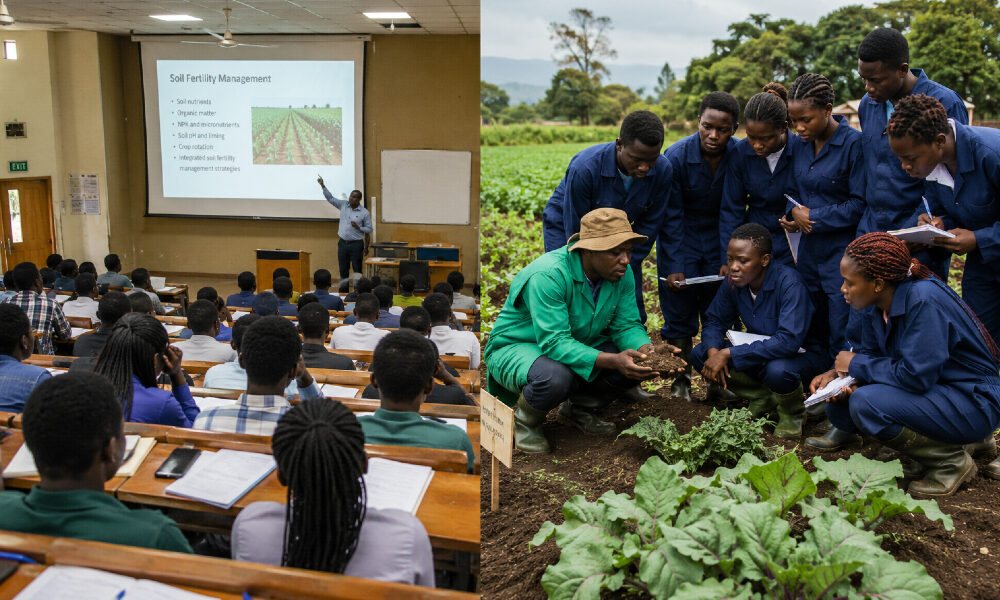
First, field immersion must become a core component of every agricultural degree, not an optional practicum bolted onto the final year. Students should be spending meaningful time on working farms, in input markets, and alongside agro-dealers – learning in real time how production cycles, pricing mechanisms, and supply chains operate. The farm, not the lecture hall, should be the primary classroom.
Second, business literacy must be treated as foundational. Understanding gross margins, input-to-output price ratios, commodity market volatility, and value chain economics is not supplementary knowledge for agricultural students – it is essential knowledge. A student who cannot read a simple farm budget or interpret a commodity price index is not ready to work in agriculture, regardless of their examination results.
Third, institutions must resist the bureaucratization of learning. Agricultural programs have in many cases become heavily weighted toward documentation, formal reporting, and administrative processes – structures that reward compliance over curiosity and paperwork over practical problem-solving. Reducing this ceremonial burden and redirecting that time toward hands-on experimentation would yield measurable dividends.
Fourth, small-scale practical enterprise should be encouraged from the earliest years of study. Students who run modest agricultural projects – whether a vegetable plot, a small poultry unit, or a community seed scheme – develop an intuitive understanding of farming economics that no classroom exercise can replicate. The lessons of failure and adaptation in a real market are among the most durable an agricultural student can receive.
Finally, market analysis must precede any business planning exercise. A business plan constructed without reference to actual commodity prices, seasonal demand fluctuations, or realistic input costs is not an educational exercise – it is a work of fiction. Requiring students to conduct genuine market research before developing any commercial agricultural proposal would sharpen both their analytical skills and their understanding of how fragile agricultural economics can be.
Raising the Bar – for Institutions, Not Just Students
There is a dimension of this problem that universities have been slow to confront. If senior faculty members cannot answer basic questions about input costs or commodity pricing, the issue is not merely pedagogical – it is institutional.
Agricultural academics who have lost touch with the markets their students will enter are poorly positioned to prepare those students for what awaits them.
Restoring the connection between university departments and the agricultural economy they ostensibly serve will require changes in hiring criteria, performance expectations, and faculty development. Academics in agricultural sciences should be expected to maintain active engagement with the sectors they teach – through farm visits, industry partnerships, and regular exposure to market data.
The alternative is a self-reinforcing cycle in which theoretically trained lecturers produce theoretically trained graduates, year after year, to little practical effect.
An Urgent Recalibration
Africa’s agricultural transformation will not be delivered by graduates who can only perform in seminar rooms. It requires practitioners who move fluently between soil science and spreadsheet analysis, between agronomic principles and market realities – people who understand that a good harvest is only half the battle, and that the other half is knowing what it is worth and how to sell it.
The good news is that this is a solvable problem. The knowledge, the tools, and the institutional models to produce practically capable agricultural graduates already exist.
What is lacking is the will to prioritize competence over credentials, and field relevance over academic formalism.
That recalibration is not optional. For a continent whose food security, rural prosperity, and economic resilience depend so heavily on what happens in its fields and markets, it is overdue.
Balbir (Shekhawat) Singh, PhD, is a results-driven agribusiness techno-commercial professional with over 18 years of experience in sales, marketing, agronomy, product management, farming, commodity trading, and agri-inputs (fertilizers, seeds, agrochemicals). Passionate about advancing sustainable farming, he currently serves as Director General/CEO of Sodesep SA-Fertilizer Abuja, Nigeria. He has worked across emerging markets including India, Uganda, Kenya, Cameroon, Tanzania, Indonesia, and Nigeria.