Opinion
Africa’s Agribusiness Future Lies Beyond Raw Exports
Why the real fortune in African agriculture lies not in the field, but in the factory – and on the shelf.


By Curtis Akunfu
A few years ago, I asked a global CEO a question that reshaped how I think about African agribusiness: why do we export African raw materials to Asia for processing, only to watch the finished goods sail on to Europe and the United States? Wouldn’t it make more sense to build that processing capacity in West Africa itself – closer to the raw material, and, as it happens, no farther from the end markets in Europe and America?
His answer was polite, but unambiguous: that simply wasn’t the direction the industry was heading.
I was working inside a multinational procurement operation in Ghana at the time, and that conversation has stayed with me ever since. Because once you step back and look at the numbers, something about this arrangement stops making sense.
The Illusion of Progress
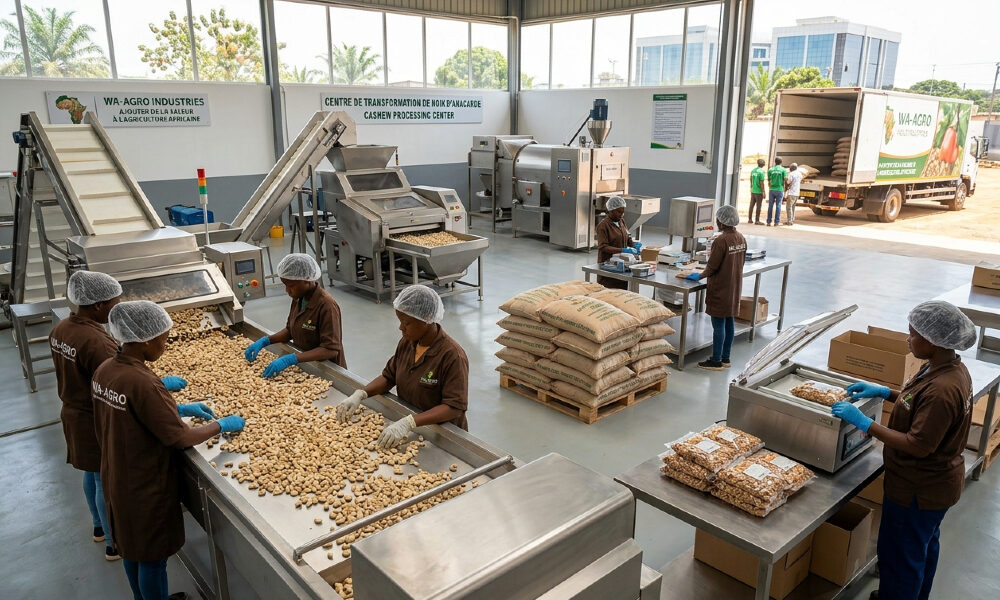
Africa produces the cashew. Africa produces the shea. Africa produces the cocoa. Africa produces the soy. And for decades, the industry has celebrated a modest kind of progress: moving from raw material to semi-processed product. Cashew nuts become kernels. Shea nuts become butter. Cocoa beans become powder. Soybeans become crude oil.
That is progress, and it deserves recognition. But it is not where agro-industrialization should end – it’s barely the midpoint.
A cashew kernel is still just an input. Shea butter is still just an input. Cocoa powder is still just an input. The real prize, the one Africa keeps leaving on the table, sits one or two steps further down the value chain: the roasted, branded cashew on a supermarket shelf; the skincare line built on African shea; the chocolate bar made from African cocoa; the packaged food product made from African soy. That is where the margins live. That is where the brand equity accumulates. And that is where multinational companies – not African producers – have historically captured the value.
It Was Never Really About the Money
It’s tempting to assume multinationals dominate finished-goods manufacturing because they have deeper pockets. Capital matters, but it isn’t the decisive advantage. The real moat is systems: procurement systems, production systems, quality-control systems, management systems, marketing systems, sales systems, and financing systems, all integrated and running in concert.
I learned this the expensive way. When we set out to build a processing business, we tried to fix branding, product development, financing, and operations all at once. It didn’t work – we lost money learning that lesson. What did work was sequencing the problem: get the product right first, then the packaging, then the branding, then the operating systems underneath all of it. Financing, we discovered, becomes dramatically easier to attract once those fundamentals are in place. Investors don’t fund raw ambition; they fund systems that already work.
The Unicorn Hiding in Plain Sight
This is the insight I keep coming back to: the next great African agribusiness will not be defined by owning a single processing factory for a single raw material. It will be defined by integrating the entire chain – procurement, primary and secondary processing, packaging, branding, and financing – into one coherent operating system.
That integration is the real competitive moat, for one simple reason: if you don’t get procurement right, nothing downstream can be right either. Poor sourcing corrupts quality, corrupts cost structure, and eventually corrupts the brand. African operators already hold a genuine advantage here – an intimate, hard-won understanding of local sourcing conditions that outsiders spend years trying to replicate. The task now is to build world-class systems on top of that advantage, rather than exporting the advantage itself in raw form and letting someone else build the systems around it.
Capturing Value at Every Step
I believe the defining African agribusinesses of the next decade won’t simply export more tonnage of raw or semi-processed goods, though that will continue. They will capture value at every link in the chain: from farm to finished product, from farmer network to factory floor, from factory to retail shelf – not just in Accra or Lagos, but in Paris, London, and New York.
That is the company Africa needs to build. It’s ambitious, it’s harder than exporting kernels and butter, and it will require patience that raw-material trading never demanded. But it’s also the only path that keeps the value where the value was created.
That is the kind of company we are building.
Curtis Akunfu is the Managing Director of Duapa Agri, a vertically integrated agribusiness operating across West and East Africa. With nearly 20 years of leadership in Africa’s agri-commodities sector, he also serves as a Global Council Member and Chair of the Agricultural Finance and Investment Working Group at the World Agriculture Forum.