Business
African leaders set for Continental Free Trade Area Deal
“No country or region can manage on its own. We have to be functional, and we have to stay together.“
–Rwandan President Paul Kagame
African leaders concluded the 30th Ordinary Session of the Assembly of the African Union, with the summit adopting a series of decisions on issues related to continental economic integration – including on the next steps for the Continental Free Trade Area (CFTA), as well as the free movement of people and air travel.
The summit in Addis Ababa, Ethiopia, also saw participants discuss progress towards realizing the continent’s own development vision, Agenda 2063, as well as the UN’s 2030 Agenda for Sustainable Development.
The African Union (AU) and the UN signed a framework agreement on implementing those two broad development-oriented agendas in a mutually supportive way.
High on the meeting agenda was the fight against corruption, a topic chosen as this year’s summit theme. Various African leaders emphasized that despite a growing recognition of the necessity to tackle this problem, more work needs to be done at all levels.
“We must seize the opportunity of the theme of this year on the fight against corruption to take decisive action against this scourge that impedes development and undermines social cohesion,” said Moussa Faki Mahamat, Chairperson of the AU Commission, in his address to the meeting.
The summit was also marked by the election of Rwandan President Paul Kagame as the new AU chairperson. He succeeds Guinean President Alpha Condé and will guide the work of the organization over the coming year.
Establishing the CFTA
African leaders agreed to hold an extraordinary summit on 21 March in Kigali, Rwanda, with the goal of considering legal texts related to the CFTA and signing the agreement establishing the free trade area.
It will be preceded by an extraordinary session of the Executive Council on 19 March, also in Kigali.
“Scale is essential. We must create a single continental market, integrate our infrastructure, and infuse our economies with technology. No country or region can manage on its own. We have to be functional, and we have to stay together,” said Kagame in his opening remarks to the AU Assembly.”
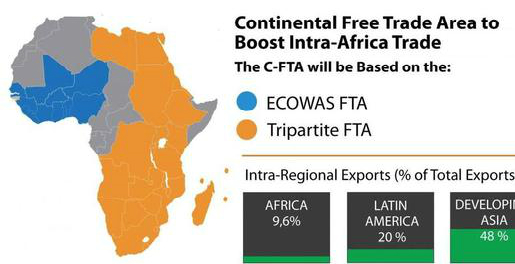
The projected mega-free trade area is expected to bring together the 55 members of the AU into a continental market with a cumulative gross domestic product GDP exceeding US$3.4 trillion and a total population of over 1 billion people.
If concluded and implemented successfully, it would become the largest free trade area in the world in terms of membership.
Negotiations towards establishing the CFTA were launched in 2015 with the initial goal of concluding a 1st phase covering trade in goods and services by the end of 2017. Despite significant progress achieved at the end of last year, however, sources say that members are still working to finalize talks on all aspects related to phase 1 negotiations.
Phase 2 will move the talks towards discussing topics such as competition policy and intellectual property.
While negotiators completed their work on the agreement establishing the Continental Free Trade Area and the Protocol on Trade in Services in November 2017, additional discussions are needed to resolve remaining sticking points involving trade in goods. This includes aspects related to rules of origin, sensitive and excluded products, trade remedies, and infant industries.
Negotiations resumed this week with a view towards bridging remaining differences ahead of the March summit, and the process of legal scrubbing is currently underway for the texts that have already been finalized.
The AU also announced last week at the summit a “strategic partnership” with the AfroChampions Initiative, a group of public-private projects driven by well-known African government officials and business leaders. This new collaboration will aim to promote the CFTA by boosting engagement with the continent’s entrepreneurs.
“By sharing the reflections of its members and their ‘on-the-ground’ experience, the AfroChampions Initiative will allow us to develop more relevant approaches on many technical subjects – especially with regards to common customs tariffs, facilitation of intra-African trade, and free movement of workers, goods, and capital,” said Albert Muchanga, the AU Commissioner for Trade and Industry.
Free Movement of people
In another effort to strengthen continental integration, the AU Assembly adopted a protocol that provides for the progressive implementation of free movement of people, right of residence, and right of establishment on the continent, as well as a related draft implementation roadmap.
While many observers have noted that free movement of people could play a central role in unleashing the continent’s economic potential, some have also warned that implementing this policy in practice will require real commitment from member states, which could prove challenging given the divisions which have emerged during the discussions so far.
While describing the importance of having the CFTA in place, Kagame said that “freedom of movement for people in Africa is equally important,” and suggesting that in his view the goal could be reached this year.
The AU summit also saw the formal establishment and launch of the Single Market for Air Transport in Africa (SAATM), a move aimed at enhancing connectivity at a continental level and developing the aviation and tourism sectors.
“This is an initiative whose execution has been long awaited,” noted AU Commission Chairperson Moussa Faki Mahamat.
So far, 23 member states have committed to the immediate implementation of the 1999 Yamassoukro decision, which provides for the liberalization of air transport services on the continent. They will be the initial members of the SAATM. This list includes Benin, Burkina Faso, Botswana, Cape Verde, Republic of Congo, Ivory Coast (Côte d’Ivoire), Egypt, Ethiopia, Gabon, Ghana, Guinea Conakry, Kenya, Liberia, Mali, Mozambique, Nigeria, Rwanda, Senegal, Sierra Leone, South Africa, Swaziland, Togo, and Zimbabwe.
“The realization of a Single African Air Transport Market is vital to the achievement of the long-term vision of an integrated, prosperous, and peaceful Africa under the AU Agenda 2063,” said an AU press release.
Like the CFTA and the free movement of people, the creation of a unified air transport market in Africa is among the flagship projects of the first ten-year implementation plan of Agenda 2063.
“By committing to break down these barriers, we will send a tremendous signal in Africa and beyond, that it is no longer business as usual,” said Kagame at the AU summit.
Source: International Centre for Trade and Sustainable Development