Business
Africa on track to becoming the largest free trade area in the world
Transport Infrastructure Driving Boost in Africa’s Cross Border Trade
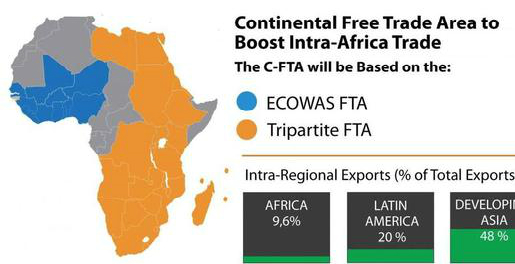
Africa could soon be the largest free-trade area in the world. This is if the African Union’s Continental Free Trade Area (CTFA) stays on track to be operational by the end of this year.
Once up and running, the continent-wide free trade zone could lead to a 52 percent (US$35 billion) increase in intra-African trade within the next 5 years, according to the United Nations Economic Commission for Africa (UNECA).
According to Stephen Karingi – the Director of the Capacity Development Division within the UNECA – boosting intra-African trade is the most effective way to speed up Africa’s economic transformation. Karingi added that “trade contributes towards industrialization and structural transformation.”
Increasing intra-African trade – which reportedly stands at 13 percent – will require the removal of certain barriers in order to improve connectivity, including improvement of custom procedures, reduction of transit and other trade costs, and, importantly, development of reliable transport infrastructure. Here’s a look at some of the inroads that have already been made in the expansion of Africa’s rail, road, and port networks to connect the fragmented African market.
Ethiopia – Djibouti rail link
This year saw the launch of the first fully electric cross-border railway in Africa. Linking Ethiopia’s capital Addis Ababa with Djibouti’s capital, Djibouti City – a stretch of more than 750 kilometers (466 miles) – the new line will incredibly cut travel time between both countries.
The rail journey, which lasts about 3 – 4 days by road, now only takes 12 hours. Each freight train reportedly transports the same cargo as at least 200 trucks, with the cost reduced by a third.
The rail link, which cost US$4.2 billion, is a significant step towards elevating the poor levels of trade between African countries.
Ethiopia is looking to construct another 5,000 kilometer (3,100 mile)-long network of rail by 2020, linking to Kenya, Sudan and South Sudan.
The Trans-African Highway
The Trans-African Highway is an ongoing network of highways intended to connect all corners of Africa from north to south, east and west.
The ambitious plan, which was initially proposed in 1971, is aimed at boosting internal trade on the continent by building 9 roads linking major cities across Africa. Those networks would collectively measure nearly 60,000 kilometers (37,000 miles).
While progress has been slow, the completion of this project will mark a new day for intra-African trade.
One of the 9 planned roads is already complete – the 4,400 kilometer (2,700 mile) Trans-Sahelian Highway which runs through 7 countries, connecting Dakar, Senegal to Ndjamena, Chad.
While more than half of the network has been paved, maintenance remains an issue. Conflicts in countries such as the Democratic Republic of Congo, and formerly in Sierra Leone, Liberia, and Angola have led to both the destruction of some highways and hampering of construction.
Doraleh Multipurpose Port
Djibouti recently opened its new 690 hectare (1,700 acre) Doraleh Multipurpose Port after 2 years of construction. The US$590 million project, one of the most advanced ports on the continent in terms of facilities, is capable of handling at least 9 million tonnes of cargo per year.
Djibouti has become one of the important trading hubs on the continent, thanks to its convenient geographic location of connecting Africa to Asia and Europe by sea. Ports in this tiny east African country of less than a million people receive the bulk of cargo from Asia, followed by Europe, and then Africa.
West Africa Regional Rail Integration
A group of West African countries have invested significantly into an ongoing extensive rail project which will boost trade in the region. When completed, the track will be 3,000 kilometers (1,860 miles) long and connect Niger, Benin, Burkina Faso, Ivory Coast (Côte d’Ivoire), Ghana, Nigeria and Togo.
The network will add newly built tracks to existing ones which will be upgraded. This project will greatly benefit landlocked countries like Niger, which face constant transport problems. Niger largely relies on its neighbors’ seaports and road infrastructure to carry its imports and exports.
The West African Regional Rail Integration project is a response to the need for better infrastructure and reliable transport to move minerals from one West African country to another, and from the mines to major ports.
The Port of Bagamoyo
With its Port of Dar-es-Salaam, Tanzania is among the major trading hubs in Africa. Now the east African country is aiming to take things up a notch with the development of Bagamoyo Port, which is set to cost US$11 billion.
While the new Tanzanian government has paused construction to focus on revamping other ports, Bagamoyo is set to be the biggest port in east Africa when completed. It will handle 20 million containers a year – more than double the capacity of the Port of Dar-es-Salaam.
If everything goes as planned, Bagamoyo will boost Tanzania’s reputation as a trading center and hub for its landlocked neighbors such as Zambia, Rwanda, Malawi, Burundi, Uganda and the Democratic Republic of the Congo.
East African Rail Masterplan
Billed as Kenya’s largest infrastructure project since independence, the first section of the US$13.8 billion railway officially opened in June 2017, connecting the capital Nairobi with the port city of Mombasa. The train has shortened travel time between the two cities from 12 hours to 4, with freight trains set to carry 25 million tonnes a year.
The east African rail Masterplan will eventually extend to Uganda, Rwanda, South Sudan, and Ethiopia – a move that will further strengthen trade relations between the east African neighbors.
Source: CNBC Africa