Opinion
Africa: The World’s Final Untapped Market


By Victory Azimih
For much of the past half-century, analysts speculated about when Africa would “rise.” That question is now obsolete.
The real issue is how fast the continent is accelerating – and which governments, investors, and companies will be positioned to benefit from its transformation.
Africa is no longer a continent of potential. It is a continent of momentum – driven by demographics, digital disruption, natural endowments, and a new generation of globally savvy entrepreneurs.
The world is beginning to take notice. Smart investors, forward-looking policymakers, and agile businesses are positioning themselves not for Africa’s future, but for its present.
1. The Demographic Dividend Is Here
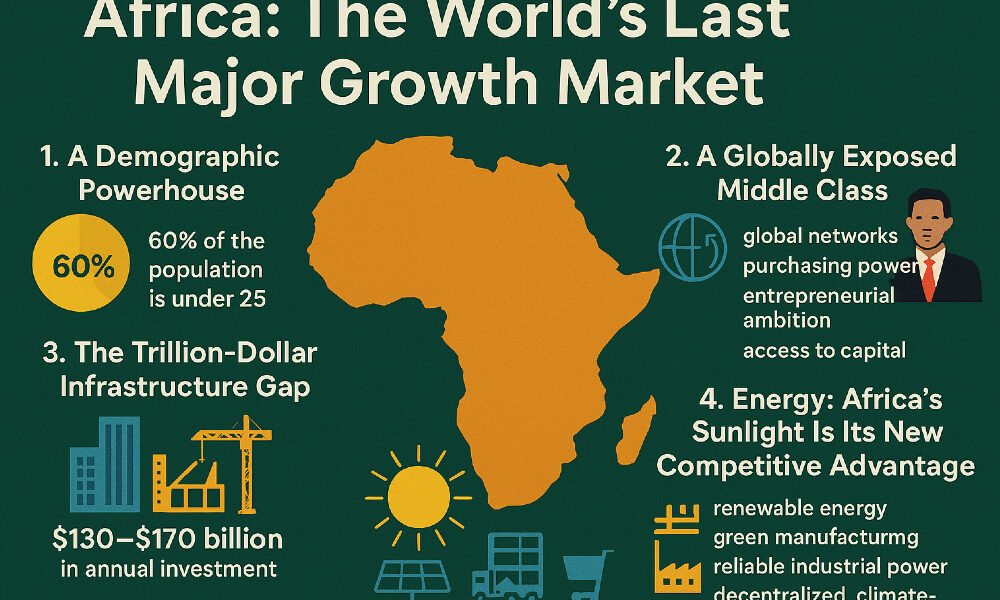
Africa is the world’s youngest continent: 60 percent of its 1.4 billion people are under 25. By 2050, one in three of the world’s youth will be African – a stark contrast to aging populations in Europe, East Asia, and North America.
This isn’t just a statistic. It’s a strategic asset: a vast, growing labor force, a rising consumer base, and a reservoir of untapped talent.
In an era defined by labor shortages and shrinking workforces elsewhere, Africa’s youth represent the last major demographic dividend.
2. Globally Connected Middle Class Is Reshaping Demand
Millions of African families have educated their children in the U.S., the U.K., Canada, Europe, and Asia. Many of these graduates are now returning home – not out of necessity, but by choice.
Armed with international experience, digital fluency, access to capital, and entrepreneurial drive, they are redefining consumption, launching high-growth ventures, and demanding quality goods and services. This emerging middle class isn’t just buying – it’s building.
3. Infrastructure: A $170 Billion Annual Opportunity
Rapid urbanization is straining cities – but also creating unprecedented demand for modern infrastructure. The African Development Bank estimates the continent needs US$130–170 billion annually in infrastructure investment, with a current financing gap of nearly US$70 billion.
From smart grids and logistics hubs to affordable housing and last-mile digital connectivity, this gap isn’t a liability – it’s a blueprint for investment. For firms that can navigate complexity and deliver at scale, Africa’s infrastructure deficit is a multi-decade opportunity.
4. Solar Energy: Africa’s Strategic Advantage
As the world races toward net zero, Africa holds an unmatched endowment: sunlight. The Sahara alone receives enough solar radiation in a single day to power Europe for a full year.
Many regions enjoy over 5,000 hours of sunshine annually – among the highest in the world.
This solar abundance positions Africa not just as a clean energy producer, but as a future hub for green manufacturing, data centers, and energy-intensive industries. Decentralized solar systems are already powering clinics, schools, and agro-processors – proving that energy access can leapfrog legacy grids entirely.
Sunlight, in this context, is more than a resource – it’s a pathway to industrial sovereignty.
5. The Continent’s Underutilized Assets
Consider this:
- Africa holds 65 percent of the world’s uncultivated arable land – critical in an era of food insecurity.
- It possesses vast reserves of cobalt, lithium, graphite, and rare earths – the very minerals powering electric vehicles and artificial intelligence.
- Its digital economy is growing faster than almost any other region’s, with fintech, e-commerce, and edtech scaling rapidly.
- Its creative industries – from Afrobeats to Nollywood – are capturing global audiences and reshaping cultural exports.
Africa isn’t “emerging.” That framing is outdated. Africa is the final major frontier of global growth.
6. Where to Play: Strategic Sectors for the Next Decade
Forward-looking investors are already allocating capital to high-impact sectors:
- Utility-scale and distributed solar energy
- Agro-processing and food systems innovation
- Industrial manufacturing and local value addition
- Critical mineral beneficiation
- Smart urban infrastructure and digital logistics
The goal isn’t just extraction or import substitution – it’s building integrated, resilient value chains that serve African consumers and global markets alike.
This Is the Decade of African Agency
Africa is not the “next” big thing. It is the last large, undercapitalized, high-growth market in a world of diminishing returns.
For investors, founders, policymakers, and students of global trends, the time to engage is now – not in five years, not after “stability” arrives, but today.
The transformation is already underway. The question isn’t whether Africa will rise – it’s whether you will be part of its ascent.
Victory Azimih is a visionary entrepreneur and global investment consultant specializing in Africa’s economic growth and industrial transformation. As the CEO and founder of Azeemi Global, he leads a pioneering firm dedicated to accelerating the continent’s development through cutting-edge technology and infrastructure solutions. Under his leadership, Azeemi Global focuses on harnessing the potential of artificial intelligence, blockchain, and smart infrastructure to unlock sustainable investment opportunities across Africa. Based in Lagos, Nigeria, Azimih is at the forefront of driving Africa’s future as a hub of innovation and industrialization.