Opinion
Africa: The Next Exponential Growth Market


By Des H Rikhotso
While Western investors obsess over basis points in saturated markets, a more compelling story is unfolding across Africa. The continent is not simply growing; it is experiencing the kind of structural transformation that produces generational wealth – the sort that made fortunes in post-war Japan, 1990s China, or early-2000s India.
Yet remarkably, it remains underweighted in most institutional portfolios.
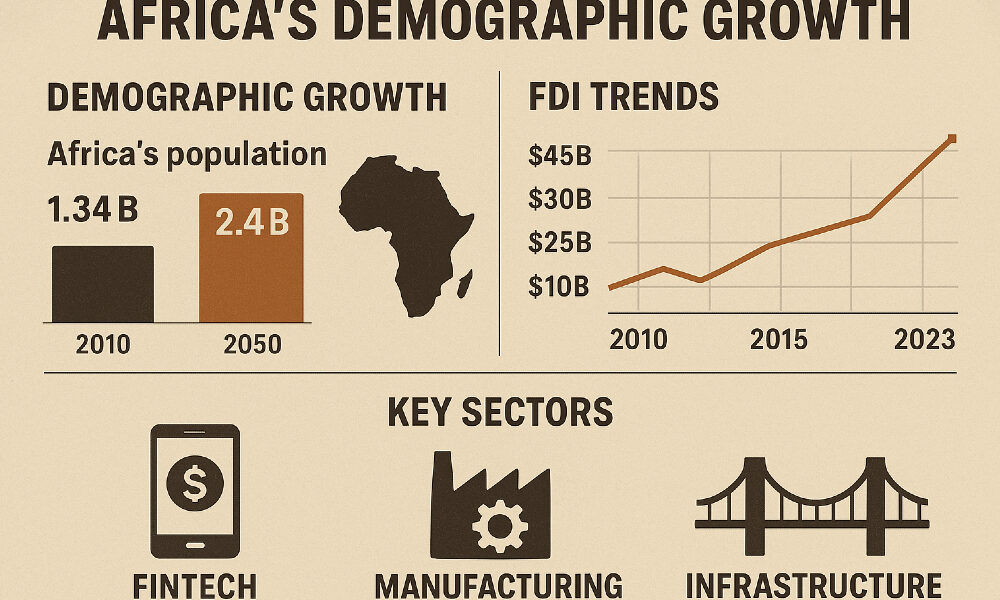
The mathematics alone should command attention. Africa’s population, already exceeding 1.4 billion, is expanding faster than any other region on Earth.
By 2050, one in four people globally will be African. This is not merely a demographic curiosity; it represents the emergence of hundreds of millions of new consumers entering the formal economy precisely when traditional markets have exhausted their growth potential.
The Urban Transformation
Africa’s urbanization is occurring at a pace that dwarfs historical precedent. Cities like Lagos, Nairobi, and Addis Ababa are expanding with breathtaking velocity, creating concentrated markets with increasingly sophisticated demand.
This urban migration is fundamentally different from rural poverty displacement; it signals the birth of a consumer class with rising incomes, aspirations, and purchasing power.
Where cities emerge, infrastructure follows – and with it, opportunity. The demand spans the entire economic spectrum: fast-moving consumer goods, pharmaceuticals, construction materials, industrial machinery, and technology.
These are not niche markets. They represent foundational industries serving hundreds of millions of people.
The ROI Equation
Consider the alternative. Developed markets offer low single-digit growth amid suffocating competition.
Every percentage point of market share is contested by entrenched incumbents with deep pockets and decades of relationships. Margins compress.
Innovation yields diminishing returns.
Africa presents the opposite proposition. First-mover advantages remain available across entire sectors.
Competition is nascent. Growth rates regularly reach double digits.
For businesses willing to navigate complexity and commit to long-term value creation, the returns can be extraordinary. This is not speculation; it is the fundamental economics of emerging markets before they emerge fully.
Capital is Paying Attention
Savvy investors have noticed. India, China, the UAE, and the European Union have dramatically increased Africa-focused investments in recent years, recognizing what the data increasingly confirms: Africa is positioning itself as a critical node in global supply chains and manufacturing networks.
This investment shift reflects more than opportunism. As geopolitical tensions fracture established trade relationships and companies seek to diversify away from concentrated production centers, Africa offers geographic advantages, abundant resources, and increasingly favorable business environments.
The continent is not merely a consumer market; it is evolving into a production powerhouse.
The Infrastructure Imperative
None of this happens without infrastructure, and here too, the transformation is tangible. Power generation projects are multiplying across the continent, addressing chronic energy deficits that have long constrained industrial development.
Water and irrigation systems are expanding agricultural productivity. Road networks and logistics capabilities are improving, reducing the transaction costs that once made doing business prohibitively expensive.
Local manufacturing is taking root, reducing dependence on imports and creating employment at scale. Mining operations are modernizing with advanced machinery, while agriculture is mechanizing, boosting yields and food security.
These are not isolated initiatives but interconnected developments that reinforce one another, creating virtuous cycles of growth.
Digital Leapfrogging
Perhaps most striking is Africa’s embrace of technological disruption. Unconstrained by legacy systems, the continent is leapfrogging directly to cutting-edge solutions.
Mobile money has revolutionized financial inclusion, bringing millions into the formal economy without the need for traditional banking infrastructure. E-commerce platforms are connecting consumers with goods and services in ways that bypass decades of retail evolution.
Renewable energy projects are proliferating, driven by abundant solar and wind resources and declining technology costs. Smart logistics networks are emerging, using real-time data to optimize supply chains.
This is not a slow, incremental modernization; it is a wholesale reimagining of economic infrastructure for the digital age.
The Contrarian Opportunity
Markets reward those who see clearly what others overlook. Africa’s growth trajectory is not hypothetical – it is already underway, visible in GDP figures, foreign direct investment flows, and the rapid expansion of middle-class consumption.
The question is not whether Africa will grow, but whether investors will position themselves early enough to capture the returns.
Traditional markets will continue to matter, of course. But the truly asymmetric opportunities – the investments that generate outlier returns – increasingly lie elsewhere.
For those willing to look beyond conventional wisdom and engage with complexity, Africa represents not merely a growth market, but the growth market of the coming decades.
The continent’s moment has arrived. The only question is who will be there to meet it.
Des H Rikhotso (PgDip-BA, MBL) is a seasoned C-suite Multi-Industry business executive with 25+ years of Business Leadership Experience across the South, East and Western Sub-Sahara Africa Region. Based in Kampala, Uganda he serves as East Africa Region Business Executive, driving Business Strategic Growth and Operational Excellence – contributing his Leadership Voice and Clarity to the Region. Des has held Business Leadership roles at BMW Group Africa, Volkswagen Group Africa, Peugeot Motors South Africa, Toyota/Lexus South Africa, Nissan Group of Africa, G.U.D Holdings (Africa Exports Operations Division) and The HDR Group of Companies. He holds Under-Graduate and Post-Graduate business degrees from the University of the Western Cape, Wits University (Wits Business School) and the University of South Africa.