Opinion
Africa poised to play a major role in the world
By David Pilling
Despite massive problems, vast continent is faring better than many people imagine.
Journalists, as Hans Rosling, the late Swedish health expert and statistician, noted, are better at capturing fast-moving catastrophes than slow-moving improvements. An Ebola outbreak makes headlines. The slow success of a vaccination campaign does not.
Partly as a result, public perception of countries or regions often lags reality. So it was with China in the early 2000s when many continued to think of the country as poor and backwards. So it is with Africa today.
It is impossible to generalize about the 54 countries that make up the vast continent. Some nations, such as Somalia, Central African Republic and Burundi, are locked in seemingly never-ending civil strife. Meanwhile, Nigeria, South Africa and Angola – the should-be motors of the continent – have been stuck in economic slow motion. Yet, notwithstanding widespread poverty and huge social problems, Africa in general is doing better than many imagine.
Much changed for the continent about the turn of the century when at least 2 events helped galvanize a period of rapid growth and – when the resulting windfalls were not squandered – development. First was the Heavily Indebted Poor Country (HIPC) Initiative, whereby US$100 billion of multilateral, bilateral and commercial debt was forgiven in 30 African countries. The move gave them the chance to escape from the burden of endless debt servicing.
Second was the entry of China into Africa. In 2000, trade between China and Africa was about US$10 billion, according to the China Africa Research Initiative (CARI) at Johns Hopkins School of Advanced International Studies in Washington. By 2017, that had risen to US$148 billion, and even that was down from the 2015 peak of more than US$200 billion.

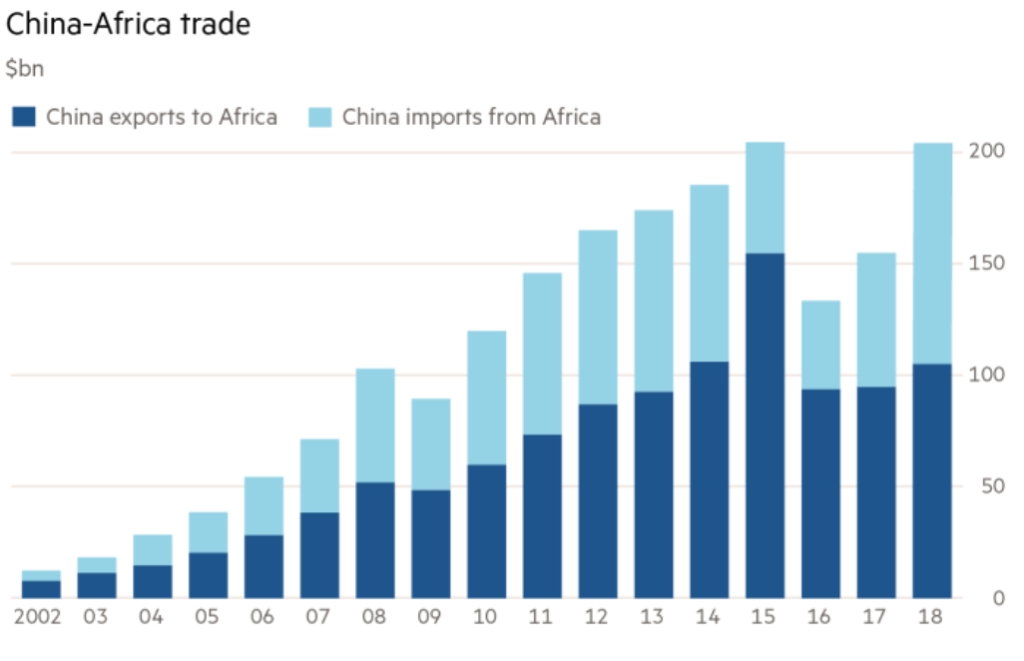
Data Sources: UN Comtrade 2002-17; Chinese customs
Over the same period to 2017, China’s government, development banks and contractors extended US$143 billion of loans to African governments and state-owned enterprises, according to CARI. The result was a flurry of construction of roads, ports and airports in a continent crying out for better infrastructure.
Although there have been concerns that countries such as Angola and Zambia may be stoking another debt crisis and that China is acting like a neocolonial power, many Africans argue that China’s arrival has been of net benefit to the continent. “There are many positives to the Africa-China relationship,” says Tito Mboweni, finance minister of South Africa, who attributes some of the negative attitude to western propaganda. “They don’t want Africans to do business with the Chinese because there’s this notion that somehow Africa is their backyard.”
In China’s wake have come others, including Turkey, India, Brazil and the Gulf states, all of which have imagined a commercial and strategic opportunity in Africa that their western counterparts have been slower to spot.
In population terms, Africa is the continent that will see the most growth over the next decades. By 2050, its population is forecast to more than double to 2 billion. By the end of the century it is likely to double again, at which time more than 1 in 3 people on earth will be African. Although that will pose vast challenges for governments seeking to improve living standards, it does mean that in brute aggregate terms African markets are likely to grow for decades.
“The new actors are seeing opportunities because of demographics and developments that show Africa is going to play a major role in the world,” says Carlos Lopes, a development economist from Guinea Bissau and former executive secretary of the United Nations Economic Commission for Africa (UNECA).
In the years after 2008 when investors were looking for the next great frontier, these trends fueled the shortlived era of the “Africa Rising” narrative. Although that hyperventilating term was overdone, it opened some people’s eyes to the continent’s potential. These developments have been accompanied by tangible, if uneven, improvements in governance and living standards.
Africa is no longer the continent of coups and civil wars. In 1990, 12 African leaders owed their position to a military overthrow, with only 6 in charge as a result of multi-party elections, according to the Brookings Institution. By 2016, 45 leaders had gone through a multi-party process. Admittedly some of those exercises in democracy, such as the recent disputed contest in Democratic Republic of Congo, are little more than a sham. But in sub-Saharan Africa almost no government owes its position directly to a coup, the recent military overthrow of Omar al-Bashir in Sudan notwithstanding.
In areas from health to steadily expanding economies, the picture is of gradual improvement. Last year, 6 of the world’s fastest-growing economies – Côte d’Ivoire (Ivory Coast), Djibouti, Ghana, Ethiopia, Senegal and Tanzania – were African. With a slightly different cast, that feat is likely to be repeated this year.
Life expectancy has also improved. A newborn baby in Africa today has an average lifespan of 65 years. Although that lags western Europe by 17 years, it is a far cry from a few decades ago when the crises of AIDS, malaria and tuberculosis had cut life expectancy to below 50 in several African countries.
The news is far from all good. Many African nations face challenges from climate change to inadequate public health and education. On almost all development measures, most lag the rest of the world. Though the continent is urbanizing, most cities are chaotic. Few countries have escaped the extractive models that see them sell low-value-added commodities to rich nations.
According to the Ibrahim Foundation, which tracks governance, African democracy has gone into reverse. In east and central Africa, some leaders have changed the constitution to prolong their rule or held flawed elections.
“What our people need is to have a vision, a 10, 20 or 30-year vision,” says Napoleon Dzombe, a Malawian businessman and philanthropist.
Yet, despite all this, the idea that African countries can grow their way out of poverty has gained traction, says Lopes, the development economist who is an Afro-optimist.
A country that has epitomised steady improvement is Ethiopia. In spite of its volatile political situation and – until recently at least – autocratic government, the country of 105 million people has changed greatly over the past 30 years. Today it is more likely to be associated with skyscrapers and the push for middle-income status than with the famines that defined its image in the 1980s.
Health and education indicators have improved and the country has recorded a decade of growth averaging about 8 percent. “Development for me is about the income level in my society increasing every year,” Abiy Ahmed, Ethiopia’s prime minister, said earlier this year.
“The level of ambition from leaders has gone up,” says Lopes, who sees a continent that – for all its problems – is brimming with energy. “This is the continent with the youngest population in the world. It will lead to a transition different from anywhere else.”
The Financial Times © Copyright 2019