A Diaspora View of Africa
Africa Must Be Wary of Its Allies


By Gregory Simpkins
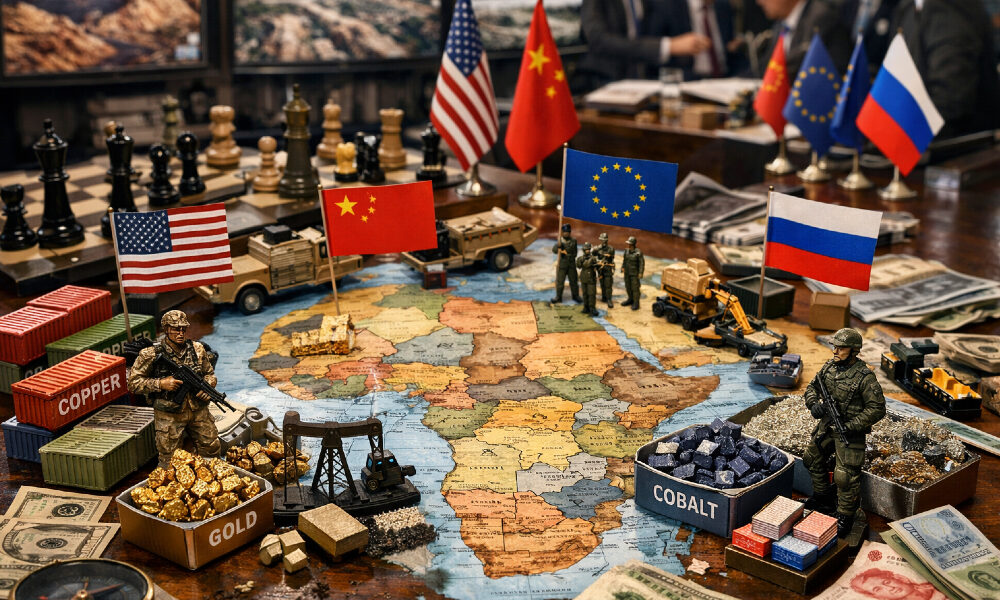
Recently, I wrote about the need for Africa governments to protect their natural and human resources and the need for African leadership to be dedicated to that purpose. This is particularly important during this new Scramble for Africa, where developed nations are increasingly desperate for African resources.
Transactional Partners and Conditional Engagement
Here are some at least nominally positive potential partners for African countries:
United States: The US is revitalizing its engagement with Africa, focusing on trade, investment and security partnerships. The Trump administration launched a new Commercial Diplomacy Strategy in Africa, aiming to increase American business presence on the continent, but US commercial engagement on the continent is undercut by the global tariff regime that also hits African nations, some harder than others.
African governments have quickly picked up on the transactional nature of US engagement and acted accordingly in their encounters. President Donald Trump has used peacemaking in the Great Lakes and Sudan, for example, as an entrée to business dealings for mineral production.
African countries want a “big brother” to come in to mediate conflicts. However, as has been the case with Rwanda, if the African leadership isn’t committed to fulfilling agreements, then no peace process will work.
The same is true in Sudan, where there is concern about a further schism involving the Darfur region in the country that saw South Sudan secede several years ago.
Emerging Middle Powers and Development-Oriented Models
India: India has elevated its relationship with Ethiopia to a Strategic Partnership, signing agreements on defense, technology, and economic cooperation. Prime Minister Narendra Modi emphasized shared goals of development and democracy.
India is also the second largest lender in Africa, with strong public-private partnerships and safeguards protecting borrowers from debt distress. In fact, most Indian aid is channeled through the African Development Bank (AfDB), which New Delhi joined in 1983.
India’s total investments in Africa amount to US$70 billion, a figure the powerful Confederation of Indian Industry aims to increase to US$150 billion by 2030.
Canada: Canada has launched its first global Africa Strategy, prioritizing economic cooperation, peace and security partnerships. The strategy includes expanding diplomatic engagement, increasing trade, and providing humanitarian assistance.
Over the past five years, Canada has significantly stepped up its political engagement with Africa. This has included leader-level dialogues with the African Union Commission, the naming of new special envoys, a new embassy and two new high commissions.
Canada has invested approximately US$4.5 billion in bilateral international assistance programming in Africa over the past five years to build African economies, support health and education and respond to humanitarian needs. International assistance for Africa has increased by 52 percent over the past eight years.
In 2024, the value of Canada’s merchandise trade with African countries totaled US$15.1 billion, an increase of nearly 30 percent in 5 years.
Japan: Japan is investing in Africa’s infrastructure and economic development through initiatives like the Alliance for Green Infrastructure in Africa (AGIA), aiming to leverage US$3 billion in private sector investment. Over the next three years, the Japanese government expects to raise US$1.5 billion for impact investment in Africa with the goal of reducing greenhouse gas emissions and promoting sustainable growth on the continent.
According to the Ministry of Foreign Affairs, the funds will be raised by the Japan International Cooperation Agency in collaboration with private investors. Impact investment, which aims to generate profits as well as demonstrable social and environmental benefits, has grown in popularity throughout the world.
Europe’s Strategic Dependence and Africa’s Resource Leverage
The Global Impact Investing Network (GIIN) estimated that last year the industry generated US$1.57 trillion in assets under management worldwide. Japan’s US$1.7 trillion Government Pension Investment Fund announced ambitions to enter the market, as reported by Bloomberg.
European Union: The EU is strengthening ties with Africa, focusing on green energy transitions, sustainable development and economic cooperation. The EU has committed to investing US$80 billion in Africa’s private sector over the next five years.
The EU is Africa’s largest trading partner and investor. According to European Commission President Ursula von der Leyen, one-third of all African exports go to Europe.
Many African countries have critical raw materials that Europe needs for its energy transition and industry: rare earths, copper, cobalt and lithium. However, there is much competition, and Africa wants to avoid unilateral dependencies as occurred during and after colonialism.
China’s Evolving Approach
Two other major African partners carry problematic conditions regarding their involvement. For quite some time, China was widely criticized for allegedly creating “debt traps” that resulted in Chinese ownership of African resources.
Monopolizing African minerals didn’t result in benefits for African countries or populations by any significant measure. In recent years, China has attempted to overcome this earlier criticism by promoting manufacturing in Africa.
As part of an overall effort to improve African relations and as a counter to the US global tariff regime enacted earlier this year, China announced in June a zero-tariff policy for all products from 53 African countries – excluding eSwatini.
This is expected to take effect once negotiations and the signing of individual economic partnership agreements with each participating country are complete.
However, South Africa, China’s largest trade partner in the continent, and other Southern African Customs Union (SACU) members are encountering an unforeseen barrier to enjoying Beijing’s zero-tariff policy. The hurdle is eSwatini’s continued diplomatic recognition of Taiwan and hence exclusion from the favorable policy.
SACU customs deals are negotiated collectively among the five member states, which means none can unilaterally benefit from the preferential tariff exemption. Beijing sees Taiwan as part of China to be reunited by force if necessary.
Most countries, including the United States and the rest of Africa, do not recognize Taiwan as an independent state. But Washington is opposed to any attempt to take the self-ruled island by force and is committed to supplying it with weapons.
John Steenhuisen, South Africa’s minister of agriculture, said in a December 7 interview with MyNews that duty-free access to China had been rendered “quite complicated” as the country is part of SACU, whose other members are Botswana, Lesotho and Namibia.
SACU’s collective bargaining agreement prevents individual members from accessing Beijing’s zero-tariff deal, so the exclusion of eSwatini over its recognition of Taiwan means all five are excluded. “It is still unclear how South Africa is going to get around our SACU agreement,” Steenhuisen said.
Russia’s Security Focus
As for Russia, the other major international African partner. It’s focus on arms and security not only haven’t produced positive results in the war against Islamist extremists but have instead been aimed at protecting the ruling regimes at the expense of African citizens.
Due to its human rights blind approach and adeptness at tapping into anti-Western grievances, Russia remains a partner of choice for many authoritarian regimes in Africa.
Russia’s appeal is exemplified by the proliferation of its military instructors and security agreements. At the July 2023 Russia-Africa Summit in St. Petersburg, President Vladimir Putin declared that Russia had 40 extant military-technical agreements with African countries.
These pacts, which encompass counterterrorism, maritime security and police training, open the door for more Russian arms sales to Africa.
A new Russian military unit that replaced the Wagner mercenary group is allegedly carrying out abuses including rapes and beheadings as it teams up with Mali’s military to hunt down extremists, dozens of civilians who fled the fighting have told the Associated Press.
The Africa Corps is using the same tactics as Wagner, the refugees said, in accounts not reported by international media until now. Two refugees showed videos of villages burned by the “white men.”
Two others said they found bodies of loved ones with liver and kidneys missing, an abuse the AP previously reported around Wagner.
“It’s a scorched-earth policy,” said a Malian village chief who fled. “The soldiers speak to no one. Anyone they see, they shoot. No questions, no warning. People don’t even know why they are being killed.”
In light of the supposed turnaround in international partnerships with African countries, even Russia is now pledging to get in on the development train. Sergey Vershinin, the deputy foreign minister of Russia, has stated that Moscow plans to help Africa achieve a new wave of independence, this time in the form of economic autonomy.
“After the achievement of the historical goal of political independence by African countries in the 1960s with the support of the USSR, today the African continent faces an equally important and, most likely, no less difficult task,” Sergey Vershinin told Russian media.
The Path Forward: Ensuring Actions Match Words
Aside from the more problematic Chinese and Russian interventions, African governments must ensure that development cooperation promises by other nations are more than mere words. The days of raw materials being shipped out of Africa only to return as paid-for processed goods must end.
According to the rhetoric, that is the international plan for Africa moving forward from now. One hopes the actions match the words.
Otherwise, African nations will end up virtually as they did as a result of the first Scramble for Africa – under the economic thumb of outside powers.
Gregory Simpkins, a longtime specialist in African policy development, is the Principal of 21st Century Solutions. He consults with organizations on African policy issues generally, especially in relating to the U.S. Government. He further acts as a consultant to the African Merchants Association, where he advises the Association in its efforts to stimulate an increase in trade between several hundred African Diaspora small and medium enterprises and their African partners.