Opinion
Africa Isn’t Behind on Payments. It Skipped a Generation.
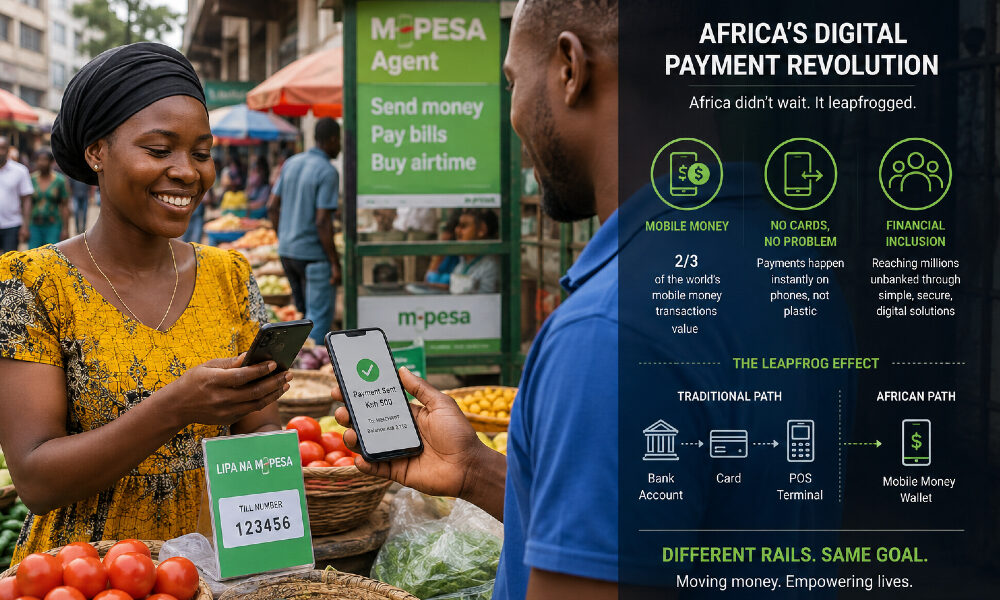
Why “low card acceptance” is the wrong metric for a continent that moves two-thirds of the world’s mobile money.


By John Kourkoutas
Pull up a Visa or Mastercard acceptance map and most of Africa glows red: “low acceptance.” Yet Sub-Saharan Africa is responsible for roughly two-thirds of the world’s mobile money value. Both facts are true at once, and reconciling them is worth real money to anyone hoping to sell into these markets.
The card networks were engineered for a world of bank branches, plastic, and point-of-sale terminals. Much of Africa never built that layer – and rather than spend decades catching up to it, the continent vaulted straight over it. Money simply lives on the phone. Kenya’s M-Pesa, MTN Mobile Money and Airtel Money across West and East Africa now handle salaries, school fees, shop inventory, and cross-border settlements, often without a card ever entering the picture.
So the red on that acceptance map doesn’t mean people can’t pay. It means they pay differently than a Western checkout page assumes.
Three Lessons From Watching Companies Get This Wrong
After years of watching businesses stumble into – or successfully navigate – African markets, the pattern repeats itself in three ways.
1. Missing Western infrastructure is not a missing market. The rails are different, not absent. Judging African payments by card acceptance is a bit like judging African retail by counting shopping malls: you will miss almost everything that actually moves goods and money.
2. A checkout built only for Visa is a checkout nobody in these markets can see. Whether it’s e-commerce, SaaS subscriptions, or a distributor’s payment terms, the fix is the same: build on local rails through providers that already aggregate them. Otherwise, customers who genuinely want to pay you will fail at the last step – and you will likely never know why.
3. Leapfrogging isn’t the exception in Africa. It’s the pattern. The continent skipped landlines for mobile phones, skipped bank branches for digital wallets, and is now skipping grid build-out for solar. The lesson generalizes: whatever infrastructure your product quietly assumes, ask what its leapfrogged version looks like. That’s what your African customer is actually using – often well ahead of your home market.
Different Isn’t Behind
The deepest mistake companies make in emerging markets is reading “different” as “behind.” Consider the European tourist who can’t pay with his card in a Nairobi market.
He isn’t looking at a broken payments system. The trader standing next to him settles more transactions on a phone in a single day than that tourist processes in a month.
Same money. Different rails.
Fix the checkout. Not the conclusion.
John Kourkoutas is business development expert that specializes in helping companies, export teams, and business leaders succeed in Africa’s dynamic and emerging markets.