Opinion
Africa Is Done Giving Its Minerals Away for Free
Ghana’s new gold rules and a landmark African Development Bank summit signal a continent-wide bet: that the way to build wealth is to keep raw resources at home, not just dig them up faster.


By Gregory September
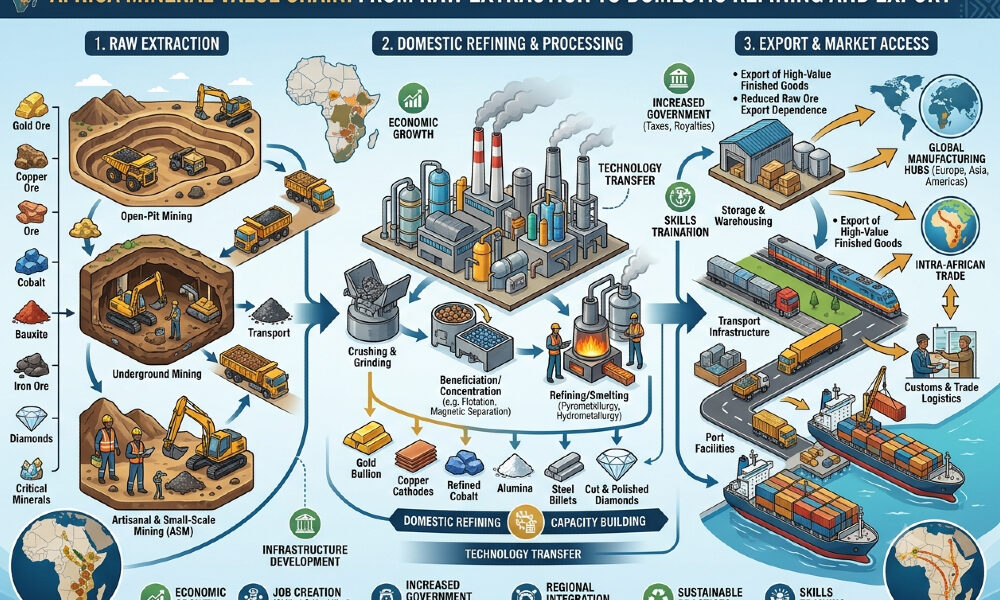
For generations, Africa’s relationship with its own resource wealth has followed a depressingly predictable script. A country pulls something valuable out of the ground – gold, cobalt, lithium, it hardly matters which – ships it abroad in raw form, and watches someone else pocket the profits from refining, manufacturing, and selling it back at a markup.
The mineral leaves. The value leaves with it. This summer, two developments suggest African governments are finally rewriting that script, and investors would do well to pay attention.
The Gold Grab, Accra Style
Starting July 1, 2026, large-scale mining companies operating in Ghana – including giants like Newmont, Gold Fields, and Zijin – must sell 30 percent of their annual gold output to the state, up from 20 percent previously. The mechanics are straightforward but consequential. Miners hand over gold in doré form, the raw, unrefined state fresh from the mine, at a modest 0.55 percent discount to the central bank’s reference rate. Ghana’s fledgling refineries process it domestically. Only after that does it head to an internationally accredited refinery for final stamping, before landing in the central bank’s vaults.
The goal, formally dubbed the Ghana Accelerated National Reserve Accumulation Program, is to stockpile roughly 157 metric tons of gold and build reserves equivalent to fifteen months of import cover by 2028 – a substantial cushion for a country that has spent much of the past decade cycling in and out of IMF bailout programs. President John Mahama has paired the policy with a broader, more audacious ambition: eliminating raw mineral exports entirely by 2030.
Skeptics will note that Ghana has tried versions of this before. The original 20 percent purchase scheme, launched in 2022, helped push central bank gold holdings to a respectable 19.2 metric tons by February of this year, but progress was gradual, and commercial terms with miners have historically been contentious. The jump to 30 percent, and the shift to doré-only purchases that force refining to happen on Ghanaian soil, is a meaningfully more aggressive bet on economic sovereignty over convenience.
A Continental Chorus
Ghana’s move would be a notable but isolated data point were it not for what happened in Abidjan on July 10. There, the African Development Bank convened ministers of mining, energy, industry, and natural resources from across the continent for the first Ministerial Forum on Critical Minerals Value Chain and Beneficiation. The headline statistic – that Africa holds roughly 30 percent of the world’s reserves of critical minerals, including cobalt, lithium, graphite, and rare earth elements – is old news to anyone who follows the sector. What made the gathering notable was the question it chose to ask instead: not how much Africa has, but who actually captures the value once those minerals leave the ground.
The forum’s communiqué did not mince words. Ministers called for regional value chains, local processing capacity, and competitive industries to replace a model that has, for decades, exported jobs, technical expertise, and industrial development along with the raw ore itself. Crucially, this was not a single country’s beneficiation law or a think-tank white paper. It was continental coordination, convened at the African Development Bank level, and tied explicitly to the bank’s new financial architecture for mobilizing capital toward mineral value chains.
Why This Matters for Anyone Watching Africa
A single summit does not rewire fifty years of extractive economics, and Ghana’s reserve target is just that – a target, not yet an achievement. Announcements of this kind have a long and uneven history on the continent; plenty have quietly evaporated once the press releases stopped.
But the direction of travel matters. Investors and policymakers who have long asked a simple question – does this country have valuable minerals? – now need to ask a sharper one: does this country’s policy environment actually intend to keep processing, refining, and value capture onshore? That question will increasingly determine which financing terms get attached to mining licenses, which countries attract downstream manufacturing investment, and which remain, as ever, exporters of raw rock.
The number worth watching in Ghana is not the 30 percent purchase requirement itself. It is whether reserves genuinely reach fifteen months of import cover by 2028, or whether this becomes one more well-intentioned policy that quietly fades. Likewise, the real test of the Abidjan forum will not be its communiqué but the financing conditions that regional development banks attach to raw-mineral exports in the months ahead. That is where rhetoric either turns into infrastructure, refineries, and jobs – or doesn’t.
Africa has spent decades being told it is rich in resources. The more interesting question, finally being asked out loud, is whether it will start acting rich.
Gregory September is a South African academic, author, and geopolitical analyst with extensive experience in government and Parliament. He is the founder and CEO of SAUP (Sustainability Awareness and Upliftment Projects NPC), which focuses on sustainability education and community development. He previously served as Head of Research and Development for the Parliament of South Africa. His work centers on sustainability, African geopolitics, and economic development, and he regularly contributes to analysis of global political and economic affairs.