Alorh’s eye on the Motherland
Africa in the Crosshairs of Global Power Competition: The Shifting Dynamics of Trade


By Mary Alorh
In today’s fiercely competitive global landscape, opportunity often emerges where others have failed – and nowhere is this more evident than in the evolving dynamics of international relations. As Western influence faces increasing scrutiny, China has seized the moment, positioning itself as a strategic alternative on the global stage, particularly in Africa.
China’s rise as a global power has been driven by its calculated efforts to capitalize on the perceived weaknesses of Western powers. While the West frequently adopts a prescriptive approach toward Africa – attaching conditions to aid, trade, and investment – China promotes a policy of non-interference, deliberately refraining from involvement in domestic affairs.
This principle has become the cornerstone of China’s engagement with African nations and has been widely welcomed across the continent.
The shifting geopolitical landscape has been further intensified by the ongoing trade tensions between China and the United States. Under the Trump administration, sweeping tariffs were imposed on a range of countries, including China, fundamentally altering the architecture of global trade.
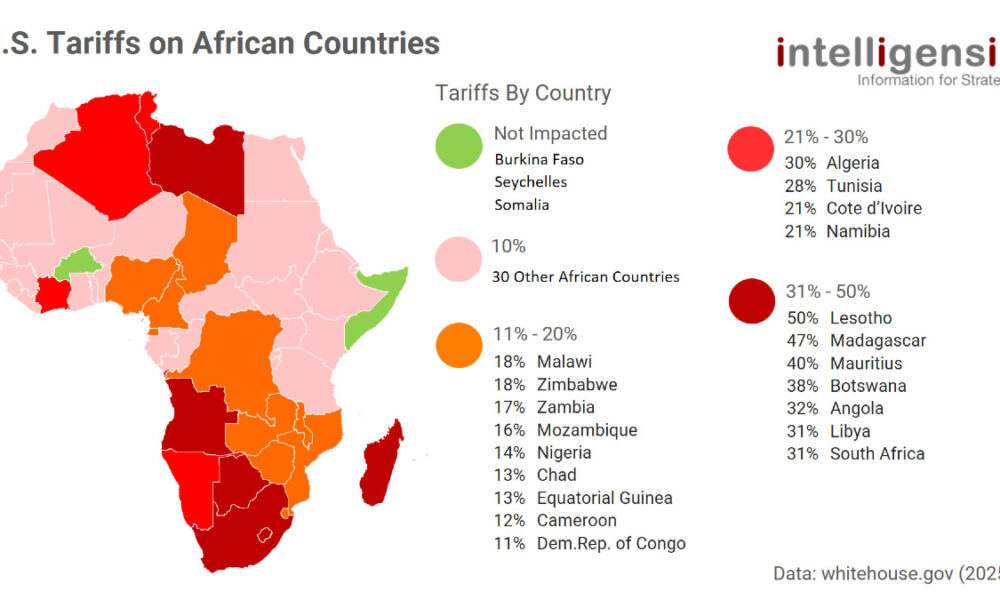
African nations were not spared; several faced some of the highest U.S. tariff rates. Lesotho, Madagascar, Mauritius, Botswana, South Africa, Côte d’Ivoire (Ivory Coast), and Nigeria were among those affected, with rates ranging from 14 percent to as high as 50 percent.
This protectionist turn raises serious economic concerns for both sides and casts uncertainty over the future of the African Growth and Opportunity Act (AGOA), which is set to expire in September 2025.
A Strategic Shift: China’s Zero-Tariff Initiative
In stark contrast to the U.S. approach, China recently announced a bold initiative: zero tariffs on all goods imported from Africa – a move that signals both economic ambition and a direct challenge to American trade policies.
As the struggle for global influence intensifies between Beijing and Washington, Africa finds itself at the center of this geopolitical chess game. Trade volumes between China and African countries continue to grow steadily.
In 2024, Africa exported US$116.79 billion worth of goods to China – an increase of 6.9 percent from the previous year – while Chinese exports to Africa rose 3.5 percent to US$178.76 billion. Despite this growth, the continent still faces a significant trade deficit of approximately US$61.93 billion, slightly improved from US$64 billion in 2023.
Toward a More Balanced Trade Relationship
Much of this imbalance stems from Africa’s continued reliance on exporting raw materials such as gold and cobalt without sufficient value addition, while importing finished goods and machinery from China. To address this structural gap, experts argue that Africa must shift toward exporting semi-finished products rather than unprocessed resources.
Beijing has signaled its intent to support this transition by offering duty- and quota-free access not only to least developed countries but also to middle-income African nations, aiming to create a more equitable global trading environment.
As Harouna Cherif, an economist and development expert, aptly put it: “Africa is constantly exporting what it should transform and constantly importing what it should export.”
The path forward demands a rethinking of Africa’s role in global trade – one that prioritizes industrialization, regional integration, and strategic partnerships. In an era defined by shifting alliances and economic recalibrations, how Africa navigates these challenges will determine its place in the new world order.
Mary Alorh is Director of Administration at DefSEC Analytics Africa Ltd., and is an expert in Gender, Youth, and Peace & Security initiatives in West Africa.