Opinion
Africa Has No Water Crisis. It Has an Infrastructure Crisis.
The most lopsided resource equation on the planet is hiding in plain sight – and it represents one of the greatest investment opportunities of the 21st century.


By John Kourkoutas
The numbers deserve a moment of stillness before analysis.
Kuwait consumes 3,850 percent of its renewable freshwater supply annually. That is not a typo. It uses nearly 40 times more fresh water than nature replenishes within its borders each year. The United Arab Emirates draws down 1,510 percent. Saudi Arabia, 974 percent. These nations do not merely exceed their natural water budgets – they obliterate them, surviving entirely on the industrial miracle of desalination.
Now consider the Democratic Republic of Congo: 0.2 percent. The DR Congo uses one-fifth of one percent of the freshwater that nature restores to it every year.
Angola: 1.9 percent. Namibia: 0.3 percent.
The Congo Basin, one of the most water-abundant regions on Earth, barely registers in the global freshwater consumption ledger – not because its people lack needs, but because the infrastructure to harness that water simply does not exist.
This is, by any measure, one of the most profound resource asymmetries on the planet. And it is almost universally misframed.
The Geography of Abundance and Scarcity
I work between Athens and Lusaka. I have seen both sides of this data up close – not as abstractions, but as lived realities.
South Africa, at 67.6 percent water stress, is already in dangerous territory. Cape Town’s near-miss with “Day Zero” in 2018 – when the city came within weeks of turning off municipal taps entirely – sent shockwaves through urban planning circles worldwide and forced a serious global conversation about the fragility of water security in the developing world.
Yet just 2,000 kilometers (1,243 miles) to the north, the Congo Basin holds more renewable freshwater than almost any comparable region on Earth. The Zambezi River system, flowing through Zambia and six neighboring nations, carries volumes that dwarf the water needs of every city in southern Africa – and remains almost entirely unharnessed for agriculture, industry, or energy generation.
The contrast is not merely striking. It is a policy failure of continental scale.
What the Data Is Actually Telling Us
The standard narrative around water in Africa centers on scarcity. Drought imagery. Cracked riverbeds. Children walking miles to reach a well. That narrative is not false – but it is dangerously incomplete, because it obscures the structural nature of the problem and, by extension, its solutions.
Africa does not have a water problem. It has a water infrastructure and distribution problem.
The water exists. In staggering abundance. What does not exist is the irrigation network to convert it into food production at scale.
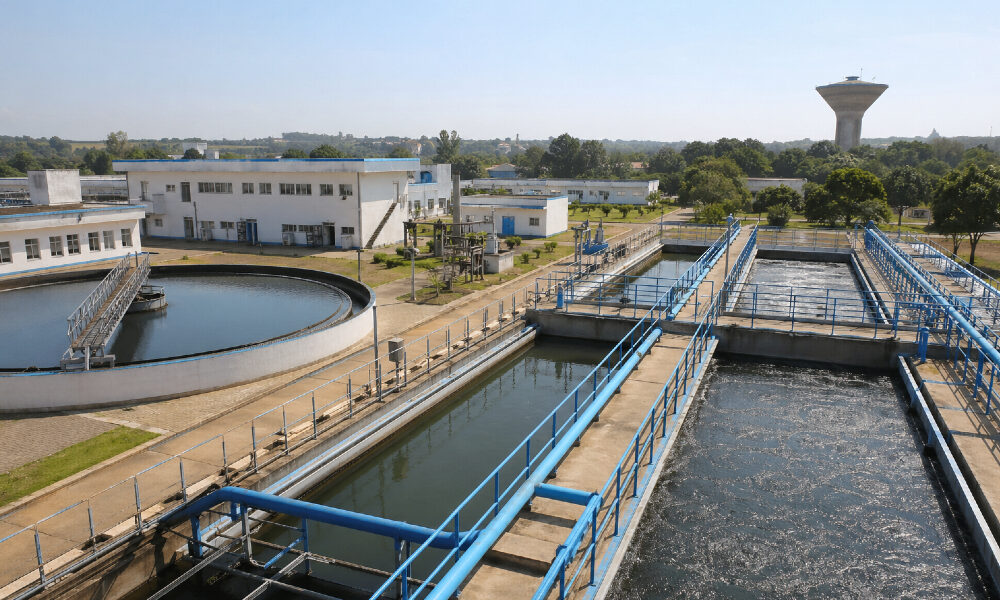
The treatment capacity to render it safe for drinking. The pipeline infrastructure to move it from where rainfall concentrates to where populations cluster. The storage systems to bridge the gap between wet and dry seasons.
This distinction matters enormously – not just analytically, but practically. A scarcity problem demands conservation. A distribution problem demands investment. And investment, unlike conservation, creates industries, jobs, and returns.
The Gulf States Wrote the Playbook
The Arabian Peninsula’s solution to genuine water scarcity offers an instructive precedent. Facing absolute hydrological limits with no realistic alternative, Gulf nations deployed capital at extraordinary scale into desalination technology.
Today, Saudi Arabia operates some of the largest desalination plants on Earth. The UAE has turned water security into an engineering showcase. Kuwait, despite consuming 38 times its natural supply, maintains functional urban water systems for its entire population.
They had no water and the capital to compensate. They built the infrastructure and solved the crisis.
Africa presents the mirror image: enormous natural water resources and a historic deficit of deployed capital. The problem is not geological. It is financial and logistical.
The Business Case That Few Are Reading Correctly
For every European, North American, or Asian company manufacturing water treatment equipment, precision irrigation systems, borehole drilling technology, pumping infrastructure, or water storage solutions: the data above is your market thesis.
The continent that will house 2.5 billion people by 2050 – a demographic reality now baked into every credible projection – cannot feed, hydrate, or industrialize that population without transforming the relationship between its water resources and its water infrastructure. That transformation requires equipment, engineering, financing, and expertise. It represents decades of sustained demand.
The companies and investors who position now – building relationships, establishing supply chains, and developing locally adapted solutions – will not simply generate profitable returns. They will be the firms that helped feed and sustain the world’s fastest-growing population through its most consequential period of development.
A Final Reframe
There is a phrase that has circulated in resource and geopolitical circles for years: “Water is the new oil.” It is meant to signal scarcity, strategic value, conflict risk.
But the framing is too modest, and ultimately misleading.
Oil can be substituted. Solar, wind, nuclear, and hydrogen are displacing it across every sector of the global economy, faster than almost anyone predicted a decade ago.
Water has no substitute. There is no synthetic alternative to human hydration, crop irrigation, or industrial cooling. Every unit of economic growth, every calorie of food production, every increment of urbanization requires it.
Water is not the new oil. Water is more important than oil. And sub-Saharan Africa – the region the world most persistently associates with resource poverty – holds more of it than most of the world has stopped to realize.
The question is not whether that water will eventually be harnessed. It will be. The only question is who builds the infrastructure to do it, and whether the capital and expertise deployed will serve African populations equitably in the process.
The numbers have been sitting in the FAO database for years. They are waiting to be read correctly.
John Kourkoutas is business development expert that specializes in helping companies, export teams, and business leaders succeed in Africa’s dynamic and emerging markets.