Opinion
Africa Grows the Miracle. Why Does the World Own the Margin?
Why moringa is the latest chapter in Africa’s oldest trade story – and how the continent could finally rewrite the ending.


By Sheena Raikundalia
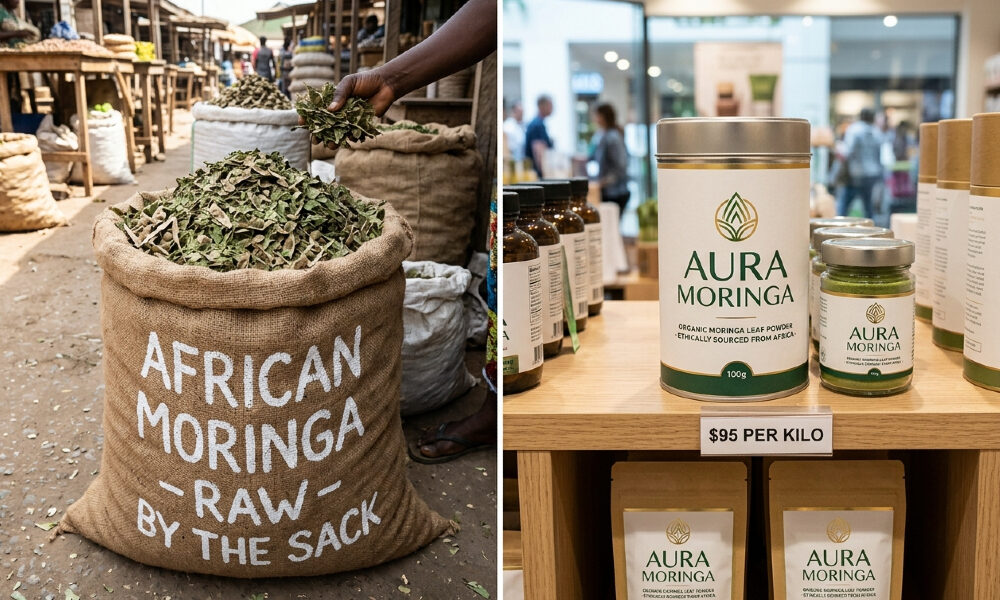
In American health food stores, a kilo of powdered African moringa sells for roughly $95. In northern Kenya, where the tree grows wild along dirt roads and fence lines, farmers sell it by the sack for a fraction of that price. Somewhere between the roadside and the retail shelf, a plant that Kenyan and Ethiopian communities have relied on for generations was rebranded as a “miracle superfood” – and the miracle margin went somewhere else.
This is not a new story. It is the same one Africa has told with cocoa, coffee, tea, and shea butter: the continent supplies the raw ingredient, and someone else builds the billion-dollar brand. What makes moringa different is the stakes. This isn’t just a missed export opportunity. It’s a nutritional lifeline that Africa is at risk of losing to its own neglect.
A Tree That Outperforms a Pharmacy
Moringa’s nutritional profile reads like a marketing exaggeration, except it isn’t. Gram for gram, the dried leaf contains more vitamin C than oranges, more calcium than milk, more iron than spinach, and all nine essential amino acids the human body cannot produce on its own. It reaches maturity in about three months. It survives conditions that kill maize.
That resilience is not theoretical. During the 2021–2023 drought that devastated Marsabit County, when livestock had nothing left to graze, farmers turned to dried moringa leaves as feed. In a very literal sense, the tree kept animals – and the families who depended on them – alive.
Africa’s own variety, Moringa stenopetala, is native to northern Kenya and southern Ethiopia and has been cultivated for generations by the Konso people. An estimated five million people across the Horn of Africa still eat it today. It is the most protein-rich species of moringa in existence, and recent Ethiopian research found that its seed powder can reduce both turbidity and E. coli contamination in unsafe drinking water – a low-cost purification tool hiding in plain sight.
Extinct in the Wild, Booming on Shelves
Here is the paradox: this remarkable plant is now considered extinct in the wild in Ethiopia. While global demand for moringa races toward a projected $25 billion market, the African variety that could anchor that growth has been left to disappear at home.
Meanwhile, a U.S. brand sources African moringa through women’s cooperatives, packages it under its own label, and sells it in roughly 11,000 stores, including Walmart, with backing from a major cereal company’s venture arm. The moringa is African. The cooperative labor is African. The profit structure is not.
This is the pattern that has defined African agriculture for a century: the continent occupies the lowest-value end of supply chains built on its own crops – and increasingly, on its own indigenous knowledge.
More Than an Export Story
It would be easy to frame this purely as a missed commercial opportunity. But that undersells what’s actually at stake. Moringa is a drought-resistant, nutrient-dense crop capable of directly addressing the malnutrition, anemia, and childhood stunting that African governments spend enormous sums importing fortified foods and supplements to treat. And it is already growing, largely untapped, in places like Turkana, Kilifi, and Marsabit.
Imagine reversing the current model entirely:
- Train women and young farmers to grow, solar-dry, and process moringa to international quality standards.
- Feed it locally first – through school meal programs, baby food, and fortified flours – so nutrition gains stay at home before anything is exported.
- Then brand it: traceable, African-owned products built for the diaspora and global markets, not raw leaves shipped out in sacks.
That sequence matters. Nutrition first, ownership second, export third. Done in that order, moringa stops being a raw commodity and becomes a livelihood, a value chain, and a story that belongs to the people who grew it.
The Real Miracle Hasn’t Happened Yet
The miracle was never that moringa grows in Kenya and Ethiopia. Nature did that part for free. The real miracle will be when African entrepreneurs, cooperatives, and governments finally build the processing, branding, and distribution infrastructure to capture the value their own soil already produces – and when the world’s US$95-a-kilo superfood is priced, packaged, and profited from right where it was grown.
Moringa is not an isolated case. It’s a preview. The uncomfortable question worth sitting with is this: what else is growing in Africa’s backyard right now that the world will “discover,” rename, and sell back at ten times the price?
Sheena Raikundalia is an accomplished entrepreneur, former lawyer, government policy advisor, and angel investor with deep expertise across the legal, financial services, and impact investment sectors in Europe and Africa. She has played a pivotal role in advancing Africa’s technology and innovation ecosystems, leveraging a career that spans top-tier London law firms, leadership as Country Director of the UK-Kenya Tech Hub for the UK Foreign, Commonwealth & Development Office (FCDO), and her current position as Chief Growth Officer at agri-tech company Kuza One. Sheena is recognized for her strategic vision, commitment to fostering innovation, and strong advocacy for Africa’s growth potential in technology, entrepreneurship, and impact investment.