Business
Africa: Expansion of rail infrastructure set to increase trade opportunities
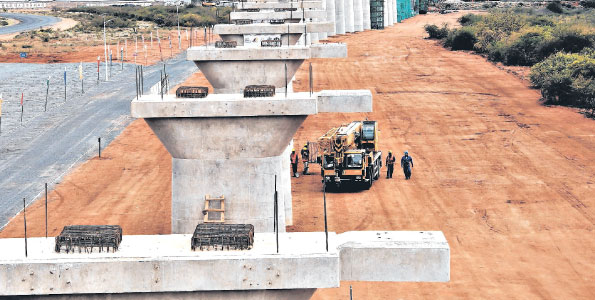
The construction of the standard gauge railway – an ambitious railway project to link east Africa countries Kenya, Rwanda and Uganda – has the potential to transform trade positively in the region. It will be a much faster and efficient alternative to road transport – given that at present there is only one major arterial road that connects the 3 countries.
The standard gauge railway, is among the most advanced of the more than US$30 billion of African rail projects planned or under way.
Together, they span more than 11,000 kilometers (6,835 miles) – enough to connect Cape Town to Copenhagen.
It is one of the bright spots on the continent, where governments are currently dealing weakened currencies and shrinking budgets following the plunge in commodity prices.
“Infrastructure constraints are one of the major things holding back Africa and this standard gauge railway will make a big difference,” said Mark Bohlund, an Africa and Middle East economist.
West Africa
Besides the East African line, others on the continent there is work proceeding to develop a 2,700 kilometer (1,678 miles) West African rail corridor. The project, which has faced legal challenges from rival developers, would link the Ivory Coast (Côte d’Ivoire ), Burkina Faso, Niger and Benin.
Also in West Africa, Senegal has already signed an agreement for the renovation of 645 kilometers (400 miles) of railroads. Projects are also planned in Tanzania, Mali and Egypt, while Ethiopia recently completed a line connecting Addis Ababa to Djibouti and has another 4,000 kilometers (2,480 miles) of projects planned.
Economic Growth
Rail infrastructure is vital to improve trade between African countries, which stood at just 13 percent of the total last year, according to the African Union.
Kenya, which moves about 5 percent of freight by rail, predicts the new project will add to economic growth. The government sealed agreements in March with Chinese partners to build the rest of the track up to the border with Uganda, which itself has signed construction agreements for the first phase.
Kenya’s initial stretch, from Mombasa to Nairobi, will be ready to start operating by June 2017, Kenya Railways Corp. CEO Atanas Maina said in an interview. The line will have daily capacity for 8 freight trains in each direction, each with the ability to carry the equivalent of more than 100 containers. It will also run as many as 2 daily passenger trains each way.
Apart from the often congested Mombasa-Nairobi highway, the only other land transportation option is the century-old railway completed by the British colonial authorities in 1901.
The standard gauge railway design also accounts for local wildlife movements, said Kenya Railways social environmentalist James Chimera. Kenya Wildlife Service provided locations of animal-crossing corridors so elevated overpasses could allow elephants and giraffes to pass underneath safely, he said.
The Export-Import Bank has agreed to fund 90 percent and 85 percent respectively of the first two phases of Kenya’s project, with the government covering the rest.
Source: Bloomberg