Opinion
Africa Day 2026: A Continent Refuses to Wait
On the 63rd anniversary of the Organization of African Unity’s founding, the world must finally reckon with Africa on its own terms.


By Mark-Anthony Johnson
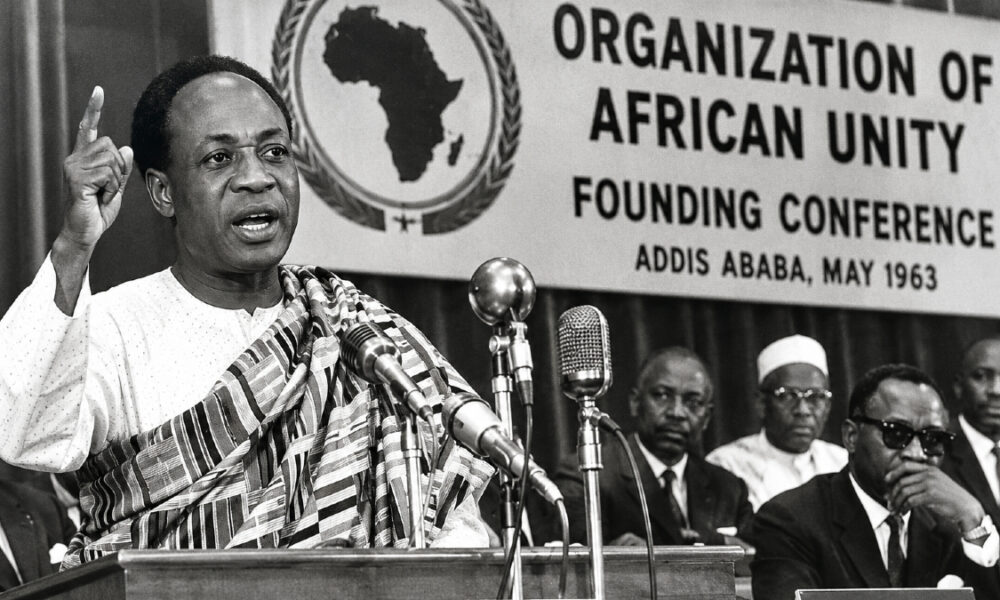
Sixty-three years ago, on a warm May morning in Addis Ababa, thirty-two newly independent African heads of state signed into existence an idea as audacious as it was urgent. The Organization of African Unity – the precursor to today’s African Union – was born not merely as a diplomatic body, but as a declaration of civilizational intent.
Its founding was Africa’s loudest announcement to the postcolonial world: we are here, we are sovereign, and we will determine our own future.
That message, delivered with uncommon force by Ghana’s first Prime Minister and President, Kwame Nkrumah, has lost none of its urgency. “We must unite now or perish,” he told the gathered delegates. “We recognize that our economic independence resides in our African union.”
In 1963, those words were aspirational. In 2026, they read like a strategic roadmap.
A Continent Defined by Complexity, Not Cliché
Africa Day – celebrated annually on May 25 – is too often treated by the outside world as an occasion for charity appeals and oversimplified narratives. That framing does a disservice to a continent of 54 nations, over 1.4 billion people, more than 2,000 languages, and millennia of recorded civilization.
Africa is not a problem to be solved. It is a story still being written – and increasingly, it is Africans who are holding the pen.
The continent’s diversity alone defies easy summary. From the Saharan trade routes of Mali’s medieval empire to the maritime kingdoms of the Swahili coast; from the constitutional democracies of Botswana and Mauritius to the ancient monarchy of the Kingdom of Eswatini; from the tech corridors of Nairobi and Lagos to the cinematic brilliance of Nollywood and the global resonance of Afrobeats – Africa contains multitudes that resist reduction.
To celebrate Africa Day authentically is to hold that complexity without flinching, and to recognize that its challenges – governance deficits, climate vulnerability, debt burdens, infrastructure gaps – exist alongside extraordinary reserves of human capital, natural wealth, and institutional ambition.
The African Union at 24: Progress, Painfully Won
When the African Union replaced the OAU in July 2002, it inherited both a legacy and a mandate. The OAU had been indispensable to the liberation movements of the 20th century, shielding newly independent states from re-colonization and providing diplomatic solidarity. But it was also criticized for its rigid non-interference doctrine – a principle that, in practice, too often meant silence in the face of autocracy and mass atrocity.
The African Union was meant to be different. Its Constitutive Act included, for the first time, the right of the Union to intervene in member states in cases of genocide, war crimes, and crimes against humanity.
Its Agenda 2063 – a 50-year continental blueprint for economic transformation – set ambitious targets for infrastructure, industrialization, and democratic governance.
Progress has been real, if uneven. The African Continental Free Trade Area (AfCFTA), which entered into force in 2021, represents the world’s largest free trade zone by the number of participating countries.
Intra-African trade, long suppressed by colonial-era infrastructure that pointed toward European ports rather than neighboring capitals, has begun – slowly, stubbornly – to grow. The African Union’s role in mediating conflicts from the Horn of Africa to the Sahel has deepened, even as those conflicts have, at times, proved resistant to resolution.
What has not changed is the core of Nkrumah’s challenge: that political unity and economic sovereignty remain inseparable goals, and that external dependency – whether to former colonial powers, to multilateral creditors, or to newer strategic partners – continues to constrain the continent’s room for maneuver.
The Demographics of Destiny
Perhaps the most consequential fact about Africa in 2026 is not political but demographic. The continent is home to the world’s youngest population. By mid-century, one in four human beings alive on earth will be African.
That is not merely a statistic. It is a structural shift in the human story – one that will reshape labor markets, consumer economies, geopolitical alignments, and cultural influence in ways that are only beginning to be understood.
For those paying attention – and increasingly, investors, policymakers, and entrepreneurs are – Africa’s youthful population is less a burden than a latent asset. The challenge is ensuring that asset is realized: that young Africans have access to quality education, functioning health systems, and economies capable of generating dignified employment at scale.
The gap between that aspiration and current reality remains wide. But it is narrowing – and in places like Rwanda, Ethiopia, Senegal, and Côte d’Ivoire (Ivory Coast), it is narrowing faster than conventional wisdom tends to acknowledge.
“I Am an African”: The Universality of Belonging
Africa Day also invites reflection of a more personal and philosophical kind – one that transcends geopolitics and speaks to questions of identity, heritage, and shared humanity.
The poet’s declaration – I am an African, not because I was born there, but because my heart beats with Africa’s – captures something that borders and passports cannot contain.
Africa’s influence on global culture is immeasurable and immemorial. Its rhythms undergird modern music from jazz to hip-hop. Its philosophical traditions – ubuntu, the idea that personhood is constituted through relationship with others – offer correctives to the atomized individualism that has frayed social fabric across the industrialized world.
To claim an African identity is not to romanticize. The continent’s history includes slavery, colonization, and the ongoing extraction of its resources by external powers.
Its present includes poverty, conflict, and democratic backsliding in too many places. But it also includes resilience, creativity, and a refusal – generation after generation – to accept that the future has already been written by others.
What the World Owes Africa – and What Africa Owes Itself
The obligations run in both directions.
The world – and particularly the wealthy nations that extracted so much from Africa over centuries, and that continue to benefit from its commodities, its labor, and its cultural output – owes the continent a different kind of engagement. That means fairer trade terms, debt relief where it is warranted, genuine technology transfer, and above all, the political respect of treating African nations as partners rather than recipients.
It also means ending the hypocrisy of climate negotiations in which African nations – which have contributed least to global emissions – are asked to bear disproportionate adjustment costs in the name of a transition they did not precipitate.
But African governments and institutions also carry obligations that cannot be deferred indefinitely. Governance quality, rule of law, the protection of press freedom and civil society, and the creation of conditions in which private enterprise and foreign investment can operate with confidence – these are not impositions from outside.
They are the internal preconditions of the prosperity that Africa’s people deserve.
Celebrating Without Sentimentality
Africa Day should be marked with joy – and it will be, in festivals and ceremonies from Dakar to Johannesburg, from Nairobi to the African diaspora communities scattered across every continent on earth. There is genuine cause for celebration: in the art, the music, the literature, the science, and the sheer vitality of a continent that has survived everything history has thrown at it.
But the most fitting tribute to the founders of the OAU – and to the billions of Africans who inhabit and will inherit this extraordinary continent – is not sentiment. It is seriousness.
A serious engagement with what Africa needs, what it offers, and what becomes possible when the world finally meets it at eye level. Nkrumah’s words, spoken in 1963, are worth repeating in 2026: We must unite now or perish.
The continent has not perished. It is, in fact, just beginning.
Mark-Anthony Johnson is the founder and CEO of JIC Holdings, a global asset and investment management firm founded in 2009. With over 30 years of experience and strong ties to Africa, his investments span mining, infrastructure, power, shipping, commodities, agriculture, and fisheries. He is currently focused on developing farms across Africa, aiming to position the continent as the world’s breadbasket.