Opinion
Africa Cannot Afford a Rushed Energy Transition – And the World Must Listen


By NJ Ayuk
In May 2021, the International Energy Agency (IEA) released its landmark report, Net Zero by 2050: A Roadmap for the Global Energy Sector. Among its most controversial recommendations: a global halt to new oil and gas exploration by the end of 2022.
The IEA argued that such a dramatic step was necessary to meet the Paris Agreement’s goal of net-zero emissions by mid-century – balancing greenhouse gas emissions with removals.
The roadmap included other bold mandates:
- No new investment in fossil fuel supply after 2021;
- A ban on new fossil-fueled boiler sales by 2025;
- An end to internal combustion engine car sales worldwide by 2035;
- And a target that 60 percent of all new car sales be electric by 2030.
At the time, I argued forcefully that this approach was fundamentally misguided. My position was deeply unpopular in international climate circles.
Yet I remained convinced that denying Africa access to its substantial oil and gas reserves would severely compromise the continent’s development trajectory – a belief that events have increasingly vindicated.
A One-Size-Fits-All Climate Agenda Ignores Reality
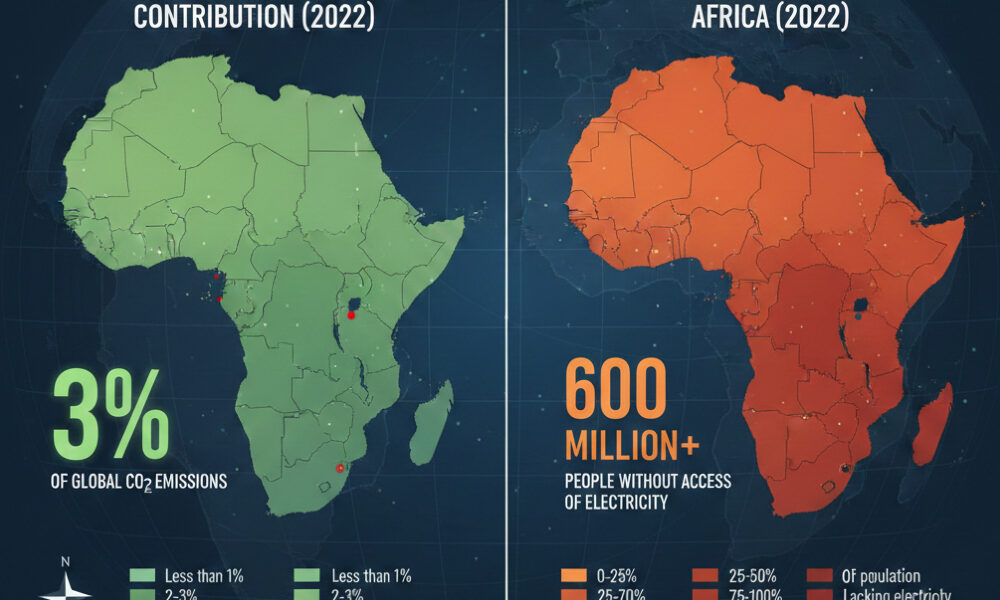
Let’s be clear: Africa accounts for less than 3 percent of cumulative global greenhouse gas emissions. Yet it is home to 600 million people who live without electricity – nearly 80 percent of the global population lacking power.
In this context, demanding that Africa “accelerate its energy transition” isn’t just unrealistic. It’s unjust.
The truth is simple:
- Africa is not Europe.
- Europe is not Latin America.
- Latin America is not Asia.
Each region has distinct historical trajectories, economic structures, and energy baselines. Imposing a uniform decarbonization timeline on nations still grappling with energy poverty doesn’t advance climate goals – it entrenches global inequality.
What Africa needs is not ideological purity, but pragmatism. A just energy transition must recognize that development and decarbonization are not mutually exclusive – they must proceed hand in hand.
If the world is serious about a just transition, it must start by respecting Africa’s right to power its own future – on its own timeline.
Africa Cannot Build Its Future on Broken Promises
Consider the promises made by wealthy nations. The European Union pledged US$15 billion to support clean energy in Africa. But will it deliver? History suggests otherwise.
According to United Nations data, more than 60 percent of climate finance flowing to low- and middle-income countries takes the form of loans – not grants. These are debts that must be repaid, often at high interest, by economies already buckling under fiscal pressure.
Is it any wonder that African leaders are skeptical?
Expecting the Global South to leapfrog directly to renewables without reliable grid infrastructure, industrial capacity, or upfront capital is not vision – it’s fantasy.
Hydrocarbons as a Bridge to Prosperity
For many African nations endowed with oil and gas – countries like Nigeria, Angola, Mozambique, and Ghana – responsible development of these resources is not a climate sin. It’s a strategic necessity.
Revenue from hydrocarbons can fund grid expansion, industrialization, and – yes – future investments in solar, wind, and green hydrogen. The choice isn’t “fossil fuels versus renewables.” It’s “energy poverty versus energy sovereignty.”
The rallying cry isn’t about reckless extraction – it’s about agency. Use our resources, on our terms, to power our people.
We will address climate change. But we cannot solve tomorrow’s emissions crisis while ignoring today’s development emergency.
Toward a Context-Sensitive Global Compact
The IEA itself has begun to shift. In its 2023 Africa Energy Outlook, the agency acknowledged that “natural gas will play a central role in expanding energy access” across the continent.
This is progress.
But more is needed. The global community must move beyond prescriptive mandates and toward partnership – supporting African nations in building integrated energy systems that blend near-term gas deployment with long-term renewable scale-up.
Climate justice cannot mean climate exclusion. If the world is serious about a just transition, it must start by respecting Africa’s right to power its own future – on its own timeline.
NJ Ayuk is the Executive Chairman of the African Energy Chamber.