Opinion
Africa 2055: The Future We Built


By Farhia Noor
In 2055, I didn’t dream of Africa’s future – I stepped into it.
What I saw was not the continent of yesterday’s headlines – not a continent defined by scarcity, dependency, or foreign aid. Instead, I walked into a reimagined Africa: sovereign, self-sufficient, and leading the world in innovation, sustainability, and human dignity.
Africa had risen – not through charity, but through will, wisdom, and work.
No longer begging. No longer waiting.
Now, the planes arrive in Africa – filled with Europeans applying for visas, Americans queuing for work permits, and investors seeking opportunity. The world has turned its gaze south, not to extract, but to learn.
Because Africa holds what the rest of the planet has lost:
- Community rooted in Ubuntu – “I am because we are”
- Land stewarded with reverence and science
- Digital brilliance born in rural labs and urban hubs alike
- Innovation that solves real problems for real people
- Vision that honors the past while building the future
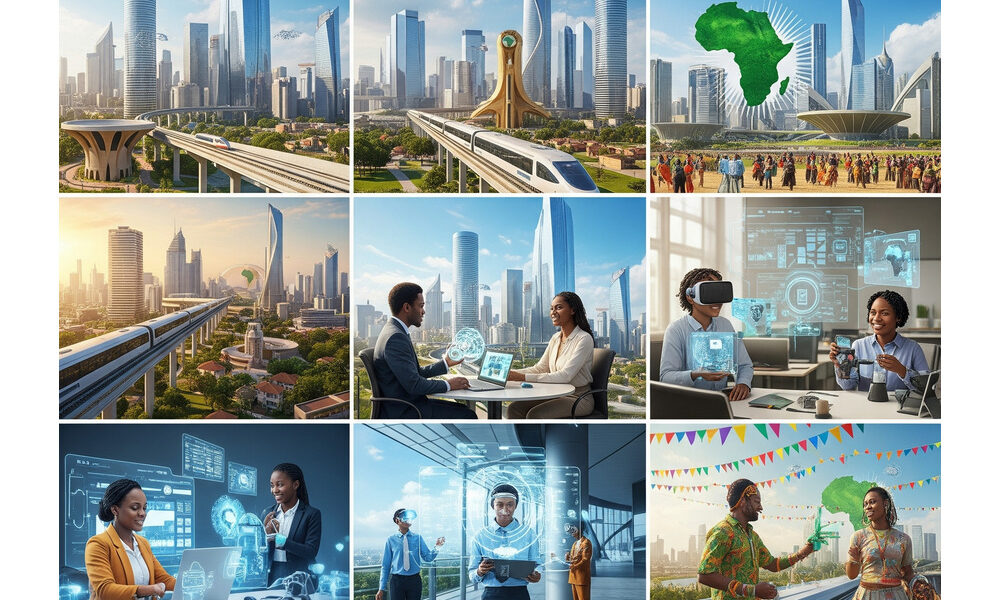
Infrastructure: The Arteries of Unity
Africa built its own arteries of progress – not with foreign loans, but with Pan-African ambition.
The Ubuntu Highway now stretches from Dakar to Dar es Salaam – a solar-lined, AI-monitored corridor where trade flows freely across borders. The Sankara Express links Niamey to Khartoum, electrified and efficient, powered by Sahelian sun. The Mandela Freight Belt runs from Johannesburg to Cairo, moving goods, ideas, and energy across 10,000 kilometers (6,000 miles) of African soil.
Every major port – from Luanda to Djibouti, Mombasa to Abidjan – operates under African ownership and digital oversight. No more foreign-controlled terminals.
No more extraction disguised as investment.
This is infrastructure as liberation.
Production: From Raw Materials to Finished Power
Africa no longer exports raw materials and imports finished goods. That colonial cycle is broken.
Today, Africa produces everything it needs – and more:
- Smartphones assembled in Lagos, running on African-developed operating systems
- Solar panels manufactured in Namibia, powering homes from Cape Town to Casablanca
- Bioplastics engineered in Kampala, replacing petroleum-based waste
- Shea butter and luxury skincare from Burkina Faso’s Karité Queens Cooperative , sold in Paris and Seoul
- Drones designed in Nairobi, delivering medicine to remote clinics
- Chocolate crafted in Ghana from bean to bar, with 90% of value retained locally
- Generic medicines produced in Tunisia, cutting healthcare costs across the continent
- Clothing stitched in Lesotho, using eco-friendly dyes and fair labor
- Furniture carved from sustainably harvested Congolese timber
- Irrigation tech invented in Harare, helping farmers adapt to climate shifts
Factories are no longer owned by distant shareholders. They are worker-cooperatives, solar-powered, and integrated into a Pan-African supply chain.
We no longer ship “raw poverty.” We export finished power.
Education: A Continent of Digital Minds
Schools across Africa are fully digitalized – not as a luxury, but as a right.
Every child receives a solar-charged tablet at age six. Lessons are delivered in Swahili, Amharic, Hausa, Yoruba, Wolof, and dozens more – because language is identity, and identity is power.
History is taught in immersive virtual reality – from the pyramids of Kemet to the universities of Timbuktu, from the Swahili coast of Kilwa to the resistance of Shaka Zulu.
In rural Mali, girls design AI models to predict crop yields. In The Gambia, boys code in Wolof, building apps for local farmers.
No more chalkboards. No more paper shortages. Just brilliance, unchained.
The Builders: Architects of a New Africa
This future wasn’t handed to us. It was built – brick by brick, line of code by line of code – by Africans who believed.
Meet the architects:
- Fatima Mohamed (Somalia): Founder of Africa’s first ocean-tech satellite network. Her fintech platform, Barwaaqo, powers trade across the Red Sea corridor.
- Aisha Traoré (Burkina Faso): CEO of the Karité Queens Cooperative, turning shea farming into a global luxury brand.
- Letlhogonolo Kgosietsile (Botswana): Inventor of Africa’s blockchain-based diamond certification system. Now, every Botswana diamond is ethically tracked — and proudly owned by its people.
- Lukusa Mwamba (DR Congo): Once a cobalt miner, now CEO of Zamani EV Batteries. He exports clean energy storage — not raw minerals. His daughter learns to code in Lingala.
- Kudzai Mhute (Zimbabwe): Creator of FoodCoin, a digital currency backed by millet, maize, and cassava. It feeds millions and stabilizes local economies.
- Nour El-Din Hassan (Egypt): Director of UbuntuSat, Africa’s constellation of climate-monitoring and education satellites — built, launched, and operated from the continent.
These are not exceptions. They are the new norm.
As the African proverb reminds us:
When the roots are deep, there is no reason to fear the wind.
The Final Scene: A Continent Reclaimed
In Kisangani, a girl named Zama stands atop a solar-powered factory roof. In one hand, she holds a tablet – her AI app just won the Pan-African Tech Prize.
In the other, a calabash passed down from her grandmother’s village.
She smiles at the skyline:
- High-speed trains glide across the continent
- Drones deliver vaccines to remote clinics
- Forests regrow where deserts once advanced
- Ports hum with African-made goods bound for global markets
And carved into the wall behind her, in Lingala, Swahili, and English:
Africa believed. She built. And the world came to her.
A Call to Action
We are not the children of charity. We are the descendants of kings and queens, farmers and philosophers, builders and healers.
Africa’s future is not a fantasy. It is a choice – one we are already making.
So don’t just dream of Africa. Build her. Defend her. Fund her. Live her.
Because in 2055, the world didn’t save Africa. Africa saved itself – and in doing so, showed the world a better way forward.
Farhia Noor is a seasoned business consultant based in Dar es Salaam, Tanzania. With a proven track record in developing enterprises and executing turnkey projects across both government and private sectors, she brings deep expertise to the table. Farhia is also a committed advocate for community-led development and is passionate about advancing sustainable, intra-African growth.