Opinion
AfCFTA’s New Rules of Origin: The Quiet Revolution That Could Unlock One Africa
How a technical trade provision is becoming the linchpin of Africa’s economic integration.


By Ashish Muley
The African Continental Free Trade Area (AfCFTA) is routinely celebrated as the world’s largest free trade agreement by number of participating nations – a landmark achievement in multilateral cooperation spanning 54 countries and a combined GDP of roughly US$3.4 trillion. Yet grand ambitions and signed agreements do not, by themselves, move goods across borders.
The uncomfortable truth about AfCFTA is that its transformative promise has always hinged less on political will than on a deceptively mundane instrument: Rules of Origin.
Now, with the AfCFTA Secretariat accelerating efforts to finalize a comprehensive Rules of Origin (RoO) framework, the agreement may be approaching the inflection point where aspiration becomes architecture.
The Gatekeeping Question: What Counts as “Made in Africa”?
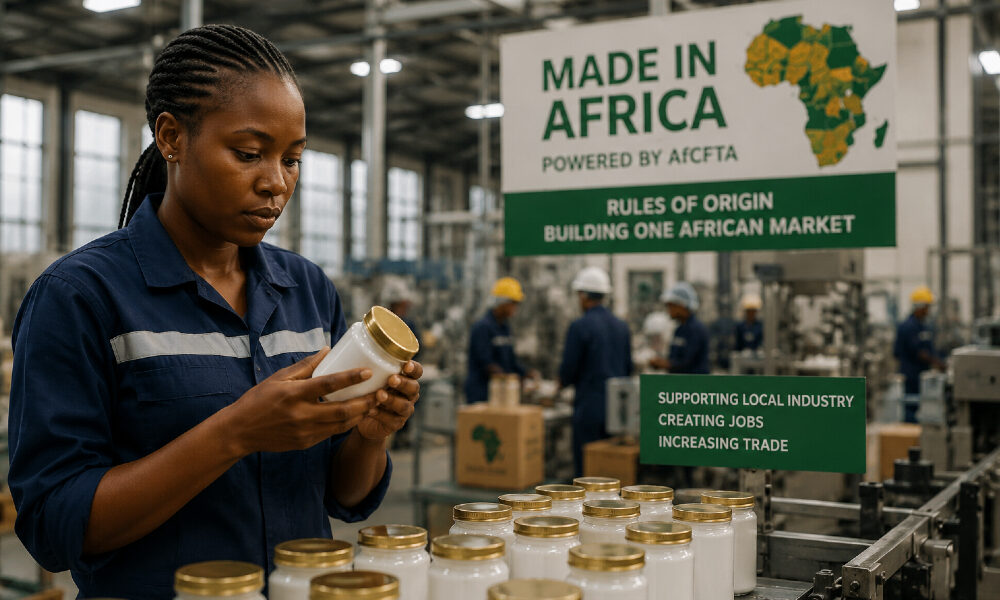
Rules of Origin determine whether a product qualifies as sufficiently African to benefit from AfCFTA’s preferential tariff treatment. The question sounds technical. The consequences are anything but.
Without robust origin criteria, AfCFTA’s tariff concessions become a backdoor for non-African goods. A manufacturer in a third country could route products through whichever African nation levies the lowest duties, then circulate them duty-free across the entire continent – a practice known as trade deflection.
Preventing this requires credible, enforceable origin thresholds that compel genuine local manufacturing and value addition rather than cosmetic re-labeling.
Beyond gatekeeping, Rules of Origin serve a more constructive purpose. Clear, predictable origin criteria give exporters, importers, investors, and customs authorities the regulatory certainty they need to commit capital and build supply chains. Without them, even a tariff-free continent remains commercially uncertain terrain.
A Framework Finally Taking Shape
Progress has historically been the AfCFTA’s most elusive commodity. The agreement entered into force in 2019, yet full operationalization of Rules of Origin across all product categories has remained incomplete – a gap that has frustrated businesses and muted investment decisions across the continent.
That picture is shifting. Recent developments signal a meaningful acceleration. Product-specific Rules of Origin are advancing toward finalization across key sectors, including textiles, automobiles, and agro-processing – industries where Africa holds significant comparative advantages but has struggled to assert them within a coherent regulatory framework.
Customs procedures are being harmonized among member states, reducing the procedural fragmentation that has long discouraged cross-border trade. Digital tools and e-Tariff platforms are improving transparency, making it easier for businesses to determine at the outset whether their products qualify for preferential treatment rather than discovering non-compliance at the port of entry.
Capacity-building initiatives are also expanding. Training programs for customs officials and trade stakeholders represent an often-overlooked but essential investment.
Rules, however well-designed, are only as effective as the institutions tasked with implementing them.
Why This Matters Beyond the Technical
For businesses operating on the continent, the stakes are straightforward. Rules of Origin determine access to preferential tariffs, shape sourcing decisions, and influence where companies choose to locate production.
A manufacturer weighing whether to build a processing facility in Ethiopia or import finished goods from Asia will consult the origin framework as a primary input. Unclear or inconsistently applied rules introduce risk that investors price into their decisions – often by walking away.
The macroeconomic implications are comparably significant. A functioning RoO regime is not merely a trade facilitation measure; it is an industrial policy instrument.
By requiring meaningful local content, it creates incentives for regional value chains to develop organically – connecting raw material producers in one country with processors in another and distributors in a third. This is precisely the kind of economic integration that transforms a continental free trade area from a diplomatic achievement into a driver of industrialization.
An Opening for Global Partners
Africa’s deepening integration is not only a continental story. For economies such as India – already a significant trade partner across East and West Africa – a more coherent African market substantially expands the scope for partnership.
A continent where origin rules are clear and customs procedures are harmonized is a continent where long-term investment in agriculture and agro-processing, manufacturing, logistics, infrastructure, and regional value chain collaboration becomes materially more viable.
Global investors and trading partners who have historically treated Africa as a collection of 54 distinct markets – each with its own regulatory idiosyncrasies – may soon need to recalibrate their thinking. The rules are changing. The market is consolidating.
The Road Ahead
Caution is warranted. AfCFTA’s history contains more milestones than breakthroughs, and the distance between finalizing a framework and implementing it uniformly across a continent of extraordinary administrative diversity remains considerable.
Political economy pressures – particularly from domestic industries seeking protection – have slowed RoO negotiations before and could do so again.
Nevertheless, the direction of travel is clear, and the current initiative represents the most substantive progress on origin rules in the agreement’s history. Getting this right matters enormously.
Tariff reductions were always the easier half of economic integration. Building the regulatory infrastructure that determines who actually benefits from those reductions is harder – and more consequential.
One continent. One market. The opportunity is real. Whether it is seized will depend, in no small measure, on whether the unglamorous work of Rules of Origin gets done properly.
Ashish Muley is an independent consultant with Stalwart Management Consulting, with 27+ years in agricultural commodity value chains, export markets, and international trade. He has led projects on business development and capacity building across African countries in partnership with international organizations. Formerly, he spent 15 years in financial services leadership, focusing on sales, marketing, and business development. Based in Pune, India, Ashish advises on agricultural trade, commodity markets, and Asia–Africa economic opportunities, and regularly writes on international trade and logistics.