Opinion
AfCFTA’s Digital Trade Ambition Must Confront Reality on the Ground


By Ziad Hamoui
The African Continental Free Trade Area (AfCFTA) Secretariat and the African Export-Import Bank (Afreximbank) are preparing to pilot a pan-African digital trade finance platform in late 2026. The ambition is admirable. The execution, if history is any guide, demands far greater scrutiny.
Over the past 18 months, digital system rollouts at West African ports have produced only marginal gains in cargo dwell times – typically 10 to 15 percent – falling well short of the 30-plus percent improvements that were promised. That gap is not a technical footnote. It is a warning.
When the Technology Works – and When It Doesn’t
The promise of digital trade infrastructure is, in principle, transformative. Blockchain-enabled platforms have demonstrated the capacity to compress Letter of Credit processing from three weeks to under 48 hours.
End-to-end cargo visibility gives banks the confidence to extend credit to small and medium-sized enterprises that were previously deemed too risky. Digital escrow mechanisms can establish the trust necessary to connect unfamiliar trading partners across borders.
These are not hypothetical gains – they are real, documented outcomes.
Yet they remain the exception rather than the rule. The stress test for Africa’s digital trade ambitions is not the technology itself; it is the implementation.
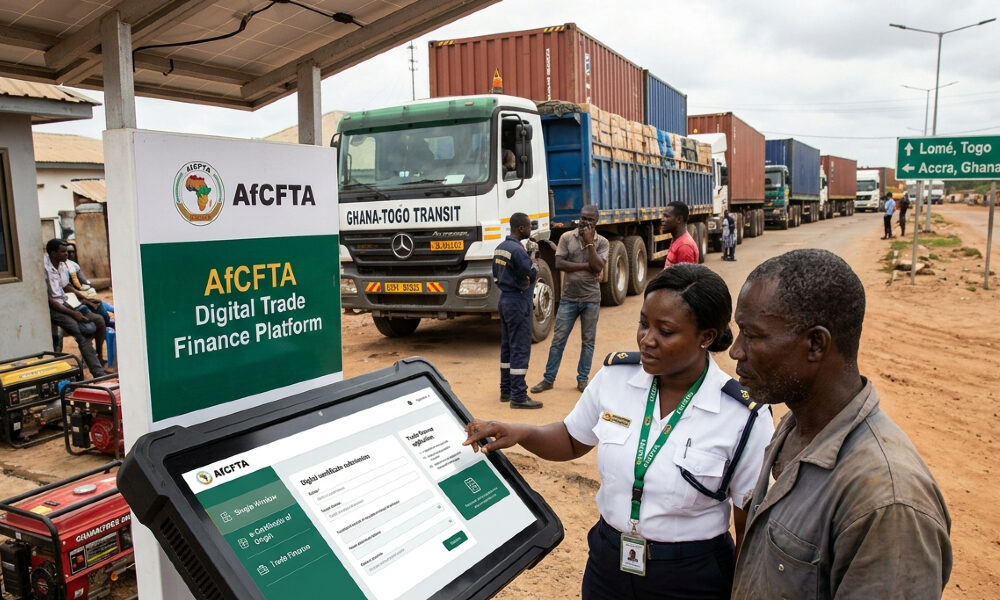
New port management systems have been deployed without any corresponding redesign of the manual inspection processes they were meant to replace. Platforms have been engineered by consultants who have never spoken to the trader managing her goods at the Aflao border crossing between Ghana and Togo.
Systems have been installed that require 4G connectivity at border posts where reliable network coverage is a distant aspiration.
These are not isolated failures of execution. They reflect a systemic tendency to treat technology launch as the finish line rather than the starting gun.
Redefining Success Before the 2026 Pilot Begins
Genuine success requires a fundamental reorientation – away from the technology and toward the people and processes it is meant to serve. That begins with interoperability.
Any new platform must integrate seamlessly with existing customs infrastructure such as UNCTAD’s ASYCUDA and Ghana’s ICUMS, while establishing clear governance frameworks that define who controls data and who verifies transactions. Without this, digital systems become parallel bureaucracies rather than improvements on existing ones.
It also requires taking change management seriously. Training border agents, customs officials, and bank staff is not a supplementary line item in a project budget; it constitutes the bulk of the real work. Adoption does not follow automatically from deployment.
Perhaps most critically, success metrics must evolve. Announcing a system launch is not an achievement. Verified reductions in transaction costs and demonstrated adoption by actual traders are.
The ultimate measure of any digital platform is not what appears on a dashboard – it is whether the person moving goods across a border finds their work meaningfully easier.
With the 2026 pilot approaching, the window to course-correct is narrowing. The operational realities at Africa’s borders must shape platform design from the outset, not serve as a post-launch afterthought.
The critical question is whether the voices at Aflao – and at the hundreds of other border crossings that will define this platform’s real-world impact – are present in the rooms where decisions are being made.
Africa’s traders deserve digital tools built around their needs. Not tools built around the ambitions of those designing them.
Ziad Hamoui is the Co-Founder and Past President of the Borderless Alliance, a leading private-sector advocacy group promoting economic integration and removing trade and transport barriers in West Africa. With extensive experience in Ghana’s road transport, logistics, and shipping sectors, he currently serves as Executive Director of Tarzan Enterprise Ltd., a long-established family business. He is a former Co-Chair of the Africa Food Trade Coalition, Co-Founder of the Trade Facilitation Coalition for Ghana, and serves on multiple high-level advisory committees on trade, transport, agriculture, and security. A Chartered Fellow of the Chartered Institute of Logistics and Transport (CILT) Ghana, he is also a former member of its Governing Council.