Opinion
Addis Ababa’s Light Rail: A Cautionary Lesson for Africa’s Urban Transport Future
Addis Ababa’s light rail proved electrified transit could work in Sub-Saharan Africa. A decade on, the bigger lesson may be what happens when nobody keeps investing.


By Dishant Shah
Ride the Addis Ababa Light Rail Transit at 8 a.m. and you will not find a museum piece. You will find a shove.
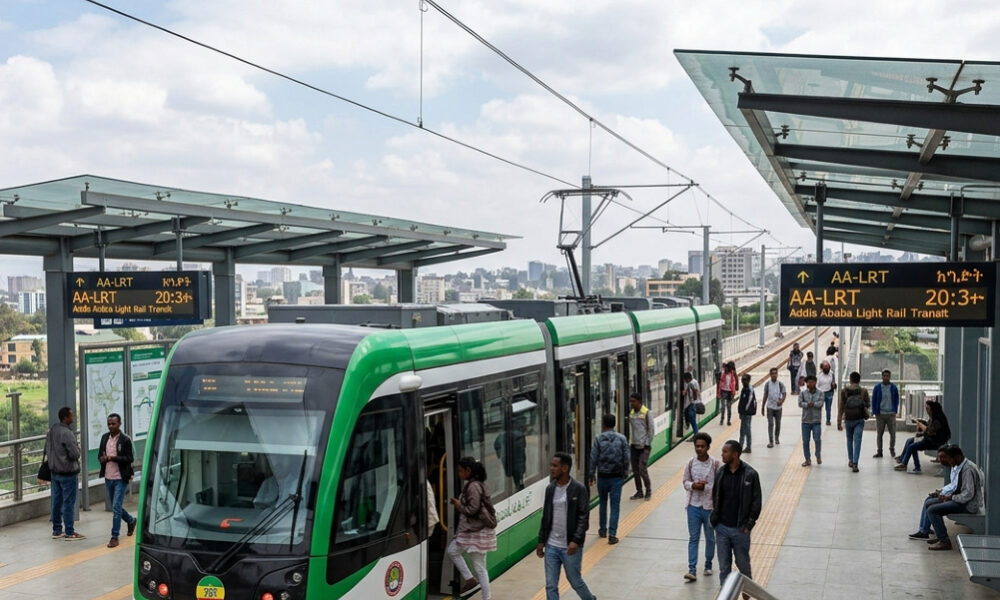
Commuters press three deep against carriage doors that no longer close on the first try. Fans that used to hum now sit silent. Somewhere down the line, a train that should be running is parked, waiting on a spare part that has to clear customs, a bank, and a currency shortage before it ever reaches a mechanic. This is not the image Ethiopia had in mind in September 2015, when it switched on the first electrified light rail system in Sub-Saharan Africa and, for a moment, made Addis Ababa look like the future of African cities.
That moment mattered. It still does. But a system built to prove a point is now testing one instead: whether African governments can sustain the infrastructure they are so eager to inaugurate.
A Bold Bet, Built Fast
The numbers behind the AALRT were never modest. Two lines, 31.6 kilometers (19.6 miles) of track, and 39 stations stitched together a city of more than 5 million people. The East-West Line runs from Ayat to Tor Hailoch; the North-South Line connects Menelik II Square to Kality. Between them, the network reaches into the residential blocks, factory zones, and government districts that keep Addis Ababa running.
China’s Export-Import Bank financed most of the roughly US$475 million project, and China Railway Construction Engineering Group built it. Trains capable of 70 km/h began carrying passengers who had spent years stuck in gridlock. The system was engineered to move more than 100,000 riders a day, with room to scale past 200,000 as the city grew. And because it runs on electricity drawn largely from hydropower, it offered something rare on the continent: mass transit with a genuinely low carbon footprint.
For a country still building its industrial base, this was not a vanity project. It was a statement that African infrastructure could be modern, clean, and homegrown in its ambition, even when the financing and construction came from abroad.
Where the Promise Is Fraying
Ambition, though, is not the same as durability. A decade of use, deferred maintenance, and macroeconomic strain has worn the system down in ways its planners likely underestimated.
Power shortages periodically shut down segments of a railway whose entire value proposition rests on reliable electricity. Foreign currency restrictions have made it harder to import the parts needed to keep aging trains on the tracks, a problem familiar to nearly every capital-intensive infrastructure project in a country managing tight foreign exchange reserves. The result is visible every rush hour: fewer functioning trains, more crowded platforms, and a system running below the capacity it was designed for. Expansion plans, meanwhile, have slowed to a crawl.
None of this erases what the AALRT accomplished. It still moves people, still cuts emissions relative to diesel buses, and still stands as proof of concept. But proof of concept is not the same as proof of endurance, and endurance is the harder problem.
The Real Test Isn’t Building Rail. It’s Keeping It Running.
This is the part of the infrastructure story that ribbon-cuttings tend to skip. Building a railway is a triumph of engineering and finance; keeping it running is a triumph of institutions, budgeting, and political attention that rarely fades once the cameras leave. Addis Ababa’s experience suggests that the second challenge is, if anything, the more demanding one.
That lesson lands squarely in the path of cities like Lagos, Cairo, Nairobi, and Johannesburg, all of which are weighing their own rail investments as populations swell and roads clog. Each will face a version of the same question the AALRT poses today: what happens in year ten, when the loans still need servicing, the currency has moved, and the original trains are no longer new?
Africa’s cities do not lack ambition. What many still lack is the sustained financial and political commitment to operate what gets built, long after the ribbon has been cut. Ethiopia’s continued investment in maintenance and operational upgrades suggests it understands the stakes. Whether that commitment outlasts the next currency crunch or power shortage is a different matter entirely.
Rail or Road? The Choice Cities Can No Longer Dodge
As Africa’s urban population climbs toward a billion by mid-century, governments face a genuine fork in the road. They can commit to electrified rail as core infrastructure, funding it not just to build but to maintain, or they can default to the familiar, cheaper path of buses and road expansion, accepting the congestion and emissions that come with it.
Addis Ababa shows that the first path is possible. It also shows, more uncomfortably, that possible is not the same as guaranteed. The city that once looked like a model now looks like something more useful: a case study in what durability actually requires. Other capitals would do well to study both halves of that story before they lay their own tracks.
Dishant Shah is a partner at Legion Exim, a company specializing in facilitating the export of high-quality engineering products directly sourced from manufacturers in India to Africa. His areas of expertise include new business development and business management.