Owusu on Africa
Abiy Ahmed’s Landslide Win Sharpens Ethiopia’s Hand on the Nile – and in the Horn of Africa
A resounding election victory gives Ethiopia’s prime minister fresh leverage over Egypt, Sudan, and Somalia. The question is whether he uses it to dig in or to make peace.


By Fidel Amakye Owusu
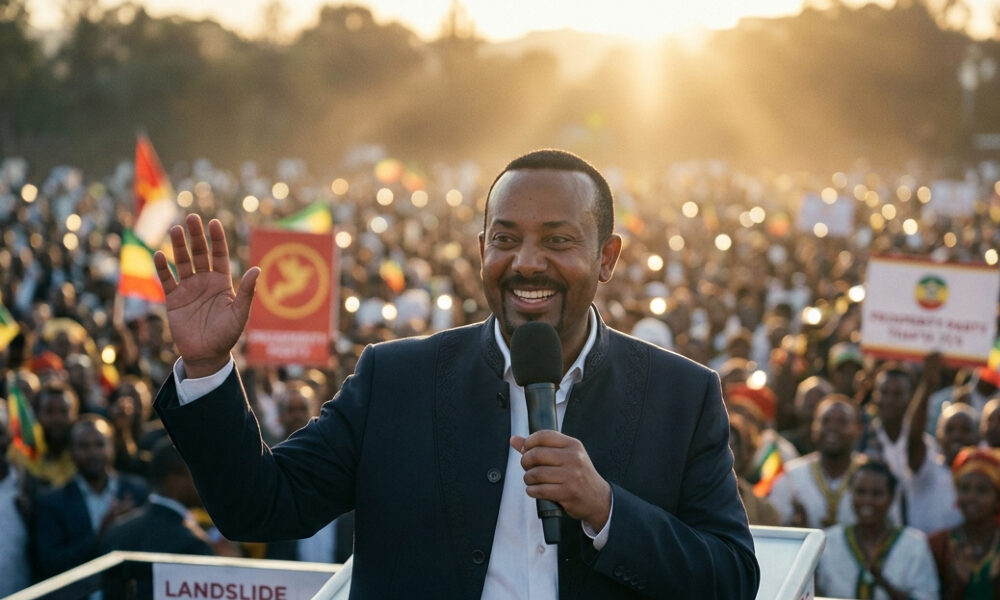
Ethiopia’s ruling party has just delivered Prime Minister Abiy Ahmed the kind of mandate most leaders only dream of. In the country’s latest national elections, his party swept to a landslide victory, capturing an overwhelming share of parliamentary seats and effectively cementing his hold on power for years to come.
The result came despite a conspicuous absence of voting in Tigray and in parts of the Amhara region – a reminder that Ethiopia’s democratic process remains tangled up with the unresolved conflicts of its recent past.
Still, a mandate is a mandate. And in the Horn of Africa, where political capital translates quickly into foreign-policy muscle, this one is likely to reverberate well beyond Ethiopia’s borders.
A More Assertive Ethiopia on the World Stage
Geopolitically, the scale of the victory hands Abiy and his party newfound confidence to pursue what has already become a noticeably bolder foreign policy. At the center of that policy is Ethiopia’s long-standing ambition: securing guaranteed access to the sea.
As Africa’s most populous landlocked nation, Ethiopia has made coastal access a strategic priority, and a strengthened domestic position only adds wind to those sails.
The Nile Dispute Gets More Complicated
Nowhere is Ethiopia’s emboldened posture more consequential than in its dispute with Egypt over the Nile River. For years, talks between Addis Ababa and Cairo have stalled, undercut by tensions that have little to do with water rights and everything to do with regional alliances.
Consider the proxy dynamics now playing out across the region. Sudan’s civil war has placed Ethiopia and Egypt on opposite sides of the battlefield, at least by reputation.
Sudan’s army-led government has accused Addis Ababa of backing the rival paramilitary Rapid Support Forces – an allegation that lingers despite Abiy’s visit to Port Sudan in 2025. Egypt, for its part, has thrown its support behind Sudan’s military establishment.
The picture grows murkier still in Somalia, where Cairo’s security partnership with Mogadishu sits uneasily alongside Ethiopia’s close ties to the breakaway region of Somaliland. Even Washington’s reported attempts to mediate the broader standoff – a notable feature of the Trump administration’s regional diplomacy – have done little to defuse the underlying tension.
Confidence as a Path to Compromise?
Yet there’s a case to be made that Abiy’s commanding win could cut the other way – toward moderation rather than escalation.
Ethiopia’s list of strained relationships is already long: Sudan’s army-aligned government, Eritrea, and Somalia all sit somewhere between wary and hostile. Egypt, widely seen as sympathetic to several of these governments, only adds to the sense of encirclement.
Faced with that many potential fronts, a leader secure in his own political standing might reasonably decide that picking fights is a luxury he can’t afford.
Having now held power for more than eight years and just won a clear, uncontested majority, Abiy may finally have the domestic political cushion to pivot toward what regional diplomats sometimes call a policy of “good neighborliness” – trading confrontation for the harder, less glamorous work of détente.
What Comes Next
Whether Abiy chooses assertiveness or accommodation will shape not just Ethiopia’s trajectory, but the stability of the entire Horn of Africa. A prime minister flush with electoral capital has more room to maneuver than one constantly looking over his shoulder. The real test is which direction he chooses to move in.
For Cairo, Khartoum, and Mogadishu, the message is the same either way: Ethiopia is not going anywhere, and Abiy Ahmed, freshly re-anointed by the ballot box, intends to be dealt with on his own terms.
Fidel Amakye Owusu is an International Relations and Security Analyst. He is an Associate at the Conflict Research Consortium for Africa and has previously hosted an International Affairs program with the Ghana Broadcasting Corporation (GBC). He is passionate about Diplomacy and realizing Africa’s global potential and how the continent should be viewed as part of the global collective.