Politics
Abidjan port aims for regional supremacy
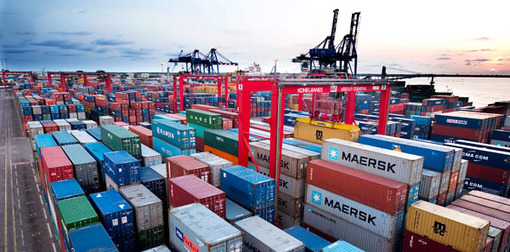
Côte d’Ivoire has launched massive upgrades to its ports to support the growth of the natural resource sector and to attract more of the regional transit trade. Buoyed by the economic recovery of the past two years and rising traffic levels, the Côte d’Ivoire government is implementing large-scale investments to upgrade its two international harbors, Abidjan and San Pedro.
The Abidjan harbor is the site of a $2.5 billion expansion project, schedule for completion by 2020. The vast project comprises of the construction of a second container terminal, the expansion of a minerals terminal and the enlargement of the Vridi Canal. Furthermore, the plans will enable the port to handle 2.25 million twenty-foot equivalent units (TEUs), which would make it the port with the largest capacity in West Africa.
The Port Autonome d’Abidjan, the country’s largest port, recorded a traffic increase of 7 percent in 2013, which is a provisional figure that does not include oil shipments. In 2012, it handled 21.7 million ton, a 31% rise from the 16.6 million ton recorded in 2011. It was also noted that container traffic also expanded 16% over the same period to 633,917 TEUs.
However, these figures are expected to rise even more. Since the economy of the world’s largest cocoa producer is bouncing back following the end of a decade-long political and social crisis in 2011, gross domestic product growth had reached 9% in 2013. Abidjan port director Yacouba Hien Sie says that the port plans not only depend on Côte d’Ivoire’s growth.
He also advised that the goal is to “re-position our port and give it the opportunity to fully play its role to the benefit of the national and regional economy.”
Disputed tender
In December 2013, the Ivorian authorities and Bolloré Africa Logistics signed a public-private partnership deal, paving the way for the construction of a second container terminal. According to the government, investment in that project will amount to as much as 403 billionn CFA francs ($825 million), including 243 billion from the government.
The new terminal will have a 1,100m long with an 18m deep dock and the work is due to last four years. The deal was signed despite a disputed bidding process. Bolloré, which already runs the first container terminal, and its partners beat bids from two groups led by Geneva-based Mediterranean Shipping Company and Marseille-based CMA CGM.
The competition department of the Union Economique et Monétaire Ouest-Africaine is still investigating the tender won in March 2013 by Bolloré’s consortium, which includes France’s Bouygues and APM Terminals.
Monopoly row
In May, CMA CGM’s consortium called for an annulment of the bid and made an appeal to Côte d’Ivoire’s public procurement authority. After the regulator dismissed the appeal, the group brought the case to the West African economic body, citing irregularities in the pre-selection procedure, non-compliance with competition laws and an arbitrary award process.
Commerce minister Jean-Louis Billon also denounced the monopoly created by the deal and advised that Bolloré should not have been allowed to bid because it controls the first terminal. CMACGM decided to drop the challenge in July, but its partners have not withdrawn their complaint.
Despite criticism from many economic operators, who are worried about high costs due to the lack of competition, the government said in January the new terminal will improve the harbor’s competitiveness and lower the prices by as
much as 40%.
Among the other projects included in the upgrade of the Abidjan port, the minerals terminal will be expanded to meet demand from the booming mining sectors in Burkina Faso, Côte d’Ivoire and Mali. The port authorities aim to handle 3 million tons of minerals, including manganese and zinc, by 2020; up from 300,000 tons currently.
In addition, China Harbor Engineering will also enlarge the Vridi Canal to enable larger ships to dock. The works, due to last three years, are supposed to start this year. In the meantime, the western port of San Pedro, the country’s main port for cocoa exports, also aims to expand and boost its traffic by increasing trans-shipments and attracting cotton and cashew exports away from the port of Abidjan.
The port has forecast that its traffic will rise 31% in 2013 to 4.2 million tons from 3.2 million tons a year earlier. Trans-shipments were set to increase to 2.8 million tons from 1.9 million tons in 2012. The harbor has begun to ship cotton from Mali and handled 21,000 tons of the commodity last year while boosting exports of cashews to 17,000 tons from 2,000 tons recorded in 2012. The port authorities target a goal of 4.55 million tons of goods in 2014, and as much as 10 million tons in 2015.
It also appears that San Pedro too will be upgraded. Officials are banking on the mining potential in the west of the country to build a minerals terminal. The new terminal project, estimated by transport minister Gaoussou Touré to cost $2 billion, includes a 500 km rail line linking the port to nickel and iron ore mines.
Source: The Africa Report