Opinion
A New World Order – or the Formal Admission of the Old


By Ronald Sanders
For decades, the international community has invoked a “rules-based order” as if law alone governed global affairs. In truth, power has always written – and rewritten – the rules.
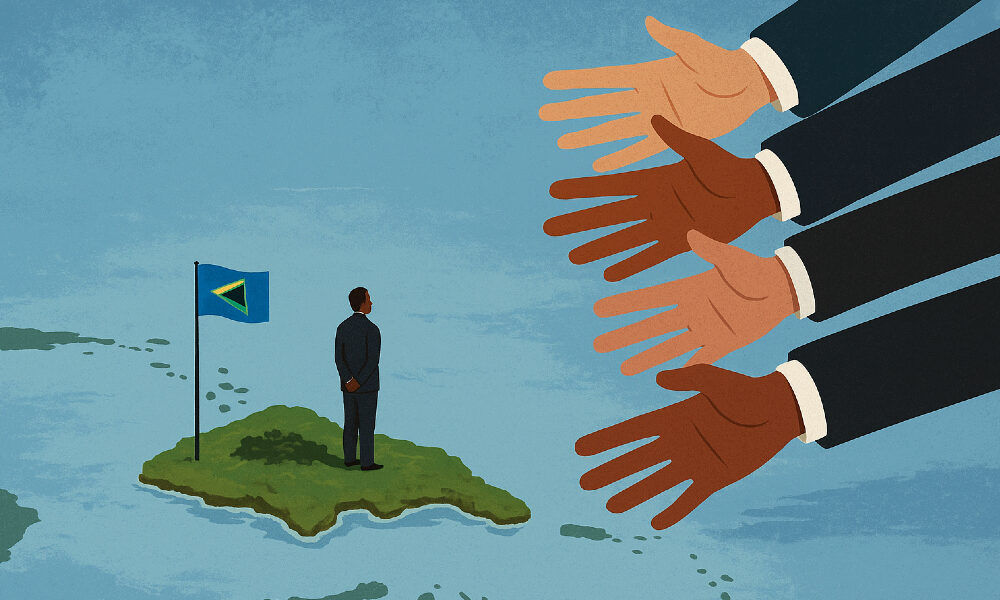
What’s changed today isn’t the nature of that order, but the candor with which its architects now wield it. The veil is lifting, and small states – long accustomed to polite fictions – are confronting a stark reality: the so-called rules-based system was never truly rule-bound.
It was, and remains, a hierarchy in diplomatic disguise.
From the Treaty of Westphalia in 1648 to the United Nations Charter in 1945, the principle of sovereign equality has been enshrined in international doctrine. Yet legal sovereignty – the right to non-interference – is universal only on paper.
Political sovereignty – the capacity to act independently – is the preserve of the powerful. Small states have always known this not through theory, but through lived experience: in the World Trade Organization (WTO) negotiations where calls for special and differential treatment were dismissed; in climate summits where pledges of loss-and-damage financing yielded token gestures, not justice.
What distinguishes the present moment is not a shift in power dynamics, but in tone. Restraint – once a hallmark of hegemonic diplomacy, however performative – has given way to unvarnished assertion.
Treaties are treated as optional, multilateral commitments as transactional, and international courts as inconvenient. The pretense of consensus is fading.
Power no longer bothers to dress itself in the robes of legitimacy.
Sovereignty as a Shield, Not a Sword
Nowhere is this more consequential than in regions like the Caribbean, where sovereignty is not a tool of influence but a fragile shield. Half a century ago, visionary leaders – Michael Manley, Errol Barrow, Forbes Burnham, and Eric Williams – declared the Caribbean a Zone of Peace, vowing that the region’s destiny would not be dictated by great-power rivalries.
Today, that pledge is fraying. As former Jamaican Prime Minister P. J. Patterson recently warned, external military operations in Caribbean waters – justified under the banner of security – represent a “fundamentally dangerous and horrible erosion” of sovereignty, often conducted with scant regard for regional consultation or international law.
This is not opposition to cooperation against transnational crime. It is a demand that such cooperation be grounded in transparency, legality, and respect for regional agency. The issue is not who acts, but where decisions are made – and who is excluded from making them.
The Caribbean’s dilemma reflects a broader paradox for small states: they depend on the international rule of law precisely because they lack the power to enforce it. When the OECD or European Union unilaterally imposes sanctions on financial services without a UN mandate, or when trade restrictions are levied under dubious claims of unfair deficits – despite Caribbean nations running chronic trade deficits themselves – the illusion of a level playing field evaporates. (Guyana’s recent oil boom is a notable exception, but one that underscores, rather than negates, the rule.)
Defending the Vocabulary of Law in an Age of Might
In effect, the Global South has long inhabited a world where justice is nominal and enforcement selective. So when pundits speak of a “new world order,” we must ask: new to whom?
The hierarchy has always existed. What’s new is the abandonment of pretense.
We are not witnessing the birth of a new order, but the formal admission of the old – one where might dictates right.
For small nations, the stakes are existential. Sovereignty may soon be reduced to the right to manage domestic affairs – so long as those affairs do not challenge the interests of those who control the seas, the markets, and the security architecture.
Yet resignation is not an option. The response must be principled insistence on the language of law – not because it guarantees protection, but because it remains the only terrain on which the powerless can stand.
The vocabulary of the rules-based order, however compromised, still defines the battlefield. The Caribbean’s security and prosperity have historically benefited from partnerships with democratic powers; the task now is to ensure those partnerships remain anchored in legal norms, not unilateral convenience.
Within CARICOM, this demands realism as much as resolve. Member states must acknowledge that national interests sometimes compel individual accommodations with larger powers.
At the same time, the ideal of “collective sovereignty” cannot be invoked if it invites punitive retaliation against individual members. Solidarity must be strategic, not symbolic.
The challenge ahead is not to accept a world order dominated by raw power, but to resist its normalization. When law falls silent and power speaks alone, the ladder of equity collapses – and the powerless are left stranded at the bottom.
In this moment of unmasking, small states must summon both caution and courage: to defend the space they have, and to insist that even in an unequal world, rules still matter.
Ronald Sanders is Antigua & Barbuda’s Ambassador to the US and the OAS