Opinion
A Continent the World Can No Longer Ignore


By Daki Nkanyane
Africa’s growing relevance is structural, not sentimental. The world has run out of ways to plan the future without it.
For a long time, the world has spoken about Africa in terms of possibility. It is a polite word. It comforts outsiders and delays responsibility. It allows the world to admire the continent from a distance – to describe Africa as “the future” while behaving as though Africa is not yet part of the present.
But something has changed.
Africa is no longer merely a hope held in speeches or a headline reserved for charity and crisis. It is becoming structurally unavoidable – not because the world has suddenly grown more compassionate, but because the global system itself is shifting.
The continent is returning to global relevance not as a guest, but as a factor. And when a continent becomes a factor, a new question replaces the old narrative of potential: how does Africa carry the burden of being wanted?
Being wanted is not the same as being respected. Being included is not the same as being empowered.
The World Is Reordering Itself
We are living through a period of profound global reordering. Supply chains are being reconfigured. Alliances are being tested.
Energy realities are in flux. Technology is reshaping the distribution of power. Food systems are under strain. Security has expanded well beyond borders to encompass climate, resources, data, and demographics.
This is not simply globalization continuing on its established course. It is globalization becoming contested – a world moving from one dominant center of power toward multiple centers, competing interests, and rival visions of the future.
In such moments, regions that were previously peripheral become pivotal. Africa is one of them – not because it has suddenly discovered its own importance, but because the world has run out of ways to pretend it can plan the future without the continent.
Africa’s Demographic Gravity
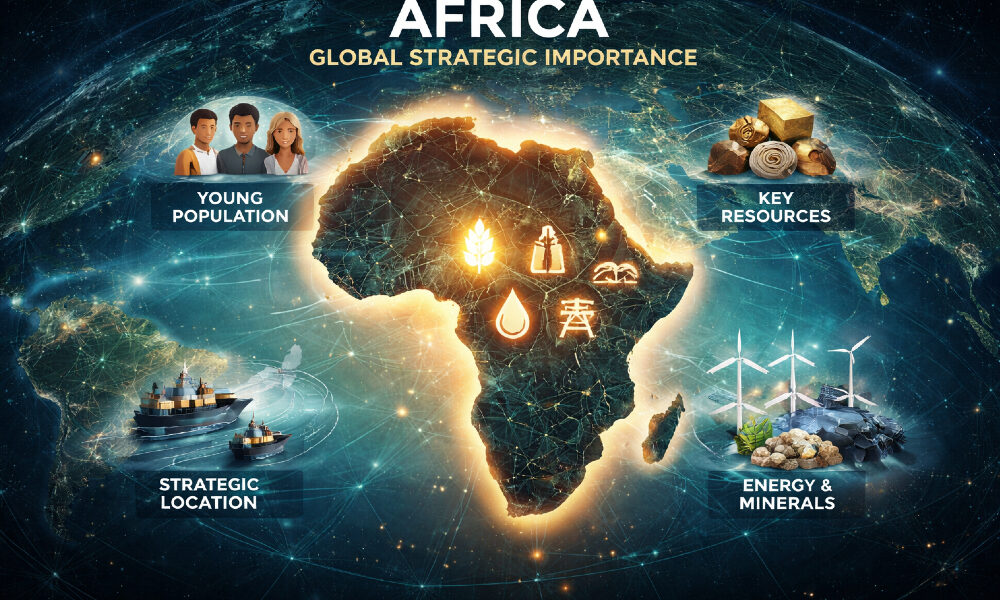
Africa’s first structural advantage is demographic. The continent is young – and growing younger relative to the rest of the world. While many regions face aging populations, shrinking workforces, and the fiscal strains of eldercare, Africa is carrying the largest wave of human potential on earth.
This youth is often framed as a risk – unemployment, instability, migration pressure. But youth is also strategic power. It determines future labor markets, future consumers, future innovation capacity, future military strength, and future cultural influence.
Demographics shape destiny. When a continent holds the world’s largest reservoir of future human capital, global strategy cannot afford to ignore it.
Africa is not merely a place where the future might happen. It is where a significant portion of humanity’s future will happen.
Africa is not merely a place where the future might happen. It is where a significant portion of humanity’s future will happen.
Resources and the New Age of Scarcity
Africa’s second structural advantage lies in its resources – but not in the simplistic, extractive sense that history has so often imposed. The world is entering an era in which resource security is being radically redefined.
It is no longer only about oil or gold. It is about the minerals that underpin modern technology, the land that sustains food resilience, water as a strategic asset, and the energy-transition materials that will power the next industrial cycle.
Africa sits at the intersection of all of these demands. This creates both opportunity and danger. The opportunity is real: Africa can leverage its position for fairer terms and deeper industrialization.
The danger is equally real: the history of extraction offers a stark lesson in what happens when a continent is resource-rich but institutionally fragile. Africa must now treat its resources not as commodities to be sold, but as strategic leverage – bargaining chips in a world that is becoming more competitive, not less.
Geography: The Forgotten Form of Power
Africa’s geographic position has always been strategically significant. The continent sits along crucial maritime routes, forms a bridge between major world regions, and is positioned near key global shipping lanes and chokepoints.
It is simply that Africa has not always been permitted to use this geography strategically.
In a world where trade routes are being securitized and contested, geography becomes power once again. When the world’s commercial arteries grow fragile, the location of continents reasserts itself as a form of leverage.
Africa cannot be treated as a backstage region in a world where the stage itself is being rebuilt.
The Multipolar Moment
Another reason Africa can no longer be ignored is the rise of multipolarity. As global power fragments, influence becomes competitive. Multiple powers seek partnerships, access, legitimacy, and alignment – and Africa increasingly becomes a region that many wish to court, economically, diplomatically, militarily, and culturally.
This is a new moment, but it carries an old risk. When many powers compete for a continent’s attention, that continent can either become a marketplace of advantage or a battlefield of interests. The difference is strategy.
Africa’s value in a multipolar world will not be determined by who approaches it. It will be determined by whether Africa approaches the world with coherence.
The Great Trap: Being Desired Without Being Strategic
There is a trap that has ensnared many regions throughout history: becoming desired without becoming strategic. When external interest rises, leaders often confuse attention with respect. Deals are celebrated for their headline size rather than their underlying structure.
Partnerships are judged by announcements rather than outcomes. Investment is welcomed without asking what is being built locally, what is being transferred, and what is being retained.
Africa cannot afford this approach in the world that is now emerging. The question is no longer whether Africa can attract interest – it clearly can. The question is whether Africa can convert that interest into sustainable, collective advantage.
In a world that wants Africa, strategy becomes the continent’s most valuable resource.
In a world that wants Africa, strategy becomes the continent’s most valuable resource.
The Burden of Relevance
Relevance sounds like victory. It is also a burden. When Africa becomes structurally important, expectations multiply. Pressures intensify. Influence is pursued with greater urgency. Decisions taken on African soil carry consequences well beyond its borders. Internal weaknesses become external vulnerabilities.
Relevance forces choice. It compels Africa to answer questions it has long postponed:
- What does Africa want from the world – and on what terms?
- What principles are non-negotiable?
- What kinds of partnerships are genuinely acceptable?
- What does sovereignty mean in an age of interdependence?
- How does Africa negotiate as a bloc when its institutions remain fragmented?
The world will not answer these questions for Africa. It will answer them about Africa – unless Africa answers them for itself.
From Symbol to Actor
The central shift now underway is this: Africa is moving from symbol to actor. For decades, it has been treated as a symbol – of suffering, of promise, of crisis, of charity.
But actors do not live as symbols. Actors negotiate, design, refuse, demand, and build.
This demands something deeper than policy reform. It demands a change of posture. Africa’s posture must evolve from receptivity to strategy – from being chosen to choosing, from being approached to setting terms, from being interpreted by others to speaking with its own coherence.
A continent that does not set its own terms is always set upon.
What Africa Must Learn – Quickly
If Africa is now unavoidable, then it must master – swiftly and collectively – a set of strategic disciplines that the current moment demands:
- Negotiation is not merely diplomacy; it is survival at scale. In a competitive world, the quality of negotiation determines whether relevance becomes prosperity or exploitation.
- Sovereignty is not isolation; it is leverage. True sovereignty is the capacity to choose, not the fantasy of standing alone.
- Unity is not sentiment; it is strategy. Without strategic alignment, Africa is approached as a collection of pieces rather than as a unified force.
- Development is not aid; it is power formation. Every major investment should strengthen Africa’s capacity to produce, not merely to consume.
- The future belongs to those who set the rules. Africa must move beyond being governed by frameworks it did not write and was not consulted to design.
Conclusion: Marketplace or Negotiating Force?
Africa is no longer on the margins of global planning. The world’s future – its labor supply, its resources, its consumer markets, its security architecture, its climate resilience, and its cultural direction – is now inextricably intertwined with Africa’s trajectory.
This is not sentimental recognition. It is structural reality. But structural relevance alone is not enough. The moment Africa becomes unavoidable is precisely the moment Africa must become strategic.
Because being wanted is not the same as being respected. And being included is not the same as being empowered.
Africa’s next chapter will ultimately be shaped by a single question: will the continent enter this new world as a marketplace – or as a negotiating force?
Daki Nkanyane is a South African – born Pan-African thought leader, entrepreneur, keynote speaker, and strategist with over 25 years of experience driving innovation, identity, and development across Africa. He is the Founder & CEO of Interflex Capital, AfrisoftLive, QonnectedAfrica, and iThinkAfrica, where he focuses on youth empowerment, entrepreneurial ecosystems, and Africa’s economic and ideological renewal. His work spans technology, digital transformation, major international events, and strategic advisory for future-ready African institutions. As a contributing writer for The Habari Network, Daki covers African innovation, leadership, human capital, economics, entrepreneurship, and Africa–Caribbean relations through cultural, philosophical, and developmental perspectives. His mission is to help shape a new African consciousness rooted in pride, possibility, and self-determination for Africans on the continent and in the diaspora. He can also be reached on Facebook and X.