Life
Will the UN face justice over the Haiti Cholera outbreak?
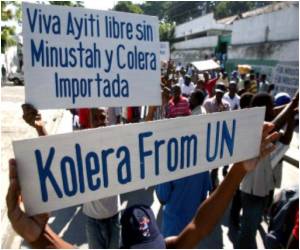
Four years into the world’s worst ever cholera epidemic, Haitians are still seeking compensation from the United Nations (UN), whose own experts have said it is “most likely” to blame for the deadly outbreak.
The cholera epidemic has killed more than 8,500 people in Haiti, and is continuing to claim victims – some 300 people are diagnosed with the disease each week, one of which, on average, will die.
Dozens of epidemiologists, including those appointed by the UN itself, have identified UN Nepalese peacekeepers stationed in central Haiti as the “most likely source of the outbreak”.
But with international health concerns now consumed by the Ebola outbreak in West Africa, thousands of families seeking amends worry that the UN will escape scrutiny for what lawyers describe as “gross reckless negligence”.
Three federal class action lawsuits, representing thousands of affected Haitian families, have been filed against the UN in the US. In 2013, Secretary-General Ban Ki-moon said the UN would not compensate any of the victims, citing a convention laid down in 1946.
In March this year, the US Justice Department sided with the UN, granting it immunity and recommending that the case be dropped.
But in a possible show of sympathy for the plaintiffs, a New York judge on Wednesday agreed to hold an oral hearing on October 23 for one of the suits (Georges vs. UN), addressing juridical questions and, critically, the immunity of the UN.
One of those facing scrutiny is Edmond Mulet, who led the UN Stabilization Mission in Haiti (MINUSTAH) at the time of the outbreak. Mulet has stringently disregarded the claims against him. In an interview with reporters, he dismissed all evidence incriminating the UN.
Mulet said that “it has not been proven that cholera was most probably brought in by Nepalese peacekeepers”. He also asserted that Nepalese peacekeepers had undergone the appropriate medical examinations ahead of their mission to Haiti, a claim contradicted by a UN-appointed panel of experts.
Shortly after the interview, Mulet’s press officer asked reporters not to air the recording.
Ban Ki-moon has also ignored requests for transparency on the issue. During a two-day trip to Haiti in July, reporters challenged the US Secretary General several times. Stressing that he was in the country “to bring a sense of hope and support,” Ban refused to answer questions concerning any potential apology or compensation to families of victims.
He was pictured meeting smiling locals and at dinner with Haitian President Michel Martelly and Prime Minister Laurent Lamothe. But beyond Ban’s security corps, a few dozen protesters gathered in the street holding banners, in both English and Korean, reading “Ban Ki-moon go home,” and “justice for the victims of cholera”.
Not everybody at the UN got the silence memo. Gustavo Gallon, a senior human rights expert who was appointed by the UN to report on the situation in Haiti, publicly disagreed with the body over its refusal to address the claims against it. “Silence is the worst of responses to a catastrophe caused by human action,” he said in March.
The UN Secretary General did not respond.
The UN has not ignored the epidemic itself. In December 2012, Ban pledged US$2.2 billion to efforts to wipe out cholera in Haiti through improved sanitation, one percent of which would come directly from the world body.
Pedro Medrano Rojas, the UN’s senior coordinator for the cholera response in Haiti, suggested in an interview with reporters in March this year that Ban’s “cholera implementation plan” and the UN’s attempts to gather funding for it was in fact a direct response to the thousands of legal complaints.
“It is important to remember that we are operating within a legal framework approved by the international community,” Medrano Rojas said in defence of the organization’s immunity from prosecution.
Instead, he added, the UN has responded by “trying to convince the international community that now is the time to stop the outbreak and the transmission of this disease”.
After losing friends and family to cholera, Haitian artist Monvelyno wrote a song about the crisis. The lyrics directly target the United Nations: “January 12 brought us pain and death. We should’ve been able to mourn and cry. But everything got worse. The UN takes our land and pays us with tombs. After the earthquake came Nepal’ s cholera on Quisqueya (the indigenous name for Haiti).”
Speaking in Little Haiti in Brooklyn, Monvelyno told reporters: “You cannot resurrect the people that died but you can at least go to the family and to say it was not intentional and we feel sorry for what happened – anything that the UN can do would show that they are sorry.”
But the UN has failed in almost 2 years to gather more than 12 percent of the funding needed for just one year. In July this year, Ban was forced to make the same pledge of US$2.2 billion, dressing it up with a new name – the “Total Sanitation Campaign”.
Wednesday’s decision by US District Judge J. Paul Oetken signals a heartening shift in the dispute, which was largely expected to go nowhere. It is suspected that the court will rule that the UN has immunity.
One of the lawyers representing Haitian victims is Mario Joseph. He says that the UN has gone to great lengths to cover up alleged wrongdoing by diverting the Meye river from where it used to flow next to the wall of the base.
“The contractor did not treat the fecal matter properly. They dumped the feces in a hole which was not covered,” he said. “When it rained, fecal matter would overflow into the river.”
The contractor is Haiti’s most lucrative sanitation service, Sanco. After the cholera outbreak and the revelations that followed, the US Department of Defense stopped working with Sanco. The United Nations, however, chose not to cut ties with the company. Instead, the UN has awarded Sanco millions of dollars’ worth of contracts over the past 4 years, including the construction of medical buildings which are undoubtedly used to treat cholera patients.
The improper disposal of feces was only the second part of a catastrophic process. The UN has also been blamed for failing to screen peacekeepers – who were sent to quell post-earthquake unrest from Nepal, where a cholera epidemic was underway.
Before September 2010, cholera had not existed in Haiti for more than 150 years. Only days after the arrival of Nepalese peacekeepers, a 28-year-old local was found dead after drinking river water downstream from the site.
“The UN, not intentionally but with the greatest level of negligence, gross reckless negligence, inflicted a disease on the people of Haiti when they were already suffering so much,” Jospeh said.
Source: AFP