Opinion
The Digital Tractor and Africa’s Agrarian Future
Precision agriculture is already reshaping how the world grows food. For a continent on the cusp of a population explosion, the stakes could not be higher.


By Jean Claude Niyomugabo
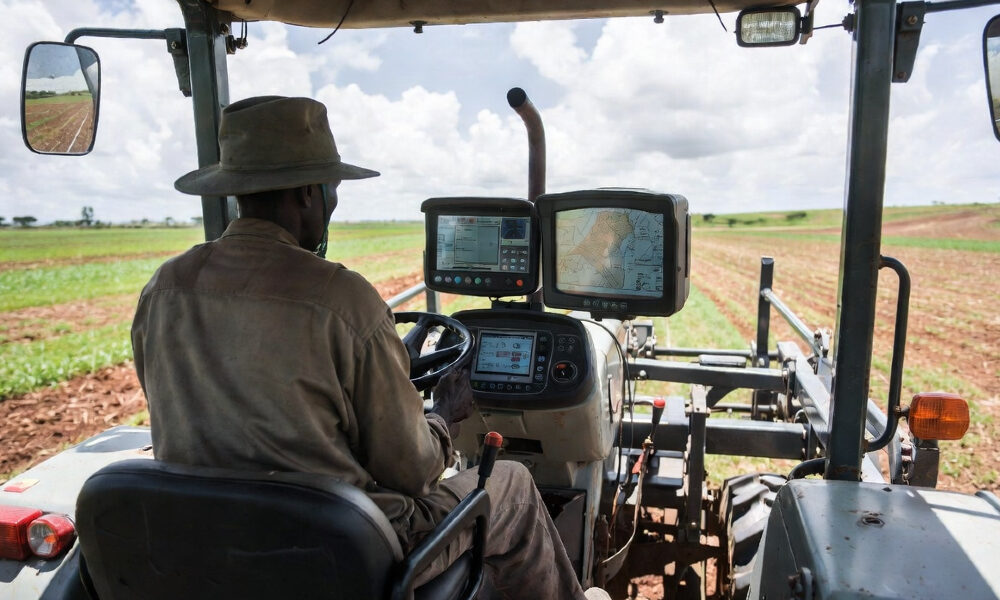
Step inside a modern tractor, and the first thing you notice is that it no longer resembles a machine. It resembles a command center.
From the moment the operator sits down, screens materialize on every side – displaying soil conditions, moisture levels, and GPS-guided pathways with a clarity that would have seemed fantastical a generation ago.
Application rates adjust in real time. Field irregularities are flagged before a wheel crosses them. Decisions that once required years of accumulated instinct can now be verified, corrected, and optimized within seconds.
This is precision agriculture, and it is already here. The more pressing question is whether Africa will be among its beneficiaries – or merely its observers.
Continent Cannot Afford To Fall Behind
The demographic arithmetic is unforgiving. Sub-Saharan Africa’s population is projected to roughly double by 2050, adding more than a billion people to a continent already straining to feed itself.
Agricultural productivity growth has consistently lagged behind population growth across much of the region. Climate volatility is tightening the margins further. Against this backdrop, the emergence of data-driven farming is not simply a technological novelty. It is a structural necessity.
What precision agriculture offers, at its core, is the elimination of guesswork. Traditional smallholder farming – which defines the overwhelming majority of Africa’s agricultural sector – depends heavily on experience, intuition, and inherited practice.
These are not weaknesses; they represent generations of accumulated knowledge. But they are no substitute for real-time data on soil nitrogen levels, canopy density, or rainfall forecasts calibrated to a specific hectare.
The modern tractor does not replace the experienced farmer. It amplifies what a skilled operator can accomplish within a single working day.
Input waste – fertilizer applied too broadly, water drawn beyond what the crop requires, pesticide used without precision targeting – represents one of the most significant and correctable sources of agricultural inefficiency on the continent. Precision technology addresses this directly, turning every application decision into a data-informed choice rather than an educated approximation.
Redefining What It Means To Farm
The implications extend beyond yield optimization. Precision agriculture is quietly reconfiguring the skills demanded of agricultural workers.
Operating equipment competently remains essential, but the role now encompasses something closer to systems management: interpreting sensor outputs, understanding algorithmic recommendations, diagnosing anomalies flagged by onboard diagnostics. The farmer of 2030 will increasingly need to be, in part, a data analyst.
This represents both an opportunity and a challenge for Africa’s agricultural workforce. The opportunity lies in the transformative potential of upskilling a young and growing rural labor pool – one that, in much of the continent, is already more comfortable with smartphones than its predecessors were.
Mobile agriculture platforms, drone-based crop monitoring, and AI-assisted advisory services are already finding adoption among smallholders in Kenya, Nigeria, and Ghana, often without the formal training infrastructure that supported precision agriculture’s rollout in North America or Western Europe.
The challenge is more structural. Access to the hardware itself remains deeply unequal. A tractor equipped with guidance systems, variable-rate application technology, and real-time telematics costs far more than most smallholder operations can absorb individually.
Infrastructure gaps – inconsistent connectivity, unreliable power supply, limited technical support networks – further complicate deployment. And the data ecosystems that make precision agriculture most effective depend on consistent land tenure arrangements that remain contested across large portions of the continent.
The Infrastructure Of Adoption
None of these obstacles is insurmountable, but none will resolve itself passively. What is required is deliberate policy architecture – investment in rural connectivity, public support for cooperative equipment-sharing models, and agricultural education curricula that treat digital literacy as foundational rather than supplementary.
Equally important is the question of who owns the data that precision agriculture generates. As private technology companies expand their footprint across African agricultural markets, the terms on which farmer data is collected, stored, and monetized will shape whether these tools empower growers or simply extract value from them.
Getting this governance right matters enormously.
Governments, development finance institutions, and the private sector all have roles to play. The window for getting the framework right is narrowing alongside the demographic curve.
The Future Is Not Waiting
The tools exist. The need is acute. And the populations that stand to benefit most from agricultural productivity gains are the very ones whose food security trajectories are most precarious.
There is a tendency, in discussions of agricultural technology, to treat adoption as an eventual inevitability – a question of when, not if. This is dangerously complacent.
Technology does not distribute itself equitably by default; it follows the path of existing infrastructure and purchasing power. Without active intervention, Africa risks becoming a continent that produces the food demand that justifies these technologies while remaining excluded from the productivity gains they enable.
The modern tractor, bristling with sensors and connected to satellite systems, is already farming someone’s fields somewhere in the world. The real question is not whether this transformation is underway. It is whether Africa’s farmers – and the policymakers who shape their operating environment – are positioned to be its authors, rather than its audience.
Jean Claude Niyomugabo is an entrepreneur and digital communication specialist with a strong passion for Africa’s development. He is dedicated to harnessing the power of social media to drive positive change and enhance livelihoods. With diverse interests and a strategic approach to digital engagement, he strives to create meaningful impact through innovation and connectivity.