Business
South Africa:Nissan halts production as work stoppage intensifies
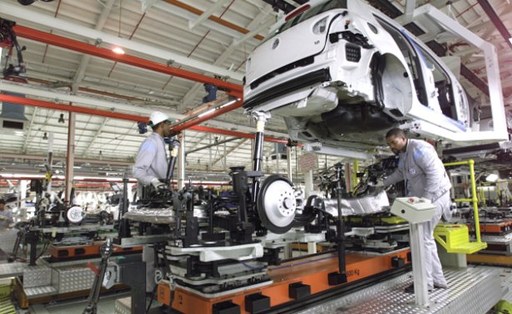
South African Workers at vehicle assembly plant. PHOTO/Volkswagen South Africa
Nissan Motor Corporation has joined auto makers including Toyota Motor Corporation and Ford Motor Corporation in halting production in South Africa as a work stoppage by metalworkers cut auto-component supplies.
Nissan has temporarily closed its production plant in Rosslyn, near the capital Pretoria, from July 14 to July 21, the company’s South African unit said in an e-mailed response to questions today. If the work stoppage that began on July 1 continues “into the following week, Nissan South Africa may have to reconsider its production schedule,” it said.
The stoppage by more than 220,000 members of the National Union of Metalworkers of South Africa (NUMSA), the nation’s largest labor union, has disrupted manufacturing output, threatening an economy still reeling from a 5-month strike by platinum mineworkers that ended in June.
“We are hoping for a speedy resolution to the strike as a prolonged stoppage affects our reputation as a supplier as well as our competitiveness,” Nissan said. The auto maker produces about 225 vehicles a day at its Rosslyn plant.
The Steel and Engineering Industries Federation of Southern Africa (SEIFSA) yesterday withdrew its offer to raise pay by 10 percent in the first year, 9.5 percent in the second and 9 percent in the third. NUMSA rejected the offer on July 13.
The union plans to intensify its strike by calling on 140,000 members in other industries to also down tools, Stephen Nhlapo, head of bargaining at NUMSA, said by phone today.
The stoppage is costing the metals and engineering industry about 300 million rand (US$28 million) a day, according to Nyatsumba Kaiser, CEO of SEIFSA, as the employers’ lobby is known.
South Africa’s gross domestic product (GDP) declined 0.6 percent in the first quarter, compared with an expansion of 3.8 percent in the final 3 months of last year. The contraction, partly caused by the mining stoppage, was the first since a 2009 recession.
Source: Bloomberg