News
South Africa: Supreme court rules that Dalai Lama visa delay ‘unlawful’
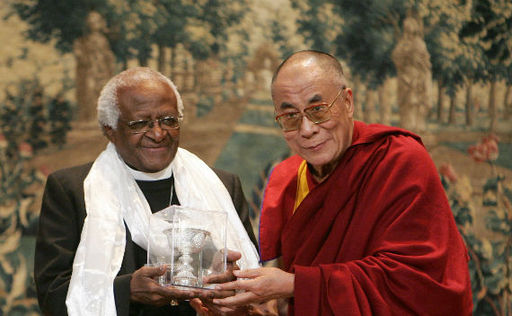
Spiritual leader of Tibet, the Dalai Lama (r), presents the International Campaign for Tibet’s Light of Truth Award to South African Nobel Laureate Archbishop Desmond Tutu. PHOTO/Thierry Roge/REUTERS
A South African court ruled Thursday that officials “unreasonably delayed” a decision about whether to grant the Dalai Lama a visa for a planned 2011 trip, largely out of fears of angering the Chinese government.
The Supreme Court of Appeal’s decision heavily criticized former Home Minister Nkosazana Dlamini-Zuma, who now serves as the chair of the African Union Commission. While only ordering the African National Congress-led government to pay court costs, the ruling is a legal embarrassment to South Africa.
“What is justified by the evidence is an inference that the matter was deliberately delayed so as to avoid a decision,” reads the ruling by Judge R.W. Nugent. “It hardly needs saying that the minister is not entitled to deliberately procrastinate. Procrastination by itself establishes unreasonable delay.”
The Dalai Lama was welcomed to South Africa in 1996 and met with the country’s first black and democratically elected president, Nelson Mandela. But in 2009, the South African government kept the Dalai Lama from attending a Nobel laureates’ peace conference, saying it would detract attention from the 2010 soccer World Cup.
The spiritual leader later made plans to travel to South Africa in October 2011 to attend the 80th birthday party of a fellow Nobel laureate, Archbishop Desmond Tutu. He and others in his entourage applied for visas through the South African High Commission office in New Delhi about two months ahead of the planned visit, according to the court ruling.
Despite meeting all the requirements, the South African government did not issue the visa and the Dalai Lama ultimately withdrew his application. In his ruling, Nugent acknowledged that pressure from China, a major trading partner with South Africa, played a part in the delays. The Dalai Lama wants increased autonomy for Tibet, the homeland from which he has been exiled since 1959. China accuses him of being a separatist.
“I accept that the proposed visit raised matters of high diplomatic importance, justifiably calling for consultation, advice and consideration,” the judge’s ruling reads. “But that begs the question what time was required to complete that process.”
However, the judge said he did not find any evidence that officials had plans to deny the visa outright.
Rights groups, academics, opposition parties and newspapers in South Africa had joined Tutu in pressing their government to grant the Dalai Lama a visa. When the leader ultimately couldn’t come to South Africa, Tutu blasted the ANC government before reporters, calling it “worse than the apartheid government, because at least you were expecting it with the apartheid government.”
Dlamini-Zuma resigned her position as minister and later took over as leader of the African Union Commission. She could not be immediately reached for comment Thursday.
Copyright 2012 The Associated Press