Business
South Africa: Industrial action cripples auto industry
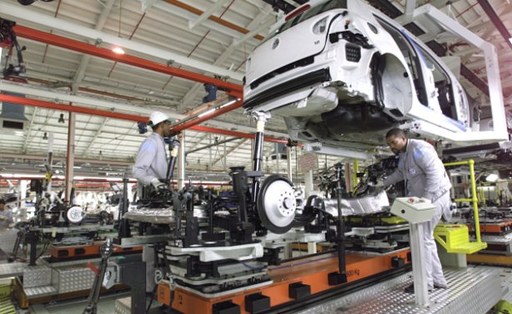
South African Workers at vehicle assembly plant. PHOTO/Volkswagen South Africa
South Africa’s auto manufacturing industry came to a near standstill on Monday when about 30,000 workers downed tools, adding to the labor woes of the continent’s largest economy which has recently been hit by labor unrest at its mines.
The stoppage would cost the industry about ZAR 600 million (US$ 59 million) a day in lost production, the National Association Automobile Manufacturers of South Africa (NAAMSA) said.
“The industrial action affects the entire value chain of the industry,” NAAMSA director Nico Vermeulen said.
Five of the seven companies operating in the South African auto sector, including Toyota, Ford and General Motors, said production had been halted or affected.
Underpinned by government incentives, the industry contributes at least 6 percent to gross domestic product (GDP) and accounts for 12 percent of exports.
A fresh round of labor unrest will be a political headache for President Jacob Zuma and the ruling African National Congress (ANC) ahead of elections next year.
The strike was called last week by the National Union of Metalworkers of South Africa (NUMSA), its largest manufacturing union, which wants pay hikes of 20 percent for its members, compared with inflation at 5.5 percent.
The auto companies are offering a 6 percent increase.
The South African central bank has warned about the inflationary impact of high wage settlements on consumer prices, however, workers are stretched financially and often have several dependents.
Labor unrest also looms in the mining sector with unions seeking pay rises of up to 150 percent, which companies say they can ill afford as metal prices slump.
Industrial unrest in the mining industry has slowed economic growth, hit the rand currency and led to sovereign credit downgrades.
President Zuma and his ANC party have faced heavy criticism for their handling of last year’s wave of wildcat strikes in the mines, which also dented growth and alarmed investors.
Elias Kubeka, national motor sector coordinator for NUMSA, said the auto industry strike was “very well supported and all of the factories, 100 percent, are shut down”.
Toyota said 80 percent of its 8,000-strong South African workforce had not turned up for work, while Guy Kilfoil, a spokesman for BMW in South Africa, said that the industrial action was costing it 345 cars a day.
Wages in the auto sector range from about US$850 a month for basic workers to US$1,800 a month for qualified technicians.
Source: Reuters