News
Senegal: President Wade and Macky Sall face off in 2nd round vote
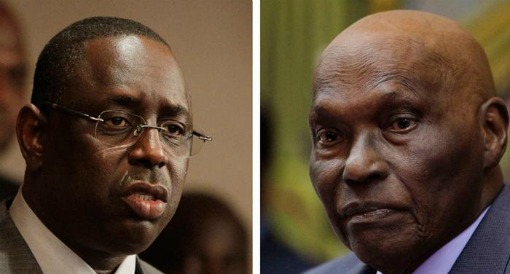

Opposition candidate Macky Sall (l) and incumbent president Abdoulaye Wade
Abdoulaye Wade received an unlikely phone call from the president conceding defeat after the 2000 election. Now many wonder whether Wade himself will be as willing to step aside if he loses Sunday’s runoff vote after 12 years in power.
Already Wade’s decision to seek a third term at the age of 85 has infuriated many Senegalese, some of whom booed him as he voted last month shouting: “Old man, get lost.”
He fell short of the 50 percent needed to avoid a runoff, receiving only 34.82 percent. He faces off Sunday against the very man who ran his last campaign five years ago, former Prime Minister Macky Sall, who received 26.58 percent and now has the support of the dozen other opposition candidates who ran in the first round.
On the streets of Senegal’s capital, vandalized posters of Wade’s face have his eyes scratched out. His convoy also was hit by rocks in the final days of the runoff campaign.
“In the short term, a Wade victory won fairly or foully would be tremendously controversial. I think he’s kind of pushed Senegalese patience to the limit. And I think it would be understood as a fraudulent election by many Senegalese,” said Jennifer Cooke, the director of the Africa program at the Center for Strategic and International Studies in Washington.
“His victory would be a bridge too far. Even if he wins legally, it will be assumed that he won fraudulently.”
Wade has overseen unprecedented economic growth in this country of more than 12 million on Africa’s western coast, with new buildings sprouting up everywhere across the seaside capital of Dakar.
However, those gains have not trickled down to most Senegalese voters, who have battled against rising costs of living, unemployment and frequent power cuts.
Violent protests leading up to the election this year have left at least six people dead, and analysts have warned of further unrest if Wade wins Sunday’s vote.
Senegal, one of the region’s most mature democracies, is a rare place in sub-Saharan Africa where voters could successfully oust a longtime incumbent at the ballot box Sunday.
By comparison, mutinous soldiers in neighboring Mali launched a coup in recent days that has forced President Amadou Toumani Toure into hiding after a decade in power. In Ivory Coast, longtime incumbent Laurent Gbagbo refused to concede defeat, bringing the country to the brink of civil war.
In Senegal, Sunday’s race is being portrayed as a choice between the incumbent elder or the younger Sall, who was born after Senegal won its independence from France. “In the name of the father or the son,” read the headline on the front page of Le Quotidien.
Sall, 50, is a geologist by training who worked for years under Wade, even leading his 2007 campaign. The two, though, had a subsequent fallout and now Wade has taken to describing Sall as an apprentice who has not yet taken in “the lessons of his mentor.”
“Senegal needs someone who will do more than me. We don’t want people who improvise, lacking in personality,” Wade said during a recent campaign stop in the city of Thies, the state-run Le Soleil newspaper reported.
In an interview at his Dakar home on Saturday, Sall told reporters that he hoped Wade would respect the ballot’s outcome.
“With him, one never knows. In any case, Wade was 25 years in the opposition and he became president afterward,” Sall said. “If he is beaten, he must accept it.”
The United States already has called Wade’s candidacy “regrettable” and a threat to the country’s democracy.
Wade was once considered among the rare African leaders committed to democracy in a neighborhood better known for rule by strongmen. His image began to suffer after he began giving an increasing share of power to his son Karim, who was derisively called “the Minister of the Sky and the Earth” after he was handed control of multiple ministries including infrastructure and energy.
The president also tried to rush a law through parliament that would have reduced the percentage a candidate needed to win on the first round from 50 to around 25 percent. He was forced to scrap the proposal after riots immobilized the capital.
Wade has insisted on running for a third term, even though he revised the constitution after he came to office to impose a two-term maximum. But he insists that when he goes, so too will his unpopular son.
“He will go with me, but he could after my departure, create his own party and win power,” Wade told Le Soleil.
Copyright 2012 The Associated Press.