News
New China President Xi Jinping embarks on Africa tour
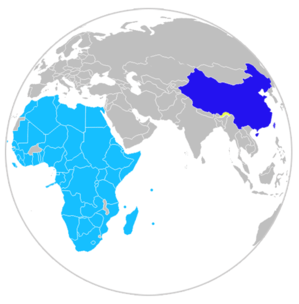
The new president of China, Xi Jinping, lands in Dar es Salaam, Tanzania on Sunday at the beginning of a three-country tour of Africa. He faces growing calls from economists and policymakers in Africa for a more balanced trade relationship between the continent and China. His African tour is symbolic of an ongoing fundamental shift in the global balance of power, and the recognition and acknowledgement of Africa’s growth and emergence on the global stage.
President Xi will visit Tanzania, the Republic of Congo and South Africa. The choice of these countries, points to China’s historical alliances, its current friendships and the future of its economic interests. China’s ties with Africa dates back to the 1950s, when China backed many African liberation movements fighting to throw off Western colonial rule.
“The decision to visit these countries was obviously very well considered. If one analyzes the strategic advantage of these countries to China, it is possible to paint a near-accurate image of the global community in the coming decades,” said Foreign Service Institute director of Kenya, Dr Philip Mwanzia.
Many across Africa see China as a valuable counterbalance to the West’s influence, however, as the relationship matures there is mounting discomfort in Africa that the continent is exporting raw materials while spending heavily to import finished consumer goods from the Asian economic powerhouse. President Xi will be looking to tone down the feeling that China is in Africa to exploit resources, said James Shikwati, director of the Nairobi-based Inter Regional Economic Network think-tank.
President Xi’s visit to Tanzania tells of historical associations, his visit to the Republic of Congo is reflective of the fact that China’s engagement with Africa is fundamentally different from the arguably failed path the West had adopted with the continent. The Republic of Congo never ranked highly in the priorities of either the Americans or the Europeans. In South Africa, President Xi’s tour will culminate at the fifth summit of the BRICS (Brazil, Russia, India, China and South Africa) bloc of emerging economies.
The BRICS states, have been experiencing booming growth and are expected to have a significant influence in the shape of the world economy over the coming decades. Africa, with its vast natural resources, will feature greatly and will fuel the engine that drives this century’s economy.
The rise of the BRICS is viewed by many as the symbolic death knell to the post-Cold War unipolar global power system with the United States at the helm. “We have been steadily moving away from the unipolar system, but we are now seeing the actual realization of a multipolar system. There is an economic reconfiguration that may transmit itself into other areas of international engagement,” Prof Macharia Munene of the United States International University in Nairobi said.
Not everyone in Africa is excited about China’s “foray” into Africa; Nigeria’s central bank governor Lamido Sanusi warned that Africa’s relationship with China carried a “whiff of colonialism.” He has argued that China is pursuing extractive policies that are undermining local manufacturing and “de-industrializing” Africa.
Africa, he says, is carrying a torch for the romance of the Non-Aligned Movement that united China and Africa. China has since ceased to be an underdeveloped state and has as much capacity to carry out mass exploitation as any Western power. “Africa must recognize that China – like the US, Russia, Britain, France and the rest – is in Africa not for African interests but its own. The romance must be replaced by hard-nosed economic thinking,” he wrote.
China is criticized for using Chinese workers on infrastructure and mining projects in Africa. Beijing estimates almost 1-million Chinese are working in Africa.
Zhong Jianhua, China’s special envoy to Africa has acknowledged that Chinese companies have faced criticism for flooding Africa with Chinese workers. “We have told Chinese companies that they cannot just use Chinese workers,” he said. “I think most Chinese firms now realize this.”
Sources: The Africa Review; Reuters