Opinion
Malawi democracy is more mature than it is given credit for
By Jimmy Kainja
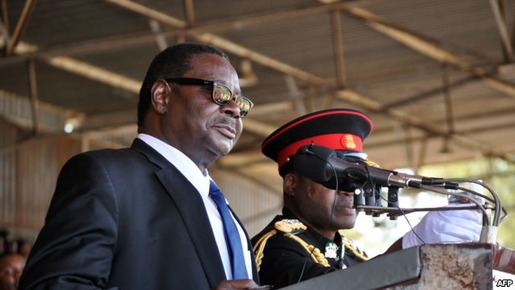
Malawian President Peter Mutharika addresses the nation shortly after he was sworn into office, June 2, 2014. PHOTO/AFP
Slightly over 20 years ago, on June 14 1993, the citizens of Malawi voted in a referendum to decide if they wanted to continue with one-party rule or adopt multiparty democracy. Sixty-four percent of Malawians voted against a one-party system. The referendum thus ended a ban which had been in place for over 30 years, on all political opposition in the country.
Prior to this referendum, the then ruling party Malawi Congress Party (MCP) was the only legitimate political grouping.
By opting for multiparty democracy, Malawian voters not only rejected the one-party system but departed from a certain ideology. Malawi now had a population that was no longer, “united under one ideology.” And when people are ideologically divided, tolerance provides key social threads that knit the societal fabric together.
This past weekend marked 21 years of multiparty democracy in the country. A number of social, economic and political factors indicate that Malawi has some way to go before it can become a truly tolerant society. Like all societies, Malawi has a historical context in which these issues must be understood.
Malawi attained democracy on the backdrop of 71 years of colonialism followed by 30 years of authoritarian rule. These regimes made the people of Malawi inward looking: any concept, culture and way of living deemed unfamiliar to “Malawian culture” was to be rejected and avoided at all costs.
This is what sustains oppressive regimes. It is a huge ask that Malawians become a tolerant society overnight. However, a sober look at the last two decades of the country’s democracy shows it is more mature than most critics would give it credit for.
Malawi has faced challenges that have tested its strength, maturity and resolve including:
– former president Bakili Muluzi’s (in office between 1994 – 2004) attempt to change the constitution in a bid to increase presidential term limits so that he could seek a third term in office; the country’s parliament voted against Muluzi, and democracy ultimately prevailed.
– Bingu wa Mutharika (in office between 2004 – 2012), Muluzi’s handpicked successor whose sudden death in office on April 5 2012 triggered a political transition, was another moment that tested the country’s democracy. Mutharika’s loyalists attempted to block Malawi’s then vice-president Joyce Banda’s succession of Mutharika as per constitutional stipulation. Again, the rule of law prevailed and Banda was sworn in on April 7 2012 as the fourth president of Malawi.
– Joyce Banda lost this year’s elections to Peter Mutharika. She is the first incumbent president to lose an election since Malawi adopted multiparty democracy. She conceded victory to Mutharika. This was yet another test for Malawi’s democracy, and the country passed it.
It is not unheard of that some sitting presidents have refused to accept defeat and have settled for power-sharing deals. It happened in in Zimbabwe in 2008 and in Côte d’Ivoire in 2010 when then president Laurent Gbagbo refused to concede electoral defeat, and thus plunging the country into crisis.
Malawi, like many African democracies, has a some ways to go, especially in the areas of social, economic and human development. There is too much politicking in the country, which takes more precedence than service delivery. Recent statistics indicate that close to fifty-two percent of Malawians live below the international poverty line. Service delivery, though improving, remains poor.
Findings by Water for People – an NGO advocating for safe drinking water in the country since 2000, show that only 62 percent of peri-urban areas have access to water that meets government standards, while in rural areas only 45 percent of people have access to safe drinking water.
These are the areas where democracy has clearly failed to deliver in Malawi. If left unchecked, it could result in voter apathy, which is harmful for a developing democracy. We need people to continue participating in politics, but if voting patterns are anything to go by, Malawians are already losing trust in politicians and the parties they represent.
The number of independent parliamentarians in the country has grown with every election. There was no single independent member of parliament in 1994 when Malawians voted for the first time in a multi-party environment. Ten years later, 40 independent MPs won elections. The 2014 elections produced more independent MPs – 52 – than any political party.
There is this general perception that African democracies are flawed, which is not without justification, however, which democracy is perfect? The danger of this view is that we tend to concentrate on the negatives only.
Malawi’s democracy has shown resilience over the past 20 years. Service delivery and political scandal continue to cast a shadow but when it comes to succession, politicians in Malawi have always respected the rule of law, which is a good sign for any democracy.
Jimmy Kainja is a professor at Chancellor College, University of Malawi. He has a blog at www.jimmykainja.co.uk.