News
Kenya: Deputy President William Ruto pleads not guilty to ICC charges
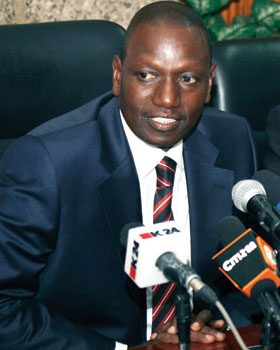
Kenya’s Deputy President William Ruto (pictured), pleaded innocent to crimes against humanity charges at the International Criminal Court (ICC) on Tuesday.
As the parties took their places in the courtroom before the judges arrived, Ruto appeared relaxed, laughing and smiling with his lawyers. Joshua arap Sang, his co-accused, gave a reporter the thumbs-up sign.
Ruto and Sang are charged with co-orchestrating a post-election bloodbath over 5 years ago, working with co-conspirators to murder, deport and persecute supporters of rival political parties in Kenya’s Rift Valley region.
“The crimes of which Mr. Ruto and Mr. Sang are charged were not just random and spontaneous acts of brutality,” said Fatou Bensouda, the ICC’s prosecutor, describing the charges in court.
The trials of Ruto and that of Kenyan President Uhuru Kenyatta, which will start in November, have split public opinion, and witness testimonies of the violence in 2007-08 that killed more than a thousand people could stir tension.
The cases are also a major test for prosecutors at the decade-old Hague-based ICC, who have had a low success rate and face accusations of focusing on African countries, while avoiding war crimes in other global hotspots.
Kenyatta, Ruto’s former rival who became a political ally, faces similar charges of crimes against humanity.
Late last, Kenyatta and Ruto joined forces for another presidential election, which was very successful. Their joint Jubilee Alliance ticket was elected in March after a campaign in which the ICC charges against the two men played a central role.
Western nations, who see a stable Kenya as central to the fight against militant Islam, have already found their ties with east Africa’s biggest economy complicated by the charges.
Ruto, is voluntarily obeying a summons to attend sessions, and was accompanied by several supporters.
The court’s public gallery was packed with dozens of Kenyan lawmakers who had traveled to The Hague in a show of solidarity with their deputy president.
In laying out the case, prosecutor Bensouda said Sang had used his prime-time radio show to pass messages to a network that was behind the violence. The broadcaster shook his head and smiled at his lawyer as Bensouda spoke.
The cases may have helped Ruto and Kenyatta into office as campaigners rallied nationalist support by accusing the court and western nations of meddling in the country.
The violence shattered almost shattered Kenya’s reputation as one of Africa’s most stable countries – however, the country has made great strides forward and is presently one of Africa’s fastest growing economies.
Anger over the charges culminated last week in a vote in parliament calling for Kenya to withdraw from the international court’s jurisdiction. Kenya threatened to suspend cooperation with the ICC if the president and his deputy were summoned simultaneously, leaving no head of state in residence.
Judges insisted the cases would alternate at one-month intervals. Even if Kenya does quit the court, trials already under way will continue.
According to Ruto’s lawyer, Karim Khan, the accusations were designed to distract attention from a fundamentally weak prosecution case.
“This case will fall apart in the end. But it will fall apart because of lack of evidence because of the deficient investigations conducted, and not for any other reason.”
Source: Reuters