Business
Investing in Africa: Opportunities, Gaps, and How to Do It Right


By Lailla Mutajogera
The most important investment opportunity of the next decade is not in artificial intelligence, not in green energy, and not in the next Silicon Valley unicorn. It is in a continent of 1.5 billion people – 60 percent of whom are under the age of 25 – where cities are expanding at 4 percent per year, demand is surging across every sector, and local supply simply cannot keep pace.
That is not a risk narrative. That is a structural gap.
For investors who are genuinely considering entering African markets – whether for the first time or returning after a previous attempt – the strategic imperative is the same: stop treating the continent as a monolith, and start treating it as a collection of sovereign, differentiated economies with distinct opportunities and constraints.
Choose a Country. Choose a Sector. Then Do the Work.
The single most common mistake foreign investors make in Africa is arriving with a pan-continental thesis and no operational specificity. The continent encompasses 54 countries, dozens of legal frameworks, and wildly divergent infrastructure realities.
Broad exposure is not a strategy – it is a liability.
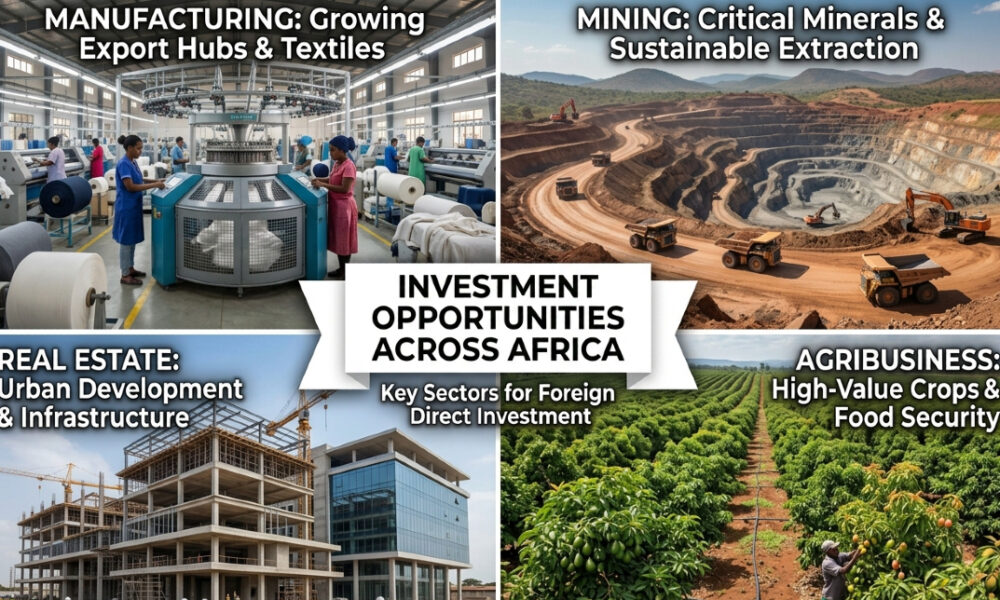
The sectors commanding serious attention right now are well-defined. Industrial and manufacturing investment addresses a production deficit that import dependency has masked for decades.
Mining offers high margins in markets rich with critical minerals, though it demands rigorous structuring and genuine local expertise – not just local optics. Real estate and infrastructure investment is being driven by urbanization rates that are outpacing housing supply in virtually every major city.
And agribusiness, despite strong demand growth, remains constrained by inadequate processing capacity – a gap that represents both a challenge and an entry point. Each of these sectors rewards investors who understand the terrain. None of them forgive those who do not.
On-the-Ground Intelligence Is Not Optional
No market research report, no matter how authoritative, substitutes for direct engagement with people who are operating in the market today. The difference between an opportunity that exists and one that merely appears to exist is often invisible from the outside – and devastatingly clear once capital has been deployed.
Investors who have succeeded in African markets consistently share a common discipline: they ask hard questions early, verify assumptions rigorously, and build relationships before they build positions. The investors who have failed are often those who moved on narrative momentum alone.
Time and capital are finite. Chasing opportunities that are not real wastes both.
The Logic and Emotion of Market Entry
There is a tendency in investment analysis to treat the human dimension of market entry as secondary – a soft consideration subordinate to the numbers. This is a mistake, and in African markets it is a particularly costly one.
The quantitative case is compelling on its own terms: a fast-growing population, rising consumer demand, limited local production capacity, and government-level incentives in countries including Rwanda, Ghana, Zambia, Guinea, and Uganda – among them tax holidays, reduced corporate tax rates, and sector-specific benefits designed explicitly to attract foreign capital.
But the qualitative dimension is equally decisive. Relationships, trust, and community standing are not peripheral to business success in these markets – they are foundational to it.
Investors who enter with extractive intent, or who treat local partnerships as regulatory formalities rather than genuine collaborations, tend to encounter friction that no incentive package can offset.
The investors who build lasting positions are those who understand that they are not simply entering a market. They are entering a social and economic ecosystem – one with its own history, its own skepticism of foreign capital, and its own definition of value creation.
The Right Question
The question that serious investors should be asking is not whether Africa represents an opportunity. The structural data settles that debate.
The right question is whether a given investor is prepared to enter ethically, operate with discipline, and create value that is visible and meaningful to the communities in which they are investing.
If the answer is yes, what awaits is not merely exposure to a high-growth market. It is the opportunity to build something durable – in economies that need production capacity, infrastructure, and investment credibility far more than they need another speculative wave of foreign interest.
The supply gap is real. The question is who will fill it, and how.
Lailla Mutajogera is an investor, entrepreneur, and CEO of Muta Investment Firm, a cross-border investment company with operations in Uganda, Rwanda, and Dubai. She specializes in connecting global investors with high-impact opportunities in African markets, focusing on commercial real estate, tourism, agribusiness, and asset management. Committed to practical, growth-driven investments, she champions projects that drive sustainable development across the continent.