News
Guinea: Vote counting continues after legislative elections that could usher in a new level of political stability
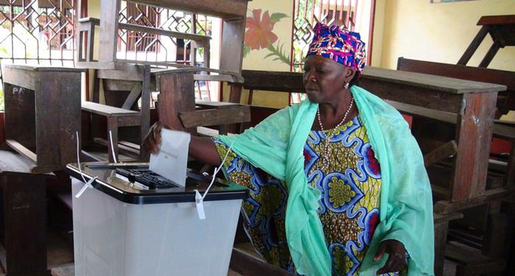
Voter casts ballot in Guinea legislative elections. PHOTO/Reuters
Guineans voted in the first parliamentary elections for more than a decade in the once troubled west African nation, after numerous delays.
Voters on Saturday, September 28, chose from more than 1,700 candidates vying for 114 seats in a national assembly, which will replace the transitional body that has been running the country since military rule came to an end in 2010.
The vote, originally due within six months of the swearing-in of President Alpha Conde in 2010, had been delayed amid disputes over its organization, stoking tensions that have dogged Guinean politics since the country’s independence in 1958.
No major incident was reported Saturday.
“We faced the challenge of a huge turnout, and a participation rate of over 80 percent. We had a calm day of voting and there was no violence – Guineans behaved well,” election commission chief Alpha Yero Conde told reporters.
Large crowds gathered in the capital Conakry for what was regarded as Guinea’s first genuinely democratic parliamentary election. Polls held during the military dictatorship in 2002, which were faced with opposition boycotts, were widely dismissed as a sham.
“These elections will allow us to emerge from a chaotic 5-year transition,” the president told reporters on the eve of the vote, expressing the hope that Guinea was about to enter a new era of prosperity.
Ballot-counting began in some polling stations as soon as voting ended, continuing into the small hours under lamp and torch light in some Conakry centers. Complete provisional results aren’t expected until Wednesday, October 2.
Conde’s main rival Cellou Dalein Diallo said many “anomalies” about which his party had complained had not been corrected – without elaborating – and accused the president’s party of trying to “cheat”.
Problems were reported in several polling stations in Conakry and in the regions, with heavy storms keeping voters away.
Some centers stayed open beyond the official cut-off time to complete 10 hours of voting. But many stations in the capital Conakry, reported healthy crowds as the polls opened amid tight security.
One of the poorest countries in the region despite its vast potential for mineral exploitation, Guinea was run by a succession of autocratic rulers after gaining independence.
A military junta took control in December 2008 at the death of president Lansana Conte, who had seized power in a coup 24 years earlier. In 2010, civilian rule was ushered in after a transition period and an election.
The president, Alpha Conde, leads the Rally of the Guinean People party and claims to espouse socialism while his main rival, Cellou Dalein Diallo, heads the centrist liberal Union of Democratic Forces of Guinea.
Copyright 2013 AFP