News
Ghana Presidential election: Race between Mahama and Akufo-Addo expected to be close
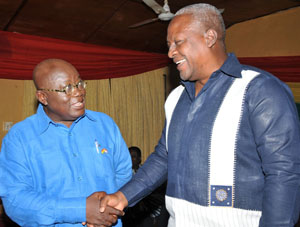
Nana Akufo-Addo (l) and President John Mahama. PHOTO/File
With Ghana’s presidential election set for December 7, the candidates faced off in their final debate this week.
Corruption and how best to manage the country’s oil sector topped the agenda.
Ghana’s four presidential hopefuls argued over the best way forward for this cocoa, gold and oil producing nation. But analysts say the vote will come down to the two main candidates: current President John Mahama from the National Democratic Congress, and former foreign minister and main opposition leader Nana Akufo-Addo, of the New Patriotic Party.
The moderator asked the candidates to explain how they would fight corruption, a problem, though small, but threatens to pervade certain levels of government.
Akufo-Addo said he would strengthen anti-corruption institutions and serve as an example.
“I see the beginning from the example that the leader will give. If you are committed to the fight against corruption you yourself of course must not be corrupt,” he said. “You yourself should be somebody who can take on the fight because you’re not corrupt, have never been and will not be. That is the position in which I stand: not being corrupt, never will be and have not been.”
The 68-year-old opposition candidate also promised to build the country’s industrial sector and make high school education free by using funds from the country’s new oil revenue.
Ghana began producing oil in 2010 and how best to manage oil revenue remains a hot campaign issue. Ghana is experiencing tremendous growth, the economy is expected to expand by 11 percent in 2012.
At the debate, President Mahama said the government has taken steps to ensure oil profits reach Ghanaians, but that foreign oil companies now need to be encouraged to buy available products from Ghana and employ locals.
“It doesn’t pay to have such a God-blessed resource and just have foreigners come and take it away without any benefit to your people,” he said. “So we are going to pass the local content bill to justify and reserve some aspects of the oil industry to Ghanaians, and to encourage the foreign companies that are involved in oil exploration and production to work for them.
Mahama, who is 53, took office in July less than 24 hours after the death of former president John Atta Mills. Mr. Mahama is a historian, communications expert, and writer. He is campaigning on the development agenda called “A Better Ghana,” started by his predecessor.
Akufo-Addo, who is favored by young and urbanized voters, lost the 2008 election to Mills by just 40,000 votes, less than one percent. Opinion polls indicate this year’s race will also be tight.
The latest poll from Research International estimated Akufo-Addo would win with 52 percent. Yet other polls, like one from the Economist Intelligence Unit, predict Mahama will win.
Analysts expect a peaceful election. Kwesi Jonah, a senior research fellow at the Institute for Democratic Governance, says there is a tradition of conceding defeat in Ghana, and he doesn’t expect this election to be any different:
“No, the two main parties that matter in this country… they normally accept election results,” said Jonah. “If one wins, there is always internal pressure on the candidate to not accept election results, but candidates in the end are prevailed upon by wise counsel to accept the results. I don’t expect anybody to dispute the results.”
If no candidate wins a clear majority, the elections will go into a second round. The run-off is planned for December 28.