Politics
Evaluating Uhuru Kenyatta’s first year
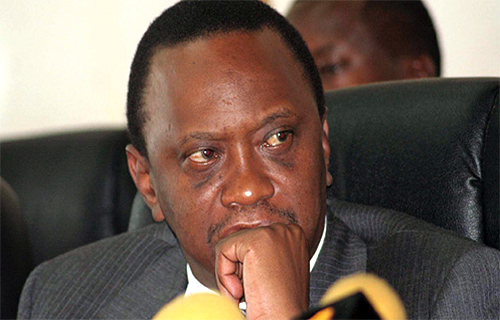
Security trumps all as the Kenyatta government enters its second year in office and the economy weakens due to concerns about terrorism and the rising costs of devolution. Just over a year ago, Kasarani Stadium just outside Nairobi hosted thousands of well-wishers cheering on Uhuru Muigai Kenyatta as he took the oath of office, having been declared winner of the fiercely contested presidential elections.
Today, it has become a detention camp for thousands of foreigners, mainly Somalis, arrested in successive police swoops for lacking valid immigration papers. At the election, the dominant issues included Kenyatta’s strong nationalist response to the International Criminal Court case against him and his deputy, William Ruto, following the post-2007 election violence, and pledges of a more peaceful political climate.
Kenyatta and his allies in the Jubilee Alliance coalition promised massive state investment in education and health, together with plans for a great economic leap forward. They said they would make Kenya the hub of a resurgent East Africa that exploits its mineral resources in partnership with Asia’s economies across the Indian Ocean.
What changed was the Westgate terror attack in September 2013. That attack killed 67 people, including relatives of Kenyatta, and the terrorists held the building for more than 72 hours. The Somalia-based Islamist Al-Shabaab militia said the Westgate takeover was retribution for Kenya’s intervention in their country.
There have been more than 90 terrorist-related attacks inside Kenya since its army went into Somalia in October 2011. Growing insecurity and threats of terrorism now dominate the political agenda. That was evident in President Kenyatta’s inaugural State of the Nation address on 27 March, 2014: “As we learned last year, insecurity anywhere in our region is a promise of insecurity everywhere. If we do not help our neighbours to achieve the peace, freedom and prosperity they deserve, then our own freedom and prosperity are threatened.”
A week earlier, gunmen raided the Joy of Jesus Church in Mombasa’s Likoni area. An 11-month old baby was among the victims, surviving a bullet that had ripped through his mother as she shielded him. Six people died in that church attack. And as doctors operated on baby Satrin Osinya at Nairobi’s Kenyatta National Hospital, gunmen on a motorbike shot and killed an Islamist cleric, Ahmed Shariff Abubakar, also known as Makaburi, outside a courthouse on the outskirts of Mombasa.
Makaburi was under sanctions from The United Nations Security Council after a probe said he recruited young Kenyans to fight for Al-Shabaab. In the same week, in the predominantly Somali neighbourhood of Eastleigh in Nairobi, a grenade attack killed five people in a restaurant.
Hysteria
The government’s response to terror attacks often fuels hysteria rather than tackling the problem on the ground. The most recent manifestation of that is the Kasarani detention and screening operation. Days after Kenyatta’s speech, the police launched one of the biggest security dragnets in recent memory, deploying 6,100 officers around the country in search of illegal immigrants, unlicensed weapons and suspected terrorists. The operation targeted Eastleigh, where thousands of immigrants were arrested and taken for screening.
The Kasarani screening program partly reflects the government’s increasing frustration with developments in neighbouring Somalia and its military operations there. The opposition Orange Democratic Movement has called for the government to withdraw its troops.
Early this year, interior secretary Joseph Ole Lenku announced that the government planned to close the Dadaab refugee camp in Garissa County in northern Kenya. Over 20 years old and housing about 340,000 mainly Somali refugees, Dadaab is the world’s largest refugee camp. It is also Kenya’s fourth-largest city.
Now the government views Dadaab as a breeding ground for terrorists. Alarmed at what appears to be a scapegoating of Somalis, community leaders accuse the government of unfairly targeting their people. “The government has no interest in fighting terrorism. The screening of Somalis in Kasarani, the threat to close the Dadaab camp: these are all part of a strategy to hold the West hostage,” says Farah Maalim, a deputy speaker in the last parliament and a trenchant government critic.
Maalim went on to say, “This government is determined to target Somalis and Muslims in general…. We have been warning the government for years over the growing threat of terrorism. They have done nothing about it. Why isn’t there more monitoring of Al-Shabaab’s forays into Kenya? You don’t have to up-end the whole of Eastleigh to track down a few hundred aliens. That is fascism. It’s exactly what Hitler did with the Jews, and you can quote me on that.”
Security officials reject such claims. “No single community is being targeted. Screening is aimed at smoking out criminals in order to curb criminal activities. Every community – including Somalis – has been affected by terrorism and insecurity, and as such they too are beneficiaries of any efforts the government makes to improve security,” says Mwenda Njoka, a spokesman for the Inspector General of Police (IGP).
In Mombasa, Muslim leaders have said the government is behind the murder of Makaburi. They say his shooting is part of a pattern of attacks against militant clerics on the coast. Yet the influence of these clerics is reaching far beyond Somalis and Muslims to the wider population in towns and cities and the informal settlements housing millions of unemployed youth. Indeed, most new recruits to Al-Shabaab and its local associate, Al-Hijra, are Christian youths converted to Islam. Much of Al-Shabaab’s online propaganda is now delivered in Kiswahili, not Arabic.
Revamp results
The government’s efforts at counter-terrorism raise serious doubts about its strategy and capacity. Manoah Esipisu, a veteran journalist who is now Kenyatta’s spokesman, insists the security revamp will produce results: “This will be the biggest increase in security funding since independence. We are making up for the under-investment of the past 15 years or so. In its first year, the Jubilee administration has already raised the number of police officers. The ratio has fallen from one officer for every 750 Kenyans to one for every 535.”
Kenya’s security forces are facing a nationwide crime wave as well as the terrorist blowback from Somalia, but Kenyatta downplayed this rising criminality in his speech. He was quick to point out that crime had dropped by 8 percent over the past year. Criminal gangs have established their presence in Nairobi and other towns without a fightback from the police. In this nationwide crime wave, even Kenyatta’s family has not been spared. Over the past three months, several of his relatives have been victims of crime.
Any security response to growing crime and terrorism has been undermined by rivalries between officials over proposed reforms and budgets. The government planned to create a civilian authority to oversee and limit the formidable powers of the IGP. That has not worked out.
David Kimaiyo, the IGP, routinely ignores the authority of Johnston Kavuludi, the civil servant running the National Police Service Commission. During their vetting of senior police officers, Kavuludi and his board faced bloodcurdling threats. In August 2013, a severed human head was delivered to Kavuludi. At the end of March, a court ruled that Kimaiyo had acted unconstitutionally in unilaterally deploying police chiefs to the counties.
Kimaiyo, who regularly ignores court orders, is said to enjoy support in high places and will struggle relentlessly to retain his old authority. This power struggle pitting top officers against civil servants has led to a go-slow in the senior ranks. Criminal gangs have been quick to take advantage of it.
There are also economic costs to the security crisis. Tourism, which barely recovered from the post-election violence of 2008, is now hit by worries about safety. Tour operators say it is harder to sell Kenya to tourists. Many prefer to go to Tanzania or to South Africa.
Other tough economic decisions loom. More than a decade of the Mwai Kibaki government’s tax-and-spend policies boosted the middle classes and financed roads and communication projects. The national debt now exceeds 50 percent of gross domestic product (GDP). The wage bill has soared due to the cost of the administration in the 47 new counties, although the government is, at best, ambiguous about devolving power from the centre under the new constitution that came into force in 2010.
Notwithstanding, the official line on the economy is outright optimism. Kenya’s Bureau of National Statistics is recalculating the country’s GDP, and the results will be out in September. Insiders say that they will show a rise to about $50 billion from its current level of $37 billion.
Diminishing returns
This year the economy is expected to grow by more than 5 percent. “President Kenyatta still has the benefit of the doubt even if the economy didn’t bounce back as expected after he took over. The real concerns are about devolution. We now have 47 back offices where we used to have one. The counties need to see more administrative discipline,” says market analyst Aly-Khan Satchu.
Echoing World Bank concerns about fiscal discipline, Satchu adds: “The failure of the ‘Africa rising’ story is the failure of government to resize itself. We can expect revenues to be up this year because of efficient collection. But this is a climate of diminishing returns. The public is being over-taxed. The government needs to take a scalpel to public expenditures.
No matter how many middle-class Kenyans might agree, that does not explain how the government will finance its expensive retooling of security, and its wide-ranging promises of better quality social services and billion dollars of investments in roads, ports and railways. Unquestionably, Kenya will be key to the rise of East Africa’s regional economy and trade, but in the short term there are plenty of obstacles in its way.