Sport
Eusebio – The Soccer legend dies at 71
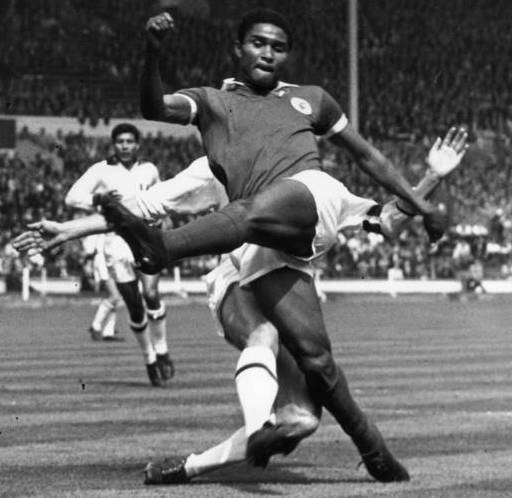
A younger Eusebio in action while playing for his club Benefica. PHOTO/File
(Reuters) – Portuguese great Eusebio, top scorer at the 1966 Soccer World Cup, died on Sunday from a heart attack at the age of 71 with the small Iberian nation mourning him as an “eternal symbol” of their soccer pride.
The death of the charismatic striker, who was idolized throughout the Portuguese-speaking world and considered one of the game’s greatest players was confirmed by former club Benfica and the Portuguese Football Federation (FPF).
“Portugal is mourning. Eusebio, the King of Portugal’s 1966 team and the eternal symbol of the country, national team and Benfica passed away,” the FPF said in a statement.
The Portuguese government declared 3 days of national mourning and many fans paid homage by visiting an iconic statue of him erected next to Benfica’s Luz stadium, leaving flowers, scarves and other tributes.
Eusebio, whose full name was Eusebio da Silva Ferreira, was European Footballer of the Year in 1965 but won global acclaim a year later at the World Cup in England, where his nine goals helped Portugal reach the semi-finals.
He earned 64 caps and scored 41 goals for Portugal, records that stood for almost two decades.
Nicknamed the ‘Black Panther’, Eusebio was a European Cup winner with Benfica in 1962 and played in 3 other finals, including the loss to Manchester United at Wembley in 1968.
Eusebio helped Benfica to 11 Portuguese championships and later served as an ‘ambassador’ for the club. He scored more than 300 league goals for the Lisbon outfit.
As news of Eusebio’s death spread, tributes began pouring in from the football family. FIFA president Sepp Blatter said on his Twitter page: “football/Soccer has lost a legend but Eusebio’s place among the greats will never be taken away.”
Eusebio hailed from Lourenco Marques, now Maputo, in colonial Mozambique (eastern Africa) and as a teenage prodigy was expected to join Benfica’s great rivals Sporting Lisbon but changed his mind at the last minute.
Even though he played for Portugal, he was widely regarded as the best known African soccer player of all-time, until the emergence in more recent times of the likes of Samuel Eto’o, Didier Drogba and Abedi Pele.
“He was one of the great figures of Portugal. I think he is immortal. We all know what he meant for soccer and especially for Portuguese soccer,” Chelsea manager Jose Mourinho told Portugal’s state broadcaster RTP. “He was not only a great inspiration but also an important figure in upholding the values, principles and feelings of soccer, even after finishing his career,” the former Porto, Inter Milan and Real Madrid coach added.
Eusebio ended his career playing in the U.S. but returned to Portugal to various roles with Benfica and the Portuguese federation. He was referred to as the “O Rei” (the king) in his later years, enjoying widespread affection.
Among the first reactions to his death came from former Benfica and Portugal team mate Toni. “I told him when he was alive much of what I felt – that it was a privilege to have played with him. We have lost one of the greatest figures of Portuguese sport,” the former midfielder said in a statement.
“There were many princes in soccer but few kings. He is in the gallery of the greats. He was gifted both physically and technically, he was like a Greek statue,” he added.