Business
China’s trade with Africa at record high
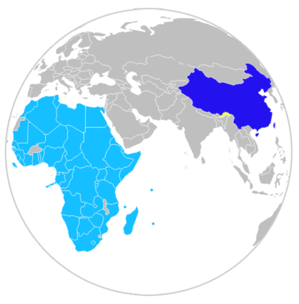
China’s enduring importance for Africa was strengthened again in 2013, when trade between the globe’s most populous country and the African continent soared to a record total of US$200 billion. That included a 44 percent spurt in Chinese direct investment in Africa.
U.S. trade with Africa, but only in goods, not services, totaled US$85 billion in 2013. Services amounted to about another US$11 billion. European trade with Africa reached US$137 billion in 2013. So long as China grows its own gross domestic product (GDP) at more than 7 percent it will need to rely on the resource commodities of Africa – the bulk of this US$200 billion trade.
Likewise, so long as China grows rapidly, Africa itself can grow at a rapid pace, currently about 5 percent per year on average. Africa, in other words, cannot prosper without China.
As Africa’s millions of people shortly become billions and countries like Nigeria, Tanzania, and the Democratic Republic of Congo swell dramatically in size, only a flourishing trade with China will permit the possibility of a realizing a demographic dividend for sub-Saharan Africa.
China’s trade with Africa is largely import driven, with China taking petroleum mostly from Angola, Cameroon, Equatorial Guinea, Gabon, Ghana, Nigeria, the Republic of Congo, Uganda, South Sudan, and the Sudan. It purchases copper, cobalt, cadmium, ferrochrome, platinum, coltan, diamonds, and gold largely for industrial purposes from countries such as the Democratic Republic of Congo, Liberia, South Africa, Zambia, and Zimbabwe. In 2011, the largest African exporters to China were South Africa and Angola, followed by the Democratic Republic of Congo, Mauritania, the Sudan and South Sudan, and Zambia.
As the world’s largest importer of iron ore, China has also been diversifying its purchases away from traditional suppliers such as Australia and South Africa to trade for the ore with 15 African nations including such previously globally unimportant producers of the metal as Guinea-Bissau, Swaziland, Tanzania, Uganda, and Zambia.
China takes hides and skins from Ethiopia and sometimes turns them locally into shoes. It fishes off Senegal and other African coastal countries. It grows cassava, maize, and sorghum in such places as Zimbabwe and Madagascar and ships the produce home to hungry animals in China. Recently, too, China became as major purchaser of cotton grown in Mozambique, a country not hitherto known for its cotton. But the new production was stimulated by a Chinese technical assistance effort, part of a Chinese attempt to help Mozambique improve its agricultural productivity.
China’s exports are a smaller proportion of this US$200 billion trade than its imports. Africa offers markets, but smaller and contained ones, for Chinese-manufactured consumables: textiles, clothing, blankets, inexpensive footwear, headgear, toys, telecoms equipment and affordable cell phones, furniture, caskets, computers, and televisions. To governments, China also sells jet fighters, military equipment and ammunition, military uniforms, heavy communications technology, agricultural implements, road machinery, and turbines and generators. This month China even shipped patrol vessels to Nigeria capable of carrying helicopters and defending the Nigerian offshore oil fields against pirates.
To Africa, China sends tourists, too, consultants, project laborers and supervisors, and diplomats – all of whom bulk up the trade statistics. This month, a single Chinese province is sending a large team of investors to Zambia to seek new opportunities to sell Chinese manufacturers and grow tourism. In 2011, in addition to countries such as South Africa, Angola, and the Democratic Republic of Congo, the major importers of Chinese goods were Tanzania, Kenya, Ghana, and Liberia.
Few African countries have failed to benefit from China’s willingness to build dams, hydroelectric facilities, and thermal power plants; construct roads; erect stadia, hospitals, and party headquarters; renovate railways; refurbish ports; and upgrade mining projects. All of these various activities help boost the trade numbers.
The top 10 beneficiaries of China’s assistance and expanded concessionary loans (components of the great rise in two-way trade) are: Ghana (US$11.4 billion); Nigeria (US$8.4 billion); the Sudan (including South Sudan) and Ethiopia (both US$5.4 billion); Mauritania (US$4.6 billion); Angola (US$4.2 billion); Equatorial Guinea and Zimbabwe (both US$3.8 billion); Cameroon (US$3 billion), and South Africa (US$2.3 billion).
The figures above are from 2000-2011 and do not include more recent ventures, especially those in the Democratic Republic of Congo, Kenya, Madagascar, Tanzania, Zambia, and Zimbabwe.
As Chinese President Xi Jinping told Senegal President Macky Sall in Beijing late last month, China and Africa are completely intertwined and interdependent as far as trade goes. Almost no African country is without its Chinese trade component, even those with Taiwanese ties, and almost every African country hosts Chinese diplomats, builders, and entrepreneurs.
Re-published from Africa and Asia: The Key Issues